
The International Society for General Systems Research formed circa 1956 became the International Society for the Systems Sciences in 1988. In 1985, Bela H. Banathy organized the annual meeting on the theme of “Systems Inquiring”. Proceedings normally are published in the year following. In 1987, John A. Dillon summarized Banathy’s perspective in the yearbook, General Systems. For easy reading, here’s an excerpt from the yearbook.
— begin excerpt —
EDITORIAL PREFACE
Systems Inquiring
One of the few perquisites which come to the President of the International Society for General Systems Research is that he or she can determine the theme of the Annual Conference. In 1985, President Bela Banathy selected the topic, Systems Inquiring as the focal point of the Conference.
Because his Introduction to that conference represents an excellent, concise description of the whole field of systems science, we shall begin this volume by quoting it here.
“Systems Inquiring involves both conclusion oriented disciplined inquiry or knowledge production and decision oriented disciplined inquiry, which makes use of knowledge produced by systems research and by the various disciplines. Systems Inquiring draws upon the three domains of systems scholarship: systems theory, systems philosophy, and systems methodology.
The program of the 1985 Annual Meeting of the Society embraces the entire scope of Systems Inquiry, by which:
SYSTEMS PHILOSOPHY is explicated and evolved,
SYSTEMS THEORY is defined and formulated through its continuous evolution, and
SYSTEMS METHODOLOGY is pursued as a field of study as well as implemented in a variety of contexts and through a variety of strategies and methods.
The 1985 Meeting has a special theme: the definition and characterization of competences required or desired for engaging in systems inquiry. The special theme addresses the following question: What knowledge, understanding, ways of thinking, skills, and dispositions are involved in:
(1) pursuing scholarship in systems theory, philosophy, and methodology, and
(2) applying systems thinking and theory and using systerms methodology in the disciplines, professions, and various human activity systems from local to global.
A follow-up question is also addressed:
What are arrangements that facilitate the acquisition of competence in systems inquiry.
A “map” of the program is displayed in the Figure on the following page.
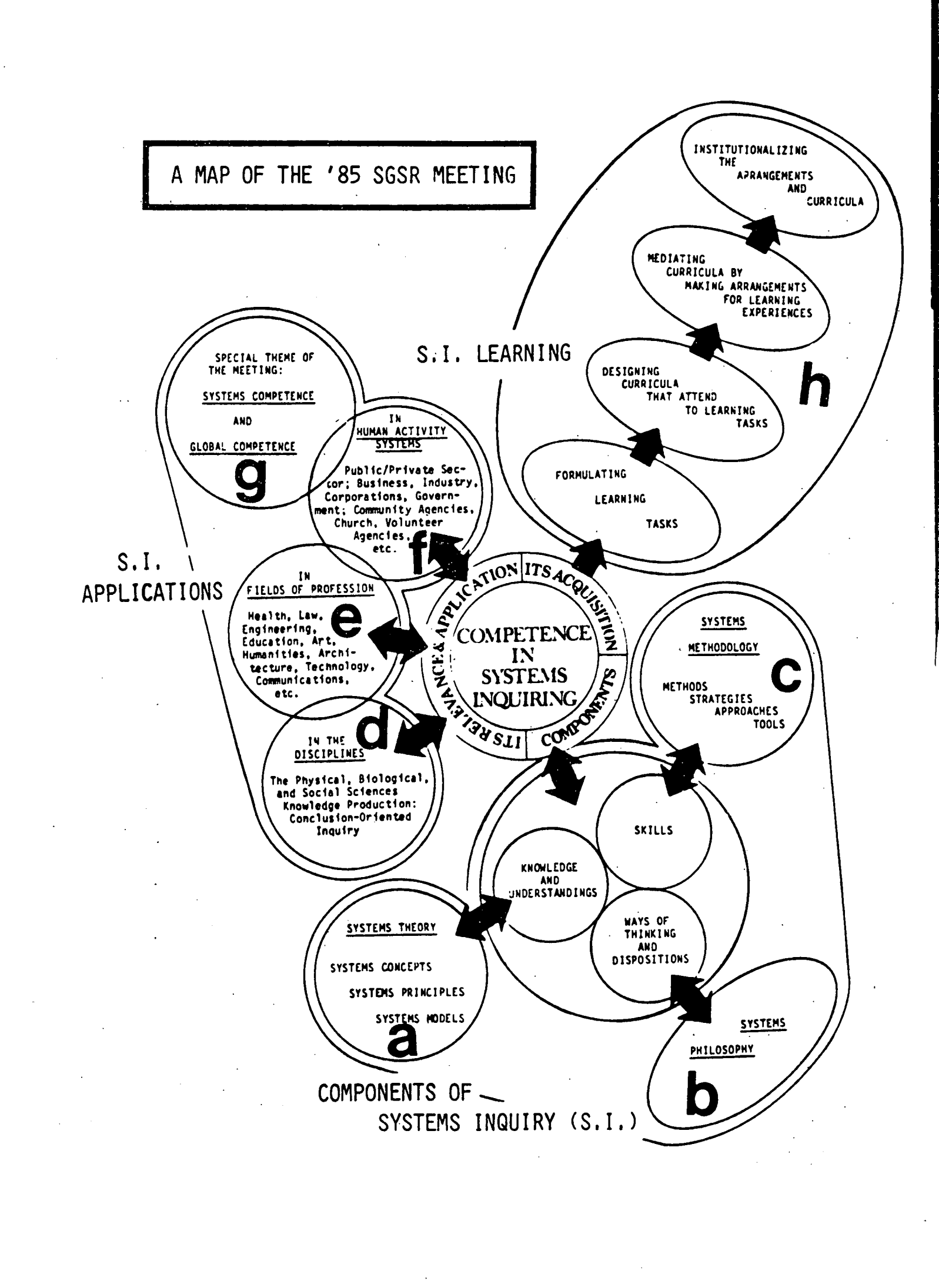
Based on the scheme described above and depicted in the program “map,” the program is organized in the following areas:
- SYSTEMS THEORY (general theory, duality theory, self-reflexive structures, and hierarchy theory)
- SYSTEMS PHILOSOPHY
- SYSTEMS METHODOLOGY
- APPLICATIONS IN THE DISCIPLINES
- APPLICATIONS IN THE PROFESSIONS
- APPLICATIONS IN HUMAN ACTIVITY SYSTEMS
- APPLICATIONS IN GLOBAL ISSUES
- THE ACQUISITION AND TRANSMISSION OF COMPETENCE IN SYSTEMS INQUIRY
The program areas are briefly described next:
Systems Theory
The ultimate foundation of competence in systems inquiry is significant command of the principal systems concepts and the theoretical models of the field. Therefore, all sessions of the systems theory segment of the 1985 conference focus on empirical verification, extension, or theoretical development of: any isomorphy, or its formal expression; any connected set of isomorphies; and specified interaction among isomorphies; any trans-disciplinary model; or any attempt at synthesizing a comprehensive survey (glossary) of systems terms. The term isomorphy here is used as defined in society publications, that is, any formal similarity between specific systems of different scales of magnitude or different disciplines.
[….]
Systems Philosophy
Systems Philosophy seeks to express a common core of concepts recognizable and adhered to by systems theorists and practitioners. It also seeks to put systems theory itself in larger contexts. Contributions include demonstrations and discussions of competence in systems philosophy. An internal focus on the nature of systems philosophy is complemented by philosophical focus on the larger wholes of which systems ideas are a part.
As the philosophy theme segment unfolds, our philosophic traditions are represented together with the current expressions of the perennial tension between rational and intuitive systems-thinking styles. As coherence develops, images of future systems philosophies are expected to emerge.
Systems Methodology
The term “systems methodology” is viewed as a coherent collection of methods for dealing with systems phenomena. Three categories of methods are recognized:
(1) Methods for studying various classes of systems with the aim of determining their desired characteristics. These methods produce systems knowledge.
(2) Methods for dealing with the various types of systems problems. Included are the non-trivial issues of problem formulation. This category of systems methodology is often referred to as systems problem solving.
(3) Methods for determining meta characteristics of the various methods in categories (1) and (2).
In systems inquiry, methods are always considered in the context of specific problem situations. This primacy of the problem situation is in sharp contrast with the primacy of methods in applied mathematics or in the traditional disciplines.
In the spirit of the central theme of the conference, contributions define and characterize competencies in working in any of the categories described above.
— end excerpt —
The text on application areas and development of competences are left for the diligent reader to seek out the original yearbook!
Presidents of the society after Bela H. Banathy and John A. Dillon were Peter B. Checkland and Russell L. Ackoff. Ackoff founded the Social Systems Science program at University of Pennsylvania, and drove the name change to the current “Systems Sciences”. Newcomers to the field might reflect if the original ideas have persisted to today.
References
Dillon, John A. 1987. “Editorial Preface: Systems Inquiring.” Edited by John A. Dillon. General Systems, Yearbook of the International Society for General Systems Research, XXX:ii–v. https://www.isss.org/yearbooks/


