
Coevolving Innovations

… in Business Organizations and Information Technologies

Pacing Changes: Elevating the when+where in living systems

At the post-meeting dinner after the February Systems Thinking Ontario session, Anna Chekhman mentioned that she was teaching a third-year course on Designing Future Systems at York University. I offered to give a lecture, and we set a date for a few weeks later.

The CSRP Institute 2024 Banathy Conversation validated that the Systems Changes philosophy and theory developed since 2019 is comprehensive for Ph.D. and master’s level audiences.  For less academic audiences, the label of “Pacing Changes” may be more appealing.  This direction is compatible with the human systems orientation of social systems design, while more sympathetic to the broader scope of living systems (associated with General Systems Theory).

Living systems aren’t static, with change occurring as unfreeze-move-refreeze.  Living systems are alive, wayfaring as lines in time in textures (i.e. lines alongside other lines, in weaves).  With a long history of presentations with static clipart, or boxes and lines, I’m now motivated to convey ideas with moving images instead.  The presentation slides ae posted on the Coevolving Commons.

The recording of the slide presentation and live demonstration is available on Youtube, with an alternate retention on the Internet Archive .

Video H.264 MP4
March 4
(55m)
[20250304_YorkU Ing_PacingChanges_HD_1247kbps.m4v
(1280×720 878kbps 508MB)
[on the Internet Archive]

The standalone audio may be less enlightening through the demonstrations, but are also available.

Audio
March 4
(55m)
[20250304_YorkU_Ing_PacingChanges.m4a]
(126kbps, 88 MB)
[on the Internet Archive]

Here’s the agenda for the talk:

  • A. Images of Systems as Living (?)
  • B. Systems Thinking: Traditions –>  Advances
  • C. What+Why < When+Where
  • D. Resequencing Systems Thinking
  • E. Continuing the Systems Learning Journey

The students were patient with my presentation.  After the lecture, they continued with an assignment of sketching a rich picture, as the first step of Soft Systems Methodology.
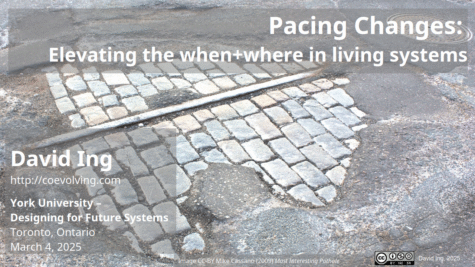
Pacing Changes: Elevating the when+where in living systems


Leave a Reply

Your email address will not be published. Required fields are marked *

  • fediscience.org/@daviding (Mastodon)

    1. Loading Mastodon feed...
  • RSS feed: on IngBrief on IngBrief

    • 2026/01/07 | Rama Akkiraju | From LLMs to Living Systems: Applying Systems Science to Agentic AI in the Enterprise | HICSS-59 Keynote
      Abstract Enterprise AI is transitioning from simple single-LLM flows to complex agentic ecosystems—adaptive systems composed of multiple agents, tools, governed data, human workflows, and organizational policies. This keynote introduces a systems-science framework for designing and managing such ecosystems using principles of modularity, control, feedback, robustness, and socio-technical alignment. We illustrate these concepts through practical examples […]
    • Timothy F.H. Allen passed away on May 01, 2025
      Timothy F.H. Allen, president of International Society for the Systems Sciences 2008-2009, passed away peacefully in his home, surrounded by his family, on May 1, 2025. With his work on ecosystem ecology, I learned more about living systems than anyone else in the systems community. After his retirement, he was proud of putting together a […]
    • Installing WordPress Studio on Manjaro Linux
      In 2024, WordPress Studio was released, making installation on a local computer simpler. The instructions were modified from MacOS to Ubuntu Linux, by Daniel Kossmann, “How to install WordPress Studio in Ubuntu Linux” | Jun 15, 2024 at https://www.danielkossmann.com/how-to-install-wordpress-studio-ubuntu-linux/ I already had NVM installed, but in Terminal, with the result “command not found”. In the […]
    • Notion of Change in the Yijing | JeeLoo Lin 2017
      The appreciation of change is different in Western philosophy than in classical Chinese philosophy. JeeLoo Lin published a concise contrast on differences. Let me parse the Introduction to the journal article, that is so clearly written. A-theories divide time into past, present and future, and the point of reference is set at “the present.” B-theories, […]
    • World Hypotheses (Stephen C. Pepper) as a pluralist philosophy [Rescher, 1994]
      In trying to place the World Hypotheses work of Stephen C. Pepper (with multiple root metaphors), Nicholas Rescher provides a helpful positioning. — begin paste — Philosophical perspectivism maintains that substantive philosophical positions can be maintained only from a “perspective” of some sort. But what sort? Clearly different sorts of perspectives can be conceived of, […]
    • The Nature and Application of the Daodejing | Ames and Hall (2003)
      Ames and Hall (2003) provide some tips for those studyng the DaoDeJing.
  • Recent Posts

  • Archives

  • RSS feed: on daviding.com on daviding.com

  • RSS feed: on Media Queue on Media Queue

  • Meta

  • Creative Commons License
    This work is licensed under a Creative Commons Attribution-NonCommercial-ShareAlike 4.0 International License
    Theme modified from DevDmBootstrap4 by Danny Machal