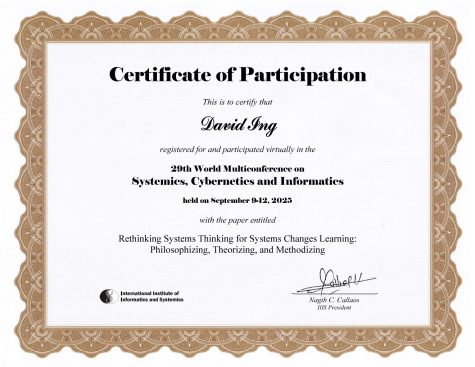
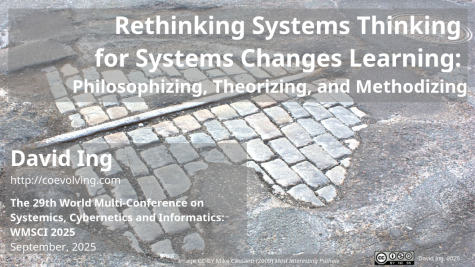
A presentation for the 29th World Multi-Conference on Systemics, Cybernetics and Informatics challenged me to reduce the research on Systems Changes over the past 6 years for article length. I proposed multiple articles, but they preferred to extend the maximum submission to 12 pages, plus 5 pages of cited references.
The collaboration with the Systems Changes Learning Circle since 2019 has always been on systems practice. However the emphasis on changes (even overshadowing systems) led not only to reading philosophy, but proposing a new World Hypothesis through philosophizing. Redefining a philosophy of science leads to theorizing, that provides foundations for continuing work on methodizing.
The resulting 30-minute talk was dense — but possibily more understandable than reading the 12-page article.
This recording is available on Youtube , as well as on the Internet Archive . The International Institute of Informatics and Cybernetics has a history spanning multiple decades, so the comments from participants were well-informed on the body of work in systems thinking.
| Video | H.264 MP4 |
| September 9 (23m28s) | [20250909_WMSCI_Ing RethinkingForSystemsChanges_1194kbps.m4v] (HD 1194kbps 230MB) [on the Internet Archive] |
The audio was ripped from the online meeting.
| Audio | |
| September 9 (23m28s) | [20250909_WMSCI_Ing RethinkingForSystemsChanges.m4a] (68.8kbps, 13.5 MB) [on the Internet Archive] |
Review of the manuscript followed a double-blind review process. The first reviewer was encouraging, picking up on my leaning more towards the tradition of General Systems Theory than Cybernetics.
The article titled “Rethinking Systems Thinking for Systems Changes Learning: Philosophizing, Theorizing, and Methodizing” offers an important and timely reframing of systems thinking by introducing a rhythm-based, cross-cultural, and ethically grounded paradigm that enriches both theory and practice, despite some underexplored connections to the cybernetic tradition.
The article makes a compelling and timely contribution by shifting from stability-focused systems metaphors to rhythm- and kairos-oriented learning frameworks, i.e. identifying when and how learning happens, seizing moments of readiness and curiosity, rather than simply measuring how much time has passed or material has been covered
While the article briefly acknowledges foundational figures in cybernetics such as Wiener and Ashby, it does not fully explore the conceptual richness of second-order cybernetics—particularly key contributions around self-reference, autopoiesis (Maturana & Varela), and the observer-dependent nature of systemic cognition (von Foerster, Pask).
Nevertheless, these omissions are FAR OUTWEIGHED BY THE ARTICLE’S INTELLECTUAL AND PRACTICAL ACHIEVEMENTS. Its rethinking of systems thinking through the novel world hypothesis of (con)texturalism-dyadicism, grounded in constructivist metaphilosophy and enriched by classical Chinese philosophy and rhythm studies, represents a bold and original contribution. It proposes a new foundation for systems thinking in a world where change is constant, complexity is irreducible, and knowing when and how to act is more important than controlling what happens. (con)texturalism-dyadicism in this context is meant to propose a new foundation for systems thinking in a world where change is constant, complexity is irreducible, and knowing when and how to act is more important than controlling what happens.
The integration of kairotic timing, situational propensity, and an ethic of “doing no harm” offers a subtle and pragmatic framework especially suited for turbulent, polycrisis-driven contexts. Furthermore, the proposed action-learning cycle and process hub open new pathways for reflective practice that is attuned to change not merely as disruption, but as an unfolding of generative rhythms. In this light, THE ARTICLE NOT ONLY COMPLEMENTS BUT ALSO EXPANDS THE SYSTEMS TRADITION, introducing a more culturally plural, ethically sensitive, and temporally important approach. The historical omissions, therefore, can be seen not as critical flaws, but as invitations for future integration with the broader cybernetic and systems discourse. THIS MAY EVEN INCREASE THE IMPACT OF THE ARTICLE.
Consequently, I am pretty sure that this article should be accepted and I suggest to the Organizing Committee to consider among the best of the conference being organized.
The second reviewer encouraged a longer publication.
Upon reading this paper (as a logician), it became clear to me that this paper should have been published yesterday and that it is essential it should be published as soon as possible, so other researchers may benefit. Aside from the extremely valuable history of systems theory, a major contribution is Eastern systems theory (which I rarely see in the West) and which is sorely needed. I wish Hegel were alive to see how this paper seems to dovetail into his Science of Logic (theory of the ground). As a sidebar, it is interesting that the authors did not mention him.
In particular, I was caught by:
Inwardly, each thread undergoes the processual coupling of yinyang as dyadic and generative. Yang qi and yin qi are interdependent, reciprocally complementary transformations. Yang increases as yin decreases, and vice versa. Yang qi does not exist without yin qi, and vice versa. This dyadic thinking differs from dualism or dialectic. Dualism sees reality as two separable parts, e.g. mind and body, or good and evil. Dialectic sees reality as shaped by contradictions that may be resolved through synthesis, e.g. control vs emergence leading to complexity, fixity vs. instability leading to negotiated order. Dyadicism envisions a cycle of where yin holds the seed of yang, and yang holds the seed of yin.
(I call this the most fundamental law.)
To me, this says it all, an essence that the West seems to miss completely and explaining a major reason it is in so much trouble today on all fronts.
Yes, let`s get this VALUABLE paper out post-haste (and let me know where I can get a copy, as I`ll be referencing it frequently). To the author(s): THANK YOU for all the research you have done and your much-needed views. Also, I`d write at least one book.
!!!!!!!!!!!!!!!!!!!!!!!
With two additional non-blind reviews, some small revisions were made to the text, resulting in the final submission.
The presentation slides and full article are also available on the Coevolving Commons.
There is a manuscript on the order of hundreds of pages to follow. Stay tuned.