
Coevolving Innovations

… in Business Organizations and Information Technologies

Currently Viewing Posts in education

Problematique Dialogue 2026 retrospective

From May 10-15, 2026, sLab convened the first Problematique Dialogue applying the Banathy Conversation Methodology, in the Graduate Studies building of OCAD University.  This brought together 26 participants in four teams, four facilitators, two methodologists, and two student volunteers.

Ashok Mathur, VP of Research and Dean of the School of Graduate Studies, opened the event with a welcome.

Welcome to OCAD U Graduate Studies, Ashok Mathur

He spoke about the personal journey that brought him to OCAD University in 2018.  Graduate studies at this institution commenced only in 2008, and he arrived to discover the uniqueness of programs such as Strategic Foresight and Innovation, and Digital Futures.

Lesley-Ann Noel, Dean of the Faculty of Design, spoke about Design Research and Generative Conversation.

Design Research and Generative Conversation, Lesley-Ann Noel

The approach developed by Bela H. Banathy complements directions in the Design Research Society with the Special Interest Group in Design Education, and with the Pluriversal Design Special Interest Group.  Her full address is posted as a sLab article.

Greg Van Alstyne, director of the sLab, spoke about the history of this research centre that predates the SFI program.

sLab Reinvigoration, Greg Van Alstyne

This 2026 Problematique Dialogue is a historic milestone in the reinvigoration of sLab.  It celebrates the sLab legacy of 18 years, inviting a new generation of scholars.

Gary Metcalf, past-president of the International Federation for Systems Research, flew in from Kentucky for the week. … Read more (in a new tab)
From May 10-15, 2026, sLab convened the first Problematique Dialogue applying the Banathy Conversation Methodology, in the Graduate Studies building of OCAD University.  This brought together 26 participants in four teams, four facilitators, two methodologists, and two student volunteers.

Ashok Mathur, VP of Research and Dean of the School of Graduate Studies, opened the event with a welcome.

Welcome to OCAD U Graduate Studies, Ashok Mathur

He spoke about the personal journey that brought him to OCAD University in 2018.  Graduate studies at this institution commenced only in 2008, and he arrived to discover the uniqueness of programs such as Strategic Foresight and Innovation, and Digital Futures.

Lesley-Ann Noel, Dean of the Faculty of Design, spoke about Design Research and Generative Conversation.

Design Research and Generative Conversation, Lesley-Ann Noel

The approach developed by Bela H. Banathy complements directions in the Design Research Society with the Special Interest Group in Design Education, and with the Pluriversal Design Special Interest Group.  Her full address is posted as a sLab article.

Greg Van Alstyne, director of the sLab, spoke about the history of this research centre that predates the SFI program.

sLab Reinvigoration, Greg Van Alstyne

This 2026 Problematique Dialogue is a historic milestone in the reinvigoration of sLab.  It celebrates the sLab legacy of 18 years, inviting a new generation of scholars.

Gary Metcalf, past-president of the International Federation for Systems Research, flew in from Kentucky for the week. … Read more (in a new tab)

Re-introducing sLab, Problematique Dialogue Call for Participation, 2026-02-25

At OCAD U Graduate Programs, we convened an event to formalize (i) Re-introducing sLab, and (ii) announcing the Call for Participation for the May 2026 Problematique Dialogue, applying the Banathy Conversation Methodology.

Peter Scott served as the moderator for the afternoon.  Greg Van Alstyne spoke about the sLab, as a unit first founded in 2008, now perhaps in a version 2.0 evolution.

In 2008 when “design thinking” was new, the label of “Strategic Innovation Lab” was coined.  In the 2026 reinvigoration, the branding is now just sLab, where the “s” might signify “systemic design”, “social innovation”, or any variety of other descriptors.  sLab continues to welcome scholarly practitioners interested in collaborating on research in a participatory style.

For the second part of the agenda, the Problematique Dialogue was overviewed, with a new website, and reference to the Advance Call for Participation in the previous Systems Thinking Ontario.

Organizing this event is in the Connecting phase, towards a maximum of 4 topics with 8 participants each.  In the Agreeing phase of self-organizing, teams experience the dance between (i) topics seeking participants, and (ii) participants seeking topics.  There may be 2 or 3 online meetings as individuals feel out which of the 4 topics with which they most resonate.  The advance preparation will be complete when each team has established a Triggering Question.

When we’re in-person in May, most of the Exploring phase will be spent in the group of 8 participants, with some opportunities for cross-pollination at the end of each day. … Read more (in a new tab)

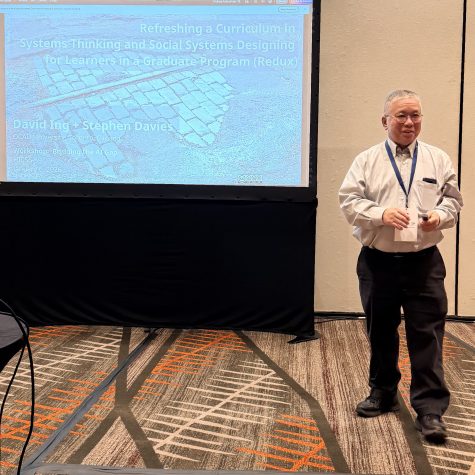
Refreshing a Curriculum (Redux) | HICSS-59 | 2026-01-06

Already registered for the HICSS-59 (Hawaii International Conference on Systems Science) conference in Maui, I signed up for a workshop on “Curriculum Design and Development”.  With a focus on “Bridging the AI Gap: Seamless Integration Across Academia and Industry Sectors”, the organizers offered an opportunity to give a short presentation and join a panel.

Three months ago, I presented a paper on “Refreshing a Curriculum in Systems Thinking and Social Systems Designing for Learners in a Graduate Program” reflecting the experiences with a winter 2025 class.  Just a few weeks from incrementing the course for January 2026, I summarized the earlier presentation, and previewed a plan to deepen the instruction on using Generative AI for research and diagramming.  A recording of the presentation is available on Youtube, as well as on the Internet Archive .

Video H.264 MP4
January 6 (9m46s) [20260106_1000_HICSS-59 Ing_RefreshingACurriculumRedux.m4v]
(HD 1268kbps 102 MB)
[on the Internet Archive]

The original audio was recorded at HICSS-59, as a foundation for reconstructing the visuals.

Audio
January 6 (9m58s) [20260106_1000_HICSS-59 Ing_RefreshingACurriculumRedux.m4a]
(1999 kbps, 48 kHz, 16 MB)
[on the Internet Archive]

With only a 10-minute slot, including questions and comments, the presention was only 6 slides.

Refreshing a Curriculum in Systems Thinking and Social Systems Designing for Learners in a Graduate Program (Redux)

After the break, a panel on “Education in the Time of AI: Challenges, Opportunities and the Road Ahead” was moderated by Eman El-Sheikh from the University of West Florida.  As I represented OCAD University from Canada, the other panelists included Leonard Przybilla from SAP Germany, and Jeremy Straub, from U.… Read more (in a new tab)

Tracing sLab’s Journey, and Reinvigoration for the Systemic Design Community | ST-ON x RSD14 | 2025-09-10

The sLab at OCADU has a history dating back to 2008 (even predating the initiation of the M.Des. program on Strategic Foresight and Innovation).  Since the summer, four OCADU systemic designers have been meeting to discuss Reinvigoration of the sLab for 2025.

The 136th meeting of Systems Thinking Ontario coincided with the RSD14 Relating Systems Thinking and Design Symposium, and our evenings lined up with Australians meeting in the mornings for the Pacific Edition.  Greg Van Alstyne and Peter Scott were featured in the conversation on history and prospects for sLab.

The history is a preamble for an in-person workshop on Friday, October 17, 3:30-5:30pm at the RSD14 hub at OCADU, 100 McCaul Street.  A description of the “Where Do Systemic Designers Go To [BLANK]?” workshop is posted in the preprints for the proceedings.

Here’s the original description for the recorded ST-ON session above.

— begin paste —

This session offers a reflection on the history of the Strategic Innovation Lab’s (sLab) at OCADU. We’ll discuss the potential for its renewal in the context of a vibrant systems thinking and design community, both locally and nationally.

sLab, at OCADU, was host to an active community of students, alumni, faculty, and stakeholders from 2002 to 2020. In this time, it produced notable projects such as Digital Governance, Economic Futures of Ontario 2032, Design Jams, amongst others. These projects and workshops used many strategic foresight methods, which have since become more well-known.… Read more (in a new tab)

Refreshing a Curriculum in Systems Thinking and Social Systems Designing for Learners in a Graduate Program

In fall 2025, Stephen Davies was appointed as the instructor for the “Understanding Systems” SFIN-6011 course in the Strategic Foresight and Innovation program, as part of the Master of Design degree at OCADU.  I”ve been a visiting lecturer in the course since 2017, and was appointed as a co-instructor in Winter 2020.  The course has a long history, first taught in 2009, and evolved by Peter H. Jones as the field of systemic design matured.  In the past few years, Lorraine Randell carried on the course, while expressing that she wished she had the time to revise it.  Since Peter now has a full-time appointment at Tec Monterrey in Mexico City, I asked Stephen if he would like some help in restructuring the course for the coming January.  Stephen said yes, so we met a few times in November and December to map out options.

I attended both the full-time and part-time sections of the class in progress, and observed where our anticipations as instructors were correct and incorrect. In addition, the standard OCADU procedure includes course evaluations, that gave us more directions for future adjustments.

With multiple conferences running in parallel, authoring a report on the experience took us past many deadlines.  A systems colleague from many years back, Nikitas Assimakopoulos, sent a call for presentations for the Hellenic Society for Systemic Studies (HSSS) conference at the University of the Peloponnese, where I could participate online. … Read more (in a new tab)

Evolving Styles for Learning Systems Thinking | Systems Thinking Ontario | 2025-02-13

The 128th meeting of Systems Thinking Ontario was convened in person.  The classroom was filled with current students, alumni, our regular participants, and a few curious newcomers.

Moderated by Zaid Khan, the conversation was sparked by Stephen Davies and myself (David Ing) on the evolving styles in learning systems thinking.  Stephen has been leading SFIN-6011 “Understanding Systems” since the beginning of this winter session.  I had previously taught in the course in winter 2020 (almost completing the term before the COVID-19 pandemic shutdown), and have been volunteering some time this winter with current students.

The master’s program in Strategic Foresight and Innovation was launched in 2009, with systems thinking at its core.

Our strategic innovation model … illustrates the integration of design, business, and futures thinking through systems thinking. This integration allows our students to move through an iterative design thinking process, understand the business context to ensure viability and develop deeper insights into the challenges a sector or organization might be facing through futures thinking. Systems thinking and mapping locates these complex challenges in a larger system and makes clear the patterns and interconnectedness of the issues; and visual thinking ensures more effective communication of complex data (Richards, 2015, p. 360).

In the earliest days, there were two courses listed:  (i) “Understanding Systems” in Year One, Winter semester, and (ii) “Social Systems” in Year Two, Fall semester (OCADU, 2011).

SFIN 6B02 Social Systems
In this introduction to complex systems, students will examine the dynamic arrangement of three interconnected and adaptive human systems; social, market and political.

… Read more (in a new tab)
  • fediscience.org/@daviding (Mastodon)

    1. Loading Mastodon feed...
  • RSS feed: on IngBrief on IngBrief

    • 2026/01/07 | Rama Akkiraju | From LLMs to Living Systems: Applying Systems Science to Agentic AI in the Enterprise | HICSS-59 Keynote
      Abstract Enterprise AI is transitioning from simple single-LLM flows to complex agentic ecosystems—adaptive systems composed of multiple agents, tools, governed data, human workflows, and organizational policies. This keynote introduces a systems-science framework for designing and managing such ecosystems using principles of modularity, control, feedback, robustness, and socio-technical alignment. We illustrate these concepts through practical examples […]
    • Timothy F.H. Allen passed away on May 01, 2025
      Timothy F.H. Allen, president of International Society for the Systems Sciences 2008-2009, passed away peacefully in his home, surrounded by his family, on May 1, 2025. With his work on ecosystem ecology, I learned more about living systems than anyone else in the systems community. After his retirement, he was proud of putting together a […]
    • Installing WordPress Studio on Manjaro Linux
      In 2024, WordPress Studio was released, making installation on a local computer simpler. The instructions were modified from MacOS to Ubuntu Linux, by Daniel Kossmann, “How to install WordPress Studio in Ubuntu Linux” | Jun 15, 2024 at https://www.danielkossmann.com/how-to-install-wordpress-studio-ubuntu-linux/ I already had NVM installed, but in Terminal, with the result “command not found”. In the […]
    • Notion of Change in the Yijing | JeeLoo Lin 2017
      The appreciation of change is different in Western philosophy than in classical Chinese philosophy. JeeLoo Lin published a concise contrast on differences. Let me parse the Introduction to the journal article, that is so clearly written. A-theories divide time into past, present and future, and the point of reference is set at “the present.” B-theories, […]
    • World Hypotheses (Stephen C. Pepper) as a pluralist philosophy [Rescher, 1994]
      In trying to place the World Hypotheses work of Stephen C. Pepper (with multiple root metaphors), Nicholas Rescher provides a helpful positioning. — begin paste — Philosophical perspectivism maintains that substantive philosophical positions can be maintained only from a “perspective” of some sort. But what sort? Clearly different sorts of perspectives can be conceived of, […]
    • The Nature and Application of the Daodejing | Ames and Hall (2003)
      Ames and Hall (2003) provide some tips for those studyng the DaoDeJing.
  • Recent Posts

  • Archives

  • RSS feed: on daviding.com on daviding.com

    • 2026/10 Moments October 2026
      Dartmouth, Nova Scotia; Halifax, Nova Scotia; Lunenberg, Nova Scotia; Peggy’s Cove, Nova Scotia; Bible Hill, Nova Scotia; Louisbourg, Nova Scotia; Sydney, Nova Scotia; Baddeck, Nova Scotia; Toronto, Ontario Fraser’s Mills Fish Hatchery: Side trip to hatchery built in 1928 by provincial government, gravity-fed from South River. Water in pen dark, ripples at surface due to […]
    • 2026/09 Moments September 2026
      Vancouver BC; Toronto, Ontario, Burlington, Ontario; Shanghai PR China Serenade of the Seas: From the foredeck of level 12 of the Royal Caribbean Line ship, the panorama west to the Vancouver Convention Centres, turning to the north across Vancouver Harbour. Observed Princess Line ship leaving the dock, a departure we never experienced. Arrived for lunch, […]
    • 2026/08 Moments August 2026
      Toronto, Ontario; Vancouver BC Next Perfect Day Playlist: Korean Town Street Festival, 20260808 Night View O What A Shiny Night Honey Haneum Playlist: Korean Town Street Festival, 20260808 Happiness Prince of Jeju Ieodo Sana Seouje Sori Leida Lay Down Together Star North Sky Beautiful Country Encore Chris Fraser Trio | Meo | 2026-08-30: Nestled in […]
    • 2026/07 Moments July 2026
      Quiet summer mostly at home writing, taking breaks to meet with friends, and exercise on bike rides.
    • 2026/06 Moments June 2026
      Cool summer catching up with family and friends, music festivals
    • 2026/05 Moments May 2026
      Cool spring, busy with Jane's Walk, bathroom renovation, closing out father's apartment, OCADU GradEx, Problematique Dialogue applying the Banathy Conversation Methodology, Qingming.
  • RSS feed: on Media Queue on Media Queue

  • Meta

  • Creative Commons License
    This work is licensed under a Creative Commons Attribution-NonCommercial-ShareAlike 4.0 International License
    Theme modified from DevDmBootstrap4 by Danny Machal