Coevolving Innovations

… in Business Organizations and Information Technologies

Inquiring systems and asking the right question | Mitroff and Linstone (1993)

Inputs, Operator, Outputs, Guarantor

Fit the people around an organization; or an organization around the people? Working backwards, say @MitroffCrisis + #HaroldLinstone, from current concrete choices to uncertain futures, surfaces strategic assumptions in a collective decision, better than starting with an abstract scorecard to rank candidates. The Unbounded Mind is an easier-reading follow-on to The Design of Inquiry Systems by C. West Churchman.

This scorecard metaphor shows up in the second of five ways of knowing (i.e. inquiring systems)

Chapter 3 is “The World as a Formula: The Second Way of Knowing”. A case study commonly used in business school education is described.

To illustrate the use and meaning of the Analytic-Deductive IS in a social realm, we’ll apply it to a situation that on the surface at least is as “simple” as the question that occupied us in the last chapter. There is a somewhat dated yet classic case in the Harvard Business Review that provides a perfect depiction of the Analytic-Deductive IS. [5] Four men are running for the presidency of a fictitious life insurance company, Zenith Life. Background information on their strengths and weaknesses, families, career history, skills, and so on, is given for all four, although we do not receive the same information for each of them. Thus, we know more about one candidate in one category than we do about another. Also, the history and current nature of Zenith Life itself, its prospects and problems, its opportunities as well as threats, are described.

… Read more (in a new tab)

Doing, not-doing; errors of commission, errors of omission

Should we do, or not-do?  Russell Ackoff, over many years, wrote about (negative) potential consequences:

There are two possible types of decision-making mistakes, which are not equally easy to identify.

  • (1) Errors of commission: doing something that should not have been done.
  • (2) Errors of omission: not doing something that should have been done.

For example, acquiring a company that reduces a corporation’s overall performance is an error of commission, as is coming out with a product that fails to break even. Failure to acquire a company that could have been acquired and that would have increased the value of the corporation or failure to introduce a product that would have been very profitable is an error of omission  [Ackoff 1994, pp. 3-4].

Ackoff has always been great with turns of phrases such as these.  Some deeper reading evokes three ideas that may be worth further exploration:

  • 1. Doing or not-doing may or may not invoke learning.
  • 2. Doing or not-doing invokes implicit orientations on time.
  • 3. Doing or not-doing raises question of (i) changes via systems of willful action, and/or (ii) changes via systems of non-intrusive action.

These three ideas, explored in sections below, lead us from the management of human affairs, beyond questions of science, and into question of philosophy.

For those interested in the history of philosophy and science, the three ideas above are followed by an extra section:

… Read more (in a new tab)

Systemic design agendas in education and design research

Research can take some time to wend through reflection, reviews and revisions.  An article coauthored with Susu Nousala and Peter Jones took about 2 years to formal publication.

While a working paper can be more open-ended, a scientific publication seeks greater closure.  From the conclusion, here’s a paragraph that wasn’t in our original 2016-2017 writing.

The RSD5 DesignX workshop provided for continuity and discourse building between members of various design programmes, practices and allegiances. It was a not intended as a venue for specifically articulating and defining the design research agendas linking DesignX with systemic design studies or with these agendas. Further development of these enquiries through other workshops and discourses will extend the continuity of the discussion and evolve something of a common language, if not a corpus, to better fulfil the potential of design research agendas in systemic design.

The RSD5 workshop held in Toronto October 2016 resulted in a rich body of conversations amongst participants that is only partially reflected in this summary.

… Read more (in a new tab)

A federated wiki site on cPanel

Since my cPanel shared hosting provider supports node.js hosting, installing a federated wiki site beside the usual Softaculous packages is an option. The app requires node.js, and there is a variety of ways to deploy that.

In 2014, I had installed a federated wiki site on Openshift, but then didn’t maintain it as other priorities surfaced.  The site is now available at http://wiki.coevolving.com, and the prior content has been restored.

The installation isn’t a one-button procedure.  However, an administator comfortable with opening an SSH terminal onto your shared hosting account should be able to follow the steps below.  (If you have problems, the federated wiki community hangs out in a room on matrix.org).

A. Creating a Subdomain

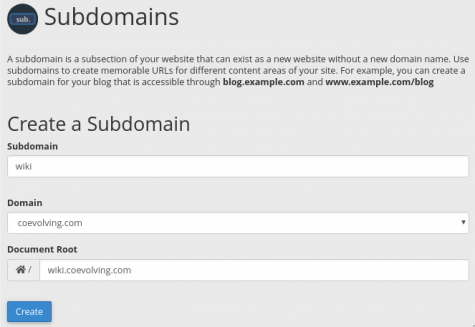
(1) Through your browser, from cPanel … Domains … , create a Subdomain.

  • As an example, I can create a Subdomain wiki in the Domain coevolving.com, that will actually be stored in my Home (Document Root) as a wiki.coevolving.com directory.

Subdomain_CreateASubdomain

B. Installing Federated Wiki

(2) From cPanel … Software … Setup Node.js App.

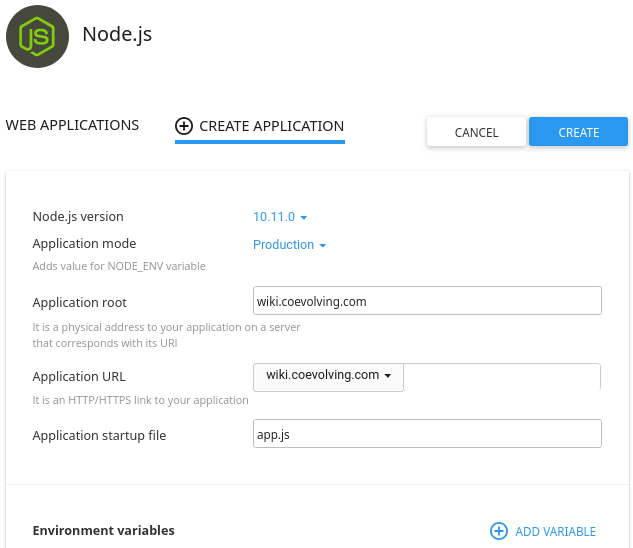
  • In the Web Applications list, Create Application.  As an example, set:
      • Node.js version: 10.11.0
      • Application mode: Production
      • Application root: wiki.coevolving.com
      • Application URL: wiki.coevolving.com
      • Application startup: app.js
  • (If you leave the Application startup field blank, app.js automatically fills in as the default)

NodeJs_CreateApplication

  • At this point, the node.js environment is not yet activated, as the package.json has not yet been downloaded, and the Run NPM Install button is greyed out.
… Read more (in a new tab)

Artificial intelligence, natural stupidity

Psychologist Amos Tversky, with Daniel Kahneman, collaborated not on artificial intelligence, but on the study of natural stupidity.  Their research into cognitive biases eventually became recognized in an emerging field of behavioral economics.  In hindsight, I can claim to have received an “A” in a Ph.D. course taught by the winner of a Nobel Prize in economics.

In my first cycle of doctoral studies, I was guided at UBC by my supervisor Ken MacCrimmon into a PSYC546 “Seminar in Psychology Problems”, which was led by Danny Kahneman.  This course was offered shortly after the 1982 publication of the book Judgment under uncertainty: Heuristics and biases, edited by Daniel Kahneman, Paul Slovic, and Amos Tversky.  With Kahneman at UBC in Vancouver, and Tversky at Stanford University in the San Francisco Bay Area, the back-and-forth flights to visit each other was frequent.  I uncovered more about the relationship between the two psychology professors in reading The Undoing Project. That book describes a difficult history of university faculty offers, not only around the two collaborators, but also the accommodation of wives Barbara Gans Tversky and Anne Treisman.

In late 1977, after Danny had told him that he wasn’t returning to Israel, word spread through academia that Amos Tversky might leave, too.  […]  Harvard University quickly offered Amos tenure, though it took them a few weeks to throw in an assistant professorship for Barbara. The University of Michigan, which had the advantage of sheer size, scrambled to find four tenured professorships — and, by making places for Danny, Anne, and Barbara, also snag Amos.

… Read more (in a new tab)

The impacts of platforms

Concerns in the larger research body of research on platforms often leads to a subset looking into the impacts of the platform economy.  Let’s try some more digests responding to questions.

  • A. Is a shift to platforms considered as disruptive innovation?
  • B. Do network effects lead to a platform economy of “winner take all”?
  • C. With digital platforms based in information systems, what are the opportunities for knowledge effects?
  • D. What is the logic of participation on a platform?
  • E. Should platform capitalism be seen as positive or negative?
  • F. As an alternative to platform capitalism, should platform cooperativism be considered?
  • G. In the larger context of the sharing economy, how might platform initiatives be categorized?

The rise of the platform economy may be described either by the metaphor of “We Don’t Know Who Discovered Water, But We Know It Wasn’t a Fish” or the fable of the “Boiling Frog“.

A. Is a shift to platforms considered as disruptive innovation?

In a clarification about definition of disruptive innovation, Clayton Christensen doesn’t see Uber as disrupting the taxi business, because (i) the innovation doesn’t original on a low-end or new-market foothold; and (ii) the innovation doesn’t catch up with mainstream customers until quality catches up to their standards.  With disruptive innovation seen as a process, Uber is categorized by Christensen as as an outlier to the taxi business, offering a better quality service in the regulated taxi industry.… Read more (in a new tab)

  • fediscience.org/@daviding (Mastodon)

    1. Loading Mastodon feed...
  • RSS feed: on IngBrief on IngBrief

    • 2026/01/07 | Rama Akkiraju | From LLMs to Living Systems: Applying Systems Science to Agentic AI in the Enterprise | HICSS-59 Keynote
      Abstract Enterprise AI is transitioning from simple single-LLM flows to complex agentic ecosystems—adaptive systems composed of multiple agents, tools, governed data, human workflows, and organizational policies. This keynote introduces a systems-science framework for designing and managing such ecosystems using principles of modularity, control, feedback, robustness, and socio-technical alignment. We illustrate these concepts through practical examples […]
    • Timothy F.H. Allen passed away on May 01, 2025
      Timothy F.H. Allen, president of International Society for the Systems Sciences 2008-2009, passed away peacefully in his home, surrounded by his family, on May 1, 2025. With his work on ecosystem ecology, I learned more about living systems than anyone else in the systems community. After his retirement, he was proud of putting together a […]
    • Installing WordPress Studio on Manjaro Linux
      In 2024, WordPress Studio was released, making installation on a local computer simpler. The instructions were modified from MacOS to Ubuntu Linux, by Daniel Kossmann, “How to install WordPress Studio in Ubuntu Linux” | Jun 15, 2024 at https://www.danielkossmann.com/how-to-install-wordpress-studio-ubuntu-linux/ I already had NVM installed, but in Terminal, with the result “command not found”. In the […]
    • Notion of Change in the Yijing | JeeLoo Lin 2017
      The appreciation of change is different in Western philosophy than in classical Chinese philosophy. JeeLoo Lin published a concise contrast on differences. Let me parse the Introduction to the journal article, that is so clearly written. A-theories divide time into past, present and future, and the point of reference is set at “the present.” B-theories, […]
    • World Hypotheses (Stephen C. Pepper) as a pluralist philosophy [Rescher, 1994]
      In trying to place the World Hypotheses work of Stephen C. Pepper (with multiple root metaphors), Nicholas Rescher provides a helpful positioning. — begin paste — Philosophical perspectivism maintains that substantive philosophical positions can be maintained only from a “perspective” of some sort. But what sort? Clearly different sorts of perspectives can be conceived of, […]
    • The Nature and Application of the Daodejing | Ames and Hall (2003)
      Ames and Hall (2003) provide some tips for those studyng the DaoDeJing.
  • Recent Posts

  • Archives

  • RSS feed: on daviding.com on daviding.com

    • 2026/10 Moments October 2026
      Dartmouth, Nova Scotia; Halifax, Nova Scotia; Lunenberg, Nova Scotia; Peggy’s Cove, Nova Scotia; Bible Hill, Nova Scotia; Louisbourg, Nova Scotia; Sydney, Nova Scotia; Baddeck, Nova Scotia; Toronto, Ontario Fraser’s Mills Fish Hatchery: Side trip to hatchery built in 1928 by provincial government, gravity-fed from South River. Water in pen dark, ripples at surface due to […]
    • 2026/09 Moments September 2026
      Vancouver BC; Toronto, Ontario, Burlington, Ontario; Shanghai PR China Serenade of the Seas: From the foredeck of level 12 of the Royal Caribbean Line ship, the panorama west to the Vancouver Convention Centres, turning to the north across Vancouver Harbour. Observed Princess Line ship leaving the dock, a departure we never experienced. Arrived for lunch, […]
    • 2026/08 Moments August 2026
      Toronto, Ontario; Vancouver BC Next Perfect Day Playlist: Korean Town Street Festival, 20260808 Night View O What A Shiny Night Honey Haneum Playlist: Korean Town Street Festival, 20260808 Happiness Prince of Jeju Ieodo Sana Seouje Sori Leida Lay Down Together Star North Sky Beautiful Country Encore Chris Fraser Trio | Meo | 2026-08-30: Nestled in […]
    • 2026/07 Moments July 2026
      Quiet summer mostly at home writing, taking breaks to meet with friends, and exercise on bike rides.
    • 2026/06 Moments June 2026
      Cool summer catching up with family and friends, music festivals
    • 2026/05 Moments May 2026
      Cool spring, busy with Jane's Walk, bathroom renovation, closing out father's apartment, OCADU GradEx, Problematique Dialogue applying the Banathy Conversation Methodology, Qingming.
  • RSS feed: on Media Queue on Media Queue

  • Meta

  • Creative Commons License
    This work is licensed under a Creative Commons Attribution-NonCommercial-ShareAlike 4.0 International License
    Theme modified from DevDmBootstrap4 by Danny Machal