
Coevolving Innovations

… in Business Organizations and Information Technologies

Currently Viewing Posts Tagged systems-science

A Proposal for Collaboration on a Pattern Language for Service Systems

A meeting of systems scientists and systems engineers together as the Systems Science Working Group at the INCOSE International Workshop 2014 provided a forum for “a proposal for collaboration on a pattern language for service systems (science, management, engineering and design)”.  The title is deliberately long, and required some hours to unpack the content in the slide deck.
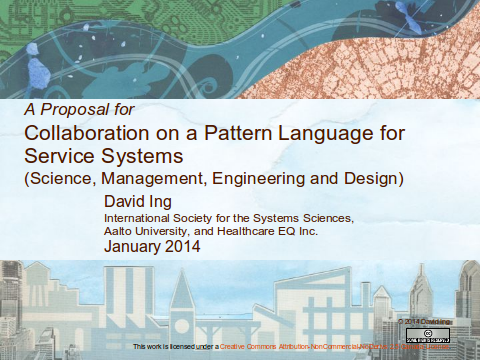
A Proposal for Collaboration on a Pattern Language for Service Systems (Science, Management, Engineering and Design)

The initiative has been presented as ambitious.  Writing a (good) pattern language is non-trivial.  The originator of the pattern language, Christopher Alexander, published his first work in 1968, and then spent 9 years in collaboration until the 1977 release of the landmark A Pattern Language: Towns, Building, Construction.  In a 2010 interview, Alexander was asked about his perception on similar efforts.

[Rob Hoskins]: What’s been your opinion of subsequent peoples’ attempts at doing Pattern Languages – I’ve seen a couple of different ones, have you seen many?

[Christopher Alexander]:  Some. They’re not that good. The reason I say that is that the people who’ve attempted to work with Pattern Languages, think about them, but are not conscious of the role of morphological elegance in the unfolding. In a biological case, they always are elegant and the unfolding morphology is a sort of magic. But it’s very simple.  It’s not as if it’s magic because it’s complicated, it’s just … like that.

[Rob Hoskins]:  I guess when we were talking before about how a Pattern Language goes from the large down to the small, maybe when we were talking about it as going outwards maybe it is more like an unfolding process?
… Read more (in a new tab)

A meeting of systems scientists and systems engineers together as the Systems Science Working Group at the INCOSE International Workshop 2014 provided a forum for “a proposal for collaboration on a pattern language for service systems (science, management, engineering and design)”.  The title is deliberately long, and required some hours to unpack the content in the slide deck.

A Proposal for Collaboration on a Pattern Language for Service Systems (Science, Management, Engineering and Design)

The initiative has been presented as ambitious.  Writing a (good) pattern language is non-trivial.  The originator of the pattern language, Christopher Alexander, published his first work in 1968, and then spent 9 years in collaboration until the 1977 release of the landmark A Pattern Language: Towns, Building, Construction.  In a 2010 interview, Alexander was asked about his perception on similar efforts.

[Rob Hoskins]: What’s been your opinion of subsequent peoples’ attempts at doing Pattern Languages – I’ve seen a couple of different ones, have you seen many?

[Christopher Alexander]:  Some. They’re not that good. The reason I say that is that the people who’ve attempted to work with Pattern Languages, think about them, but are not conscious of the role of morphological elegance in the unfolding. In a biological case, they always are elegant and the unfolding morphology is a sort of magic. But it’s very simple.  It’s not as if it’s magic because it’s complicated, it’s just … like that.

[Rob Hoskins]:  I guess when we were talking before about how a Pattern Language goes from the large down to the small, maybe when we were talking about it as going outwards maybe it is more like an unfolding process?

… Read more (in a new tab)

An interview on “Service Systems, Natural Systems” and the systems sciences

An interview by Performance magazine — with an issue focused on systems in architecture and related disciplines — has now been published. Since the content has been translated into German (as well as reduced for length) — the original interview is posted below, in English.


  • David Ing is the president (2011-2012), of the International Society for the Systems Sciences. He welcomes deep thinkers from around the world to join in an interactive learning experience at the annual meeting of the ISSS, scheduled for July 15-20, 2012, in San Jose, California. David Ing responded to this interview from his home in Toronto, Canada.

Performance, 2012, number 2

1. Could you please, in just a few words, explain to us what the systems sciences deal with and what your specialty area is?

The systems sciences — many of us prefer sciences in the plural — study the nature of parts and wholes. People may say that they are systems thinkers: they view the world primarily as relations of part-whole, part-part and whole-whole arrangements in space and time. Systems thinking enables a basic foundation across a wide variety of domains, including (i) natural systems in geographic and biological domains, and (ii) man-made systems in social and informatic domains.

In 2011-2012, I am serving as the president of the International Society for the Systems Sciences (ISSS). Our annual meeting for July 2012 will be at San Jose State University, in California. We expect a broad range of systems researchers and practitioners to come together for interdiscipinary and transciplinary discussions over five days.… Read more (in a new tab)

Systems thinking and (the) systems science(s) in a system of ideas

On the discussion list of the Systems Science Working Group, there’s a request to comment on the Overview of Systems Science wiki page (draft version 0.5) that is part of the Guide to Systems Engineering Book of Knowledge.  Basic descriptions are hard to write.  Asking the “what is …” question is a challenge of ontology, and may not cover the “why …” question coming from the perspective of teleology or the “how …” question coming from the history and philosophy of science.

I appreciate that novices like definitions.  In a scholarly style, I generally cite descriptions by individual thinkers who each have a system of ideas.  In an attempt to appreciate commonalities and differences between prominent figures in the systems movement, I had been hosting a series of Systems Sciences Connections Conversations aimed at traversing social ties between individuals.  As a fun example, we asked Allenna Leonard if Stafford Beer and Jane Jacobs knew each other, as they both lived in the Annex neighbourhood in Toronto.  Allenna’s response was, of course, they would see each other in places like the drug store.  Stafford Beer did use Cities and the Wealth of Nations as a foundation for his work in Uruguay, but there wasn’t really an occasion for ongoing collaboration.  Developing a network of systems of ideas is a more modest endeavour than trying to create a system of system of ideas.

Describing the world in objective entities isn’t the way I think.  … Read more (in a new tab)

Digest on Service Systems Science at Tokyo Institute of Technology (2009)

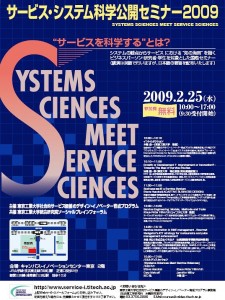
Systems Sciences Meet Service SciencesThe Service Innovation Educational Program at the Tokyo Institute of Technology hosted an “Open Seminar on Service Systems Science” (with a flyer in PDF) — as well as a private “Invited Workshop on Services Science, Management and Engineering” — in February 2009.

I’ve just noticed that much of the content is totally opaque to people who don’t read Japanese, so I’ve posted my (English-language) digest of the meetings on the Coevolving Innovation Commons.  The text is incomplete, but it at least provides a minimal sketch of some of the ideas discussed. (Digital photographs help, too!).  Speakers include:

The 2009 meetings were an annual extension of the 2008 21st Century CoE Symposium, and the first Invited Workshop on SSME.

With many of the researchers coming from a perspective of systems science, the trend has been to work out some of the ideas on an emerging science of service systems.

Business Models and Evolving Economic Paradigms: A Systems Science Approach

In summer 2006, I constructed a curriculum on International Service Business Management for a one-year master’s program in Finland. Appropriate to the Finnish style, this content was assembled in rapid development. With a profile of students admitted mostly with technical undergraduate degrees and 5-to-10 years of working experience, the curriculum leaned toward the style normally expected in a practical executive MBA program.

In contrast, at presentations in August 2007, and then again in March 2008, Jim Kijima proposed a more ambitious challenge — for the new program at the Tokyo Institute of Technology — looking at services science based on systems science. For full-time graduate students, he sees systems science as a “liberal art” where their perspectives are broadened beyond their disciplinary technical teaching. In Japan, it’s not enough to have T-shaped professionals, they expect pi-shaped people, i.e. two downward stems with at least a major and a minor, in addition to the crossbar.

I took the idea of services science and systems science as a challenge, and constructed an article and a presentation for the ISSS Madison 2008 meeting as an exercise. With a target of master’s level engineering and management students, developing this content was based on a few premises:

Curriculum in a coevolving world

If the world is changing so that co-evolution of organizations and technology is required, what is the content that students should be trained in?

Here’s an interesting high-level view of “New ICT Curricula for the 21st Century“:

… the Career Space consortium recommends that ICT Curricula should consist of the following core elements:

  • a scientific base of 30%,
  • a technology base of 30%,
  • an application base and systems thinking of 25% and,
  • a personal and business skills element of up to 15%.

It’s probably something that should be noted, given the “brand name” recognition of sponsors associated with the consortium.

I’m active in the systems science community, so I find it interesting that “systems thinking” is named on the list. This requirement is less surprising, given the origins of the initiative in Europe.

So, should we have a similar interest in “systems thinking” in North America?

  • fediscience.org/@daviding (Mastodon)

    1. Loading Mastodon feed...
  • RSS feed: on IngBrief on IngBrief

    • 2026/01/07 | Rama Akkiraju | From LLMs to Living Systems: Applying Systems Science to Agentic AI in the Enterprise | HICSS-59 Keynote
      Abstract Enterprise AI is transitioning from simple single-LLM flows to complex agentic ecosystems—adaptive systems composed of multiple agents, tools, governed data, human workflows, and organizational policies. This keynote introduces a systems-science framework for designing and managing such ecosystems using principles of modularity, control, feedback, robustness, and socio-technical alignment. We illustrate these concepts through practical examples […]
    • Timothy F.H. Allen passed away on May 01, 2025
      Timothy F.H. Allen, president of International Society for the Systems Sciences 2008-2009, passed away peacefully in his home, surrounded by his family, on May 1, 2025. With his work on ecosystem ecology, I learned more about living systems than anyone else in the systems community. After his retirement, he was proud of putting together a […]
    • Installing WordPress Studio on Manjaro Linux
      In 2024, WordPress Studio was released, making installation on a local computer simpler. The instructions were modified from MacOS to Ubuntu Linux, by Daniel Kossmann, “How to install WordPress Studio in Ubuntu Linux” | Jun 15, 2024 at https://www.danielkossmann.com/how-to-install-wordpress-studio-ubuntu-linux/ I already had NVM installed, but in Terminal, with the result “command not found”. In the […]
    • Notion of Change in the Yijing | JeeLoo Lin 2017
      The appreciation of change is different in Western philosophy than in classical Chinese philosophy. JeeLoo Lin published a concise contrast on differences. Let me parse the Introduction to the journal article, that is so clearly written. A-theories divide time into past, present and future, and the point of reference is set at “the present.” B-theories, […]
    • World Hypotheses (Stephen C. Pepper) as a pluralist philosophy [Rescher, 1994]
      In trying to place the World Hypotheses work of Stephen C. Pepper (with multiple root metaphors), Nicholas Rescher provides a helpful positioning. — begin paste — Philosophical perspectivism maintains that substantive philosophical positions can be maintained only from a “perspective” of some sort. But what sort? Clearly different sorts of perspectives can be conceived of, […]
    • The Nature and Application of the Daodejing | Ames and Hall (2003)
      Ames and Hall (2003) provide some tips for those studyng the DaoDeJing.
  • Recent Posts

  • Archives

  • RSS feed: on daviding.com on daviding.com

    • 2026/10 Moments October 2026
      Dartmouth, Nova Scotia; Halifax, Nova Scotia; Lunenberg, Nova Scotia; Peggy’s Cove, Nova Scotia; Bible Hill, Nova Scotia; Louisbourg, Nova Scotia; Sydney, Nova Scotia; Baddeck, Nova Scotia; Toronto, Ontario Fraser’s Mills Fish Hatchery: Side trip to hatchery built in 1928 by provincial government, gravity-fed from South River. Water in pen dark, ripples at surface due to […]
    • 2026/09 Moments September 2026
      Vancouver BC; Toronto, Ontario, Burlington, Ontario; Shanghai PR China Serenade of the Seas: From the foredeck of level 12 of the Royal Caribbean Line ship, the panorama west to the Vancouver Convention Centres, turning to the north across Vancouver Harbour. Observed Princess Line ship leaving the dock, a departure we never experienced. Arrived for lunch, […]
    • 2026/08 Moments August 2026
      Toronto, Ontario; Vancouver BC Next Perfect Day Playlist: Korean Town Street Festival, 20260808 Night View O What A Shiny Night Honey Haneum Playlist: Korean Town Street Festival, 20260808 Happiness Prince of Jeju Ieodo Sana Seouje Sori Leida Lay Down Together Star North Sky Beautiful Country Encore Chris Fraser Trio | Meo | 2026-08-30: Nestled in […]
    • 2026/07 Moments July 2026
      Quiet summer mostly at home writing, taking breaks to meet with friends, and exercise on bike rides.
    • 2026/06 Moments June 2026
      Cool summer catching up with family and friends, music festivals
    • 2026/05 Moments May 2026
      Cool spring, busy with Jane's Walk, bathroom renovation, closing out father's apartment, OCADU GradEx, Problematique Dialogue applying the Banathy Conversation Methodology, Qingming.
  • RSS feed: on Media Queue on Media Queue

  • Meta

  • Creative Commons License
    This work is licensed under a Creative Commons Attribution-NonCommercial-ShareAlike 4.0 International License
    Theme modified from DevDmBootstrap4 by Danny Machal