
Coevolving Innovations

… in Business Organizations and Information Technologies

Currently Viewing Posts in services

AI Automation or IA Intelligence Augmentation? | ISSIP | 2025-07-15

The International Society for Service Innovation Professionals (ISSIP) hosted an online “radio show” call-in roundtable to discuss “Where can service systems benefit more from Intelligence Augmentation (IA), over AI Automation?“.  This was third in the Roundtable on Systems of Services series.

Panelists to spark the conversation included Michelle Zhou, David Ing, and Gary Metcalf.  The event was moderated by Jim Spohrer. The ISSIP Ambassadors added more insights, recorded for streaming on YouTube.

Michelle started the discussion on negotiation skills and essential human services.  I recalled the socio-technical systems of coal mines reorganizing into autonomous workgroups, and then accountabilities established through language-action commitments.  Gary spoke to his experience in graduate education beginning in distance learning, that evolved into online learning over the Internet, and now the possibilities with asynchronicity and AI.  These seeds bloomed into group discussions about critical thinking, working in teams, and the potential for AI to provide personality insights that might better guide collaborations.  Opening up the conversation to others on the call built on these themes.

For those to prefer to read, there’s an AI summary and transcript produced by Zoom.

In having this conversation in real time, the roundtable cocreated knowledge that probably isn’t readily available through a generative AI.  Above all, we had fun!

Here’s the original invitation to participation.


Intelligence Augmentation (IA) enhances and elevates human’s ability, intelligence, and performance with the help of information technology.… Read more (in a new tab)
The International Society for Service Innovation Professionals (ISSIP) hosted an online “radio show” call-in roundtable to discuss “Where can service systems benefit more from Intelligence Augmentation (IA), over AI Automation?“.  This was third in the Roundtable on Systems of Services series.

Panelists to spark the conversation included Michelle Zhou, David Ing, and Gary Metcalf.  The event was moderated by Jim Spohrer. The ISSIP Ambassadors added more insights, recorded for streaming on YouTube.

Michelle started the discussion on negotiation skills and essential human services.  I recalled the socio-technical systems of coal mines reorganizing into autonomous workgroups, and then accountabilities established through language-action commitments.  Gary spoke to his experience in graduate education beginning in distance learning, that evolved into online learning over the Internet, and now the possibilities with asynchronicity and AI.  These seeds bloomed into group discussions about critical thinking, working in teams, and the potential for AI to provide personality insights that might better guide collaborations.  Opening up the conversation to others on the call built on these themes.

For those to prefer to read, there’s an AI summary and transcript produced by Zoom.

In having this conversation in real time, the roundtable cocreated knowledge that probably isn’t readily available through a generative AI.  Above all, we had fun!

Here’s the original invitation to participation.


Intelligence Augmentation (IA) enhances and elevates human’s ability, intelligence, and performance with the help of information technology.… Read more (in a new tab)

Socio-Technical Systems, Service Systems Science

In order to move forward, the Systems Changes Learning Circle has taken a step backwards to appreciate the scholarly work that has come before us.  This has included the Socio-Psychological Systems, Socio-Technical Systems and Socio-Ecological Systems perspective, from the postwar Tavistock Institute for Human Relations.  The deep dive on “Causal texture, contextualism, contextural” takes us back to 1934-1935 articles by Pepper, Tolman and Brunswik.  These influenced Fred Emery and Eric Trist in their famous 1965 article.

In Trist’s later years (i.e. between 1977-1985, when he was in Toronto at York University, with the Action Learning Group). the younger researcher with whom he was collaborating most was Calvin Pava.  There is a great summary of Pava’s work and life in Austrom and Ordowich (2019).

Through some fortunate coordination, I was able to meet Doug Austrom in Indianapolis in August 2018, having discovered a preprint of the article, just a few days before I was to travel to Iowa.

In our conversation, I discovered that as Austrom, after completing his doctoral dissertation at York U. in 1982, received an appointment as a postdoctoral researcher.  Austrom was interested in Quality of Life, and Trist was interested in Quality of Working Life.  This led to many conversations.  Austrom and Trist never published anything together, as Trist was wrapping up his project with the Ontario Ministry of Labour.  Austrom has since had an entire career in Socio-Technical Systems, consulting to the current day.… Read more (in a new tab)

Remembering Doug McDavid

Doug McDavidThe news that Doug McDavid — my friend, colleague, and one of the original cofounders of the Coevolving Innovations web site in 2006 — had passed, first came through mutual IBM contacts.  More details subsequently showed up on LinkedIn from Mike McClintock.

Doug left us on May 9, while working at his desk, likely in the very earliest hours of the morning. His wife Carleen, accustomed to his habit of disappearing into intense all-nighters, expected to get him to pay a bit of attention to breakfast. Instead, she found him at peace amid his books and his papers.

I left a response to that posting.

Doug McDavid was in my path towards systems thinking. He was the first person that I had met, who had a copy and read Living Systems by James Grier Miller. This came from his studies when systems were still active at San Jose State University. I’m not sure, but I seen to recall that Bela H. Banathy was an instructor there.

There was a memorable meeting at IBM Palisades in 1997 with Stephan Haeckel where Ian Simmonds (from IBM Research) and I were trying to make sense of the Sense and Respond approach with Doug. That launched me into attending some seminars with Russell Ackoff, and becoming deeply immersed in the International Society for the Systems Sciences . In later years, Doug would be an active participant at ISSS meetings.

Inside IBM, Doug was leading the Business Architecture community, in our continuing battle for recognition with the Enterprise Architecture competency within IBM.

… Read more (in a new tab)

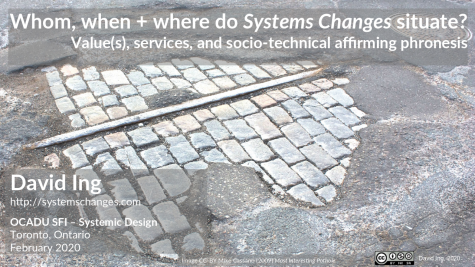
Whom, when + where do Systems Changes situate?

Covering practical wisdom (phronesis), the third of four lectures again was compressed for the Systemic Design course in the Master’s program in Strategic Foresight and Innovation at OCAD University. The students in the part-time session on February 7 extended their discussion period longer than those in the full-time session on February 5. I again jumped slides in the sequence to stay within the timebox.

The agenda was in four sections:

  • [preamble] Episteme, Techne, Phronesis (reordered)
    • Intellectual Pursuits (Rethinking Systems Thinking)
    • Systems changes as situated c.f. ideal-seeking
  • A. Value(s), Judgment, Soft Systems Thinking
    • Appreciative Systems (Vickers, Checkland)
    • Policy, impacts and consequences of systems changes
  • B. Service Systems (c.f. Production Systems)
    • Science of Service Systems (Spohrer, Kijima)
    • Material-products c.f. information-services as systems changes
  • C. Socio-Technical Systems Perspective
    • Tavistock Institute + Legacy (Trist, Emery, Ramirez)
    • Coproduction and design principles guiding systems changes

The web video can be streamed on Youtube.

Copies of the video files are downloadable for disconnected viewing.

Video H.264 MP4 WebM
February 7
(1h21m)
[20200207_OCADU_Ing HD m4v]
(HD 2477kbps 1.6GB)
[20200207_OCADU_Ing nHD m4v]
(nHD 1344kps 866MB)
[20200207_OCADU_Ing HD webm]
(HD VP8 375kbps 349MB)
[20200207_OCADU_Ing nHD webm]
(nHD VP8 139kbps 206MB)

Readers who want to follow through on web link references may want to review the slides directly.

Whom, when + where do Systems Changes situated?

The same presentation slides were used for both lectures.  The questions from the students were considerably different across the class sections, so the diligent listener might want to compare them. … Read more (in a new tab)

Services methods in a process framework

From the mid-1990s to the mid-2000s, methods for organizing for service engagements at scale were developed at IBM. Although this investment in knowledge management was huge, changes in the organization by the late-2000s saw this rich body of intellectual capital practically disappear.  Appreciation for the framework remains in the memories of practitioners in the IBM Global Services organization — particularly the methodologists — immersed during that period. Some foundational historical artifacts can be rediscovered on the open Internet:

  • 1. Configurable Development Processes (2002)
  • 2. Method Adoption Workshops (2000)
  • 3. Eclipse Process Framework Composer (2007)

The resemblance to pattern language, as prescribed by Christoper Alexander, is not accidental. Excerpts from these three sources are provided here, to entice readers who might seek out the full articles.

1. Configurable Development Processes (2002)

The Work Product based methods started in IBM at the rise of object-oriented methods. With OO as a new paradigm, incompatibilities across the variety of approaches frustrated clients trying to get work done.  The end results seemed pretty much the same. The resolution for IBM came through centering on ends (work products) first, and means (techniques) second. The methods originating in software development became cross-appropriated into services engagement for other domain offerings (e.g. business strategy, organizational change).

Here’s an excerpt that shows the centrality of Work Product Descriptions (WPDs) from:

Work products cover the full range of project work including project management, business process design, organizational change, requirements, usability, architecture, design, construction, and testing.

… Read more (in a new tab)

Evolving Pattern Language towards an Affordance Language (Almaden, 2018/05/09)

With a visit of one week at IBM Research Almaden with @rarar and @jimspohrer , I was invited to give a talk.  As an IBM alumnus who was active in pattern language community from the mid-1990s, this was an occasion to surface some history of science about activities inside the company that is otherwise opaque.  This history shapes my aspirations and predispositions towards continuing the development of pattern language in new domains.

The high-level agenda aimed to cover three parts:

  • 1. 1964 → 1999 → 2012:
    Synthesis of Form→OOPSLA 1996→Battle (Eishin)
  • 2. 1993 →2002→2006→2010:
    Hillside Group→IGS Method→AWB→Eclipse
  • 3. 2014 → … :
    Wicked Messes→Service Systems Thinking

Here’s the abstract sent in advance of my arrival:

Pattern language has its origins from architects of built physical environments. The approach was cross-appropriated into software development methods at the rise of object-oriented design, and was influential in the emerging styles with agile practices. The idea has been extended into social change. Are the philosophical foundations from the 1960s-1970s appropriate for the 21st century era of service science, and innovations in augmented intelligence?

The communities of interest on pattern language are coming together (i.e. PLoP and PUARL-Purplsoc are colocating in Portland, OR, in October 2018), coming from three historical subgroups.

The PUARL subgroup is led by former students of Christopher Alexander from the Center for Environmental Structure at Berkeley in the 1970s. They continue to work on “towns, buildings and construction”, with recent interests in large scale incidents (e.g.

… Read more (in a new tab)
  • fediscience.org/@daviding (Mastodon)

    1. Loading Mastodon feed...
  • RSS feed: on IngBrief on IngBrief

    • 2026/01/07 | Rama Akkiraju | From LLMs to Living Systems: Applying Systems Science to Agentic AI in the Enterprise | HICSS-59 Keynote
      Abstract Enterprise AI is transitioning from simple single-LLM flows to complex agentic ecosystems—adaptive systems composed of multiple agents, tools, governed data, human workflows, and organizational policies. This keynote introduces a systems-science framework for designing and managing such ecosystems using principles of modularity, control, feedback, robustness, and socio-technical alignment. We illustrate these concepts through practical examples […]
    • Timothy F.H. Allen passed away on May 01, 2025
      Timothy F.H. Allen, president of International Society for the Systems Sciences 2008-2009, passed away peacefully in his home, surrounded by his family, on May 1, 2025. With his work on ecosystem ecology, I learned more about living systems than anyone else in the systems community. After his retirement, he was proud of putting together a […]
    • Installing WordPress Studio on Manjaro Linux
      In 2024, WordPress Studio was released, making installation on a local computer simpler. The instructions were modified from MacOS to Ubuntu Linux, by Daniel Kossmann, “How to install WordPress Studio in Ubuntu Linux” | Jun 15, 2024 at https://www.danielkossmann.com/how-to-install-wordpress-studio-ubuntu-linux/ I already had NVM installed, but in Terminal, with the result “command not found”. In the […]
    • Notion of Change in the Yijing | JeeLoo Lin 2017
      The appreciation of change is different in Western philosophy than in classical Chinese philosophy. JeeLoo Lin published a concise contrast on differences. Let me parse the Introduction to the journal article, that is so clearly written. A-theories divide time into past, present and future, and the point of reference is set at “the present.” B-theories, […]
    • World Hypotheses (Stephen C. Pepper) as a pluralist philosophy [Rescher, 1994]
      In trying to place the World Hypotheses work of Stephen C. Pepper (with multiple root metaphors), Nicholas Rescher provides a helpful positioning. — begin paste — Philosophical perspectivism maintains that substantive philosophical positions can be maintained only from a “perspective” of some sort. But what sort? Clearly different sorts of perspectives can be conceived of, […]
    • The Nature and Application of the Daodejing | Ames and Hall (2003)
      Ames and Hall (2003) provide some tips for those studyng the DaoDeJing.
  • Recent Posts

  • Archives

  • RSS feed: on daviding.com on daviding.com

    • 2026/10 Moments October 2026
      Dartmouth, Nova Scotia; Halifax, Nova Scotia; Lunenberg, Nova Scotia; Peggy’s Cove, Nova Scotia; Bible Hill, Nova Scotia; Louisbourg, Nova Scotia; Sydney, Nova Scotia; Baddeck, Nova Scotia; Toronto, Ontario Fraser’s Mills Fish Hatchery: Side trip to hatchery built in 1928 by provincial government, gravity-fed from South River. Water in pen dark, ripples at surface due to […]
    • 2026/09 Moments September 2026
      Vancouver BC; Toronto, Ontario, Burlington, Ontario; Shanghai PR China Serenade of the Seas: From the foredeck of level 12 of the Royal Caribbean Line ship, the panorama west to the Vancouver Convention Centres, turning to the north across Vancouver Harbour. Observed Princess Line ship leaving the dock, a departure we never experienced. Arrived for lunch, […]
    • 2026/08 Moments August 2026
      Toronto, Ontario; Vancouver BC Next Perfect Day Playlist: Korean Town Street Festival, 20260808 Night View O What A Shiny Night Honey Haneum Playlist: Korean Town Street Festival, 20260808 Happiness Prince of Jeju Ieodo Sana Seouje Sori Leida Lay Down Together Star North Sky Beautiful Country Encore Chris Fraser Trio | Meo | 2026-08-30: Nestled in […]
    • 2026/07 Moments July 2026
      Quiet summer mostly at home writing, taking breaks to meet with friends, and exercise on bike rides.
    • 2026/06 Moments June 2026
      Cool summer catching up with family and friends, music festivals
    • 2026/05 Moments May 2026
      Cool spring, busy with Jane's Walk, bathroom renovation, closing out father's apartment, OCADU GradEx, Problematique Dialogue applying the Banathy Conversation Methodology, Qingming.
  • RSS feed: on Media Queue on Media Queue

  • Meta

  • Creative Commons License
    This work is licensed under a Creative Commons Attribution-NonCommercial-ShareAlike 4.0 International License
    Theme modified from DevDmBootstrap4 by Danny Machal