
Coevolving Innovations

… in Business Organizations and Information Technologies

Currently Viewing Posts Tagged st-on

Systems Thinking Ontario as Systems Convening | ST-ON | 2024-10-21

The 125th meeting of Systems Thinking Ontario coincided with the closing day for the RSD13-RSDX online program.  As a regular systems convening group, we’ve had monthly meetings since January 2013.

Zaid Khan moderated  a discussion including me (David Ing), Tim Lloyd, Allenna Leonard, and Kelly Okamura.

We recollected starting as a spinoff from Design with Dialogue, adopting their tradition of meeting in a circle in the Lambert Lounge at OCADU.  In the summers, we’ve celebrated the Synthesis Maps created by Master of Design students from the Strategic Foresight and Innovation program in the Visual Analytics Lab.  The COVID-19 pandemic saw us shift to online meetings, with a few in-person opportunties taken in the summer.

This video recording is available for download, on Youtube, and also on the Internet Archive .

Video H.264 MP4
October 21
(1h35m)
[20241021_ST-ON_RSDx-RSD13_FHD_620kpbs.m4v
(1920×1080 626kbps 538MB)
[on the Internet Archive]

An audio version was also created during the meeting.

Audio
October 21
(1h35m)
[20241021_ST-ON_RSDx-RSD13.m4a]
(126kbps, 88 MB)
[on the Internet Archive]

In 2025, Systems Thinking Ontario meetings are planned to continue.  We’re shifting to a different evening, to enable inclusion of students currently in the SFI program.  With an increase in the number of sessions where we’ll meet in person, we hope that novices will join our regulars.  Stay posted at https://wiki.st-on.org.
Systems Convening, in the RSD13-RSDX program

The 125th meeting of Systems Thinking Ontario coincided with the closing day for the RSD13-RSDX online program.  As a regular systems convening group, we’ve had monthly meetings since January 2013.

Zaid Khan moderated  a discussion including me (David Ing), Tim Lloyd, Allenna Leonard, and Kelly Okamura.

We recollected starting as a spinoff from Design with Dialogue, adopting their tradition of meeting in a circle in the Lambert Lounge at OCADU.  In the summers, we’ve celebrated the Synthesis Maps created by Master of Design students from the Strategic Foresight and Innovation program in the Visual Analytics Lab.  The COVID-19 pandemic saw us shift to online meetings, with a few in-person opportunties taken in the summer.

This video recording is available for download, on Youtube, and also on the Internet Archive .

Video H.264 MP4
October 21
(1h35m)
[20241021_ST-ON_RSDx-RSD13_FHD_620kpbs.m4v
(1920×1080 626kbps 538MB)
[on the Internet Archive]

An audio version was also created during the meeting.

Audio
October 21
(1h35m)
[20241021_ST-ON_RSDx-RSD13.m4a]
(126kbps, 88 MB)
[on the Internet Archive]

In 2025, Systems Thinking Ontario meetings are planned to continue.  We’re shifting to a different evening, to enable inclusion of students currently in the SFI program.  With an increase in the number of sessions where we’ll meet in person, we hope that novices will join our regulars.  Stay posted at https://wiki.st-on.org.
Systems Convening, in the RSD13-RSDX program

Reifying Systems Thinking towards Changes | ST-ON 2022-10-17

The October online meeting of Systems Thinking Ontario presented an opportunity for an update on progress made by the Systems Changes Learning Circle by 2022.  A slide deck had been prepared an in-person seminar at the Universitat de Barcelona Graduate Programmes in Business, organized by Ryan C. Armstrong, one week earlier.  Our regular monthly meeting, centered in Toronto, allowed a more leisurely pace, and a better affordance for capturing the session for playback.

The agenda provided the background history leading to the Systems Changes Learning Circle, and then focused on the practical approach to “doing” on our pilot engagement.

A. Rethinking Systems Thinking
B. Doing: Hub + 4 spokes
C. Thinking: Action learning for facilitators
D. Making: Systematic methods via multiparadigm inquiry
E. Ongoing learning opportunities

The meeting followed our usual practice of having participants introduce themselves. About 10 minutes in, the presentation on Parts A and B then started.  At 47 minutes, we took a pause for questions and comments.  At 1h14m, the presentation on Parts C, D, and E resumed.  At 1h32m, the presentation was completed, and more questions and comments were taken to the meeting ending at 1h51m.

This recording of the session is available on Youtube , as well as on the Internet Archive .

Video H.264 MP4
October 17
(1h51m20s)
[20221017_ST-ON_Ing_ReifyingSystemsThinkingTowardsChanges.m4v]
(HDPlus 1920×900 643kbps 616MB)
[on the Internet Archive]

A standalone audio was also created during the meeting.… Read more (in a new tab)

Humanistic Principles and Social Systems Design | Douglas Austrom + Carolyn Ordowich (ST-ON 2021-05-10)

Douglas Austrom and Carolyn Ordowich shared some reflections developed jointly with Bert Painter (Vancouver, BC) on some draft humanistic principles, the three Tavistock perspectives, and a meta-methodology with Systems Thinking Ontario.

Proponents of Socio-Technical Systems design refer back to the 1960s-1980s research of Fred Emery and Eric Trist of the Tavistock Institute. Calls to reinvent approaches to organization design for hyper-turbulent environments may be better viewed through the whole systems view of three perspective for sensemaking:

  • social-psychological systems;
  • socio-technical systems; and
  • socio-ecological systems.

Those who live and work in a given social system should be given the voice and and choice in designing their system. Calvin Pava’s notion of deliberation design applies not only to non-linear knowledge work. It can serve as a meta-methodology for dialogic design of organizations, networks and ecosystems. The role of designers shifts from designing the social system itself, to co-designing the deliberations by which key stakeholders can dynamically design their own systems.

This video has been archived on the Internet Archive .

Video H.264 MP4
May 10
(1h50m)
[20210510_ST-ON_HumanisticSocialSystemsDesign.m4v]
(FHD 1431kbps 1.2GB) [on the Internet Archive]

Audio downloadable onto mobile devices was transcoded from the video into MP3.

Audio
May 10
(1h50m)
[20210510_ST-ON_HumanisticSocialSystemsDesign.mp3]
(38MB) [on the Internet Archive]

Doug Austrom has four decades of consulting experience, having co-founded three change consultancies: Turning Point Associates, Adjutant Solutions Group, and People Powered Innovation Labs. He is an adjunct professor with Indiana University’s online MBA program, Kelly Direct.… Read more (in a new tab)

Patterns and Pattern Languages Supporting Cross-boundary Collaboration | Doug Schuler (ST-ON 2021-04-12)

Doug Schuler joined the monthly Systems Thinking Ontario meeting for a conversation about the potential for patterns and pattern languages to help address wicked problems on a large scale, via technology, loose coordination, and social commitments.

Doug was exposed to the original A Pattern Language in the mid-1970s. It aimed to generate towns and buildings that would be alive and life-affirming. That framework and perspective served to orient and structure collaboration under the auspices of Computer Professionals for Social Responsibility (CPSR). The Directions and Implications of Advanced Computing conference in 2001 attracted over 100 pattern proposals. These were ultimately transformed into the Liberating Voices pattern language containing 136 patterns by 75 authors. This body of work is available online and in a book published by MIT Press in 2008.

This pattern language addresses collaboration and civic intelligence, a critical under-developed resource necessary for democratic societies and public problem solving. Doug has led workshops in his teaching at the Evergreen State College, and with community groups designing actions and projects, around the world.

The video file is archived on the Internet Archive .

Video H.264 MP4
April 12
(1h50m)
[220210412_ST-ON_PatternLanguages.m4v]
(FHD 15936kbps 1.33GB) [on the Internet Archive]

Audio playable onto mobile devices was transcoded to MP3 from the video.

Audio
April 12
(1h50m)
[20210412_ST-ON_PatternLanguages.mp3]
(40MB) [on the Internet Archive]

Douglas Schuler is currently chair of ACM SIGCAS and president of the Public Sphere Project as a non-profit organization in the State of Washington.… Read more (in a new tab)

Coexploring Systems Literacy, Peter Tuddenham (ST-ON 2021-03-08)

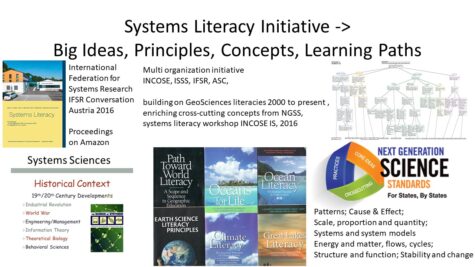
Literacy has been proposed as an understanding of a small number of pervasive principles appropriate to making informed personal and societal decisions.

  • Systems literacy includes an understanding of systems that influence you, and your influence on systems.

Peter Tuddenham has been leading an initiative on Systems Literacy across a variety of systems organizations, particularly with the International Society for the Systems Sciences, where he was president (2018-2019).

Peter joined Systems Thinking Ontario in conversation, to share his going work, with the College of Exploration.  He also invited participants to join in the monthly scheduled Cafe and Pub.

The video file is archived on the Internet Archive .

Video H.264 MP4
March 8
(1h26M
[20210308_ST-ON_SystemsLiteracy.m4v]
(4K UHD 1226kbps 840MB) [on the Internet Archive]

Audio downloadable onto mobile devices was also produced M4A.

Audio
March 8
(1h26m)
[20210308_ST-ON_SystemsLiteracy.m4a]
(79MB) [on the Internet Archive]

Open access versions of papers by Peter D. Tuddenham may be available on his ResearchGate page and/or his Academia.edu page.

This session was one in the Systems Thinking Ontario series.

Systems Literacy

Creative Systemic Research, Susu Nousala + Jelena Sucic (ST-ON 2021-02-08)

The Creative Systemic Research Platform (CSRP) Institute, led by Susu Nousala and Jelena Sucic, is distinctive in approaching systemic design from a bottom-up, longitudinal perspective.  The co-presidents were able to join us in conversation at a Systems Thinking Ontario session, remotely from Finland and Switzerland, at a significant time disadvantage.

Many approaches to systemic design presume a top-down, abstract predisposition of a world that might be.  The Creative Systemic approach emphasizes learning within communities towards the development of resilience.  Scholarly communities are nurtured at a local level, distributed across multiple peri-urban regional geographies.  The work of mapping and investigating emerging economies is informed by activities that include creative expression in social complexity that produces communal well-being.

  • Susu Nousala is a professor with the College of Design and Innovation, Tongji University, Shanghai (People’s Republic of China).  She has previously had research positions at Aalto University (Finland), University of Melbourne (Australia), and Chiang Mai University (Thailand).
  • Jelena Sucic is a researcher in systemic design and sustainable processes based in Switzerland.  She previously led as the field specialist and project manager in the nascent research group, as she completed a double degree in the PoliTong project, completing a Master of Fine Arts in Product Service Service Design at Tongi University, simultaneously with a Master of Science in Systemic Design at Politecnico di Torino.

For brevity, the usual circle of introduction was requested written in chat, rather as verbal self-introductions.  This meant that our featured speakers start just a few minutes into the web video . … Read more (in a new tab)

  • fediscience.org/@daviding (Mastodon)

    1. Loading Mastodon feed...
  • RSS feed: on IngBrief on IngBrief

    • 2026/01/07 | Rama Akkiraju | From LLMs to Living Systems: Applying Systems Science to Agentic AI in the Enterprise | HICSS-59 Keynote
      Abstract Enterprise AI is transitioning from simple single-LLM flows to complex agentic ecosystems—adaptive systems composed of multiple agents, tools, governed data, human workflows, and organizational policies. This keynote introduces a systems-science framework for designing and managing such ecosystems using principles of modularity, control, feedback, robustness, and socio-technical alignment. We illustrate these concepts through practical examples […]
    • Timothy F.H. Allen passed away on May 01, 2025
      Timothy F.H. Allen, president of International Society for the Systems Sciences 2008-2009, passed away peacefully in his home, surrounded by his family, on May 1, 2025. With his work on ecosystem ecology, I learned more about living systems than anyone else in the systems community. After his retirement, he was proud of putting together a […]
    • Installing WordPress Studio on Manjaro Linux
      In 2024, WordPress Studio was released, making installation on a local computer simpler. The instructions were modified from MacOS to Ubuntu Linux, by Daniel Kossmann, “How to install WordPress Studio in Ubuntu Linux” | Jun 15, 2024 at https://www.danielkossmann.com/how-to-install-wordpress-studio-ubuntu-linux/ I already had NVM installed, but in Terminal, with the result “command not found”. In the […]
    • Notion of Change in the Yijing | JeeLoo Lin 2017
      The appreciation of change is different in Western philosophy than in classical Chinese philosophy. JeeLoo Lin published a concise contrast on differences. Let me parse the Introduction to the journal article, that is so clearly written. A-theories divide time into past, present and future, and the point of reference is set at “the present.” B-theories, […]
    • World Hypotheses (Stephen C. Pepper) as a pluralist philosophy [Rescher, 1994]
      In trying to place the World Hypotheses work of Stephen C. Pepper (with multiple root metaphors), Nicholas Rescher provides a helpful positioning. — begin paste — Philosophical perspectivism maintains that substantive philosophical positions can be maintained only from a “perspective” of some sort. But what sort? Clearly different sorts of perspectives can be conceived of, […]
    • The Nature and Application of the Daodejing | Ames and Hall (2003)
      Ames and Hall (2003) provide some tips for those studyng the DaoDeJing.
  • Recent Posts

  • Archives

  • RSS feed: on daviding.com on daviding.com

    • 2026/10 Moments October 2026
      Dartmouth, Nova Scotia; Halifax, Nova Scotia; Lunenberg, Nova Scotia; Peggy’s Cove, Nova Scotia; Bible Hill, Nova Scotia; Louisbourg, Nova Scotia; Sydney, Nova Scotia; Baddeck, Nova Scotia; Toronto, Ontario Fraser’s Mills Fish Hatchery: Side trip to hatchery built in 1928 by provincial government, gravity-fed from South River. Water in pen dark, ripples at surface due to […]
    • 2026/09 Moments September 2026
      Vancouver BC; Toronto, Ontario, Burlington, Ontario; Shanghai PR China Serenade of the Seas: From the foredeck of level 12 of the Royal Caribbean Line ship, the panorama west to the Vancouver Convention Centres, turning to the north across Vancouver Harbour. Observed Princess Line ship leaving the dock, a departure we never experienced. Arrived for lunch, […]
    • 2026/08 Moments August 2026
      Toronto, Ontario; Vancouver BC Next Perfect Day Playlist: Korean Town Street Festival, 20260808 Night View O What A Shiny Night Honey Haneum Playlist: Korean Town Street Festival, 20260808 Happiness Prince of Jeju Ieodo Sana Seouje Sori Leida Lay Down Together Star North Sky Beautiful Country Encore Chris Fraser Trio | Meo | 2026-08-30: Nestled in […]
    • 2026/07 Moments July 2026
      Quiet summer mostly at home writing, taking breaks to meet with friends, and exercise on bike rides.
    • 2026/06 Moments June 2026
      Cool summer catching up with family and friends, music festivals
    • 2026/05 Moments May 2026
      Cool spring, busy with Jane's Walk, bathroom renovation, closing out father's apartment, OCADU GradEx, Problematique Dialogue applying the Banathy Conversation Methodology, Qingming.
  • RSS feed: on Media Queue on Media Queue

  • Meta

  • Creative Commons License
    This work is licensed under a Creative Commons Attribution-NonCommercial-ShareAlike 4.0 International License
    Theme modified from DevDmBootstrap4 by Danny Machal