
Coevolving Innovations

… in Business Organizations and Information Technologies

Currently Viewing Posts Tagged socio-technical

Reifying Socio-Technical and Socio-Ecological Perspectives for Systems Changes | STPIS | 2024-08-16

The Socio-Technical Systems (STS) perspective, dating back to the studies of Eric L. Trist and Fred E. Emery, was on the reading list of organizational behaviour classes in my undergraduate and master’s degree programs.  It wasn’t until 15 years later, when I got involved with the systems sciences and David L. Hawk, that the Socio-Ecological Systems (SES) perspective became more prominent in my worldview.  This emphasis is likely true for most audiences, where Socio-Technical is prominent, and Socio-Ecological is in the background or out of mind.

For the 10th International Conference on Socio-Technical Perspectives in Information Systems (STPIS’24) scheduled in Jönköping, Sweden, for mid-August,  I was invited to contribute a paper,   My travel plans didn’t take me to the Nordics this summer, so the organizers scheduled me for a remote online presentation.

Since the STPIS workshop has official proceedings, my thinking was mostly on completing a manuscript, that is available as a preprint.   The manuscript reviews the Trist and Emery histories, and then gets philosophical in proposing a shift from mainstream principles into a process-first approach regrounded with a postocolonial bridge to Classical Chinese foundations.  My concern on the short presentation was getting a message across to workshop attendees, with only a short slot.  My colleague Peter Bednar reported what I couldn’t see online.

Dear David, thank you for your amazing and thorough presentation. It was interesting, and deep. I always learn something from your stuff.

… Read more (in a new tab)

The Socio-Technical Systems (STS) perspective, dating back to the studies of Eric L. Trist and Fred E. Emery, was on the reading list of organizational behaviour classes in my undergraduate and master’s degree programs.  It wasn’t until 15 years later, when I got involved with the systems sciences and David L. Hawk, that the Socio-Ecological Systems (SES) perspective became more prominent in my worldview.  This emphasis is likely true for most audiences, where Socio-Technical is prominent, and Socio-Ecological is in the background or out of mind.

For the 10th International Conference on Socio-Technical Perspectives in Information Systems (STPIS’24) scheduled in Jönköping, Sweden, for mid-August,  I was invited to contribute a paper,   My travel plans didn’t take me to the Nordics this summer, so the organizers scheduled me for a remote online presentation.

Since the STPIS workshop has official proceedings, my thinking was mostly on completing a manuscript, that is available as a preprint.   The manuscript reviews the Trist and Emery histories, and then gets philosophical in proposing a shift from mainstream principles into a process-first approach regrounded with a postocolonial bridge to Classical Chinese foundations.  My concern on the short presentation was getting a message across to workshop attendees, with only a short slot.  My colleague Peter Bednar reported what I couldn’t see online.

Dear David, thank you for your amazing and thorough presentation. It was interesting, and deep. I always learn something from your stuff.

… Read more (in a new tab)

Sciencing and Philosophizing on Threads in Systems Thinking | Gary S. Metcalf + David Ing | Systems Thinking Ontario 2023-07-10

Digging into philosophies underlying the systems sciences, pragmatism seems to have been a strong historical foundation for some research streams. In ongoing discussions, Gary Metcalf and I have been approaching pragmatism from two directions. Gary has been tracking from mid-1800s forward, listening to the audiobook The Metaphysical Club, with a history of figures living through the American Civil War, seeking alternative approaches to the British and continental European ideas. I have been working backwards on two streams.  (1) West Churchman and Russell Ackoff were students of Edgar A. Singer Jr., who was a father of a pragmatic school of thought at the University of Pennsylvania, having previously taught with William James at Harvard University.  (2) Eric Trist and Fred Emery, in the development of the Socio-Ecological Systems perspective, track back to Stephen C. Pepper, who studied under Ralph Barton Perry, an associate of William James who is recognized for anthologizing and clarifying James’ writing.

The ISSS Kruger Park 2023 meeting was an opportunity for us to share our work in progress.  Tracing the institutional lineages of some of the key figures of interest shows periods when the philosophers and systems scientists had formal appointments to the same places.

Institutional lineages of key figures in systems sciences and pragmatism

Notable institions include Harvard U., U. Pennsylvania, and the Tavistock Institute for Human Relations.  The many decades give a sense of the time scales (e.g. Pepper arrived at U.C. Berkeley much before Churchman; Trist and Emery were together at Tavistock, and visited Ackoff at U.… Read more (in a new tab)

Humanistic Principles and Social Systems Design | Douglas Austrom + Carolyn Ordowich (ST-ON 2021-05-10)

Douglas Austrom and Carolyn Ordowich shared some reflections developed jointly with Bert Painter (Vancouver, BC) on some draft humanistic principles, the three Tavistock perspectives, and a meta-methodology with Systems Thinking Ontario.

Proponents of Socio-Technical Systems design refer back to the 1960s-1980s research of Fred Emery and Eric Trist of the Tavistock Institute. Calls to reinvent approaches to organization design for hyper-turbulent environments may be better viewed through the whole systems view of three perspective for sensemaking:

  • social-psychological systems;
  • socio-technical systems; and
  • socio-ecological systems.

Those who live and work in a given social system should be given the voice and and choice in designing their system. Calvin Pava’s notion of deliberation design applies not only to non-linear knowledge work. It can serve as a meta-methodology for dialogic design of organizations, networks and ecosystems. The role of designers shifts from designing the social system itself, to co-designing the deliberations by which key stakeholders can dynamically design their own systems.

This video has been archived on the Internet Archive .

Video H.264 MP4
May 10
(1h50m)
[20210510_ST-ON_HumanisticSocialSystemsDesign.m4v]
(FHD 1431kbps 1.2GB) [on the Internet Archive]

Audio downloadable onto mobile devices was transcoded from the video into MP3.

Audio
May 10
(1h50m)
[20210510_ST-ON_HumanisticSocialSystemsDesign.mp3]
(38MB) [on the Internet Archive]

Doug Austrom has four decades of consulting experience, having co-founded three change consultancies: Turning Point Associates, Adjutant Solutions Group, and People Powered Innovation Labs. He is an adjunct professor with Indiana University’s online MBA program, Kelly Direct.… Read more (in a new tab)

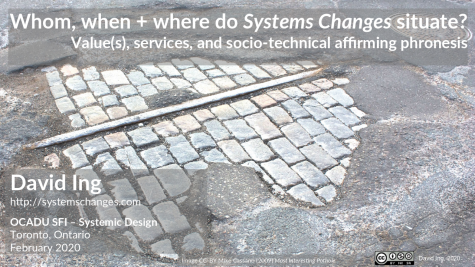
Whom, when + where do Systems Changes situate?

Covering practical wisdom (phronesis), the third of four lectures again was compressed for the Systemic Design course in the Master’s program in Strategic Foresight and Innovation at OCAD University. The students in the part-time session on February 7 extended their discussion period longer than those in the full-time session on February 5. I again jumped slides in the sequence to stay within the timebox.

The agenda was in four sections:

  • [preamble] Episteme, Techne, Phronesis (reordered)
    • Intellectual Pursuits (Rethinking Systems Thinking)
    • Systems changes as situated c.f. ideal-seeking
  • A. Value(s), Judgment, Soft Systems Thinking
    • Appreciative Systems (Vickers, Checkland)
    • Policy, impacts and consequences of systems changes
  • B. Service Systems (c.f. Production Systems)
    • Science of Service Systems (Spohrer, Kijima)
    • Material-products c.f. information-services as systems changes
  • C. Socio-Technical Systems Perspective
    • Tavistock Institute + Legacy (Trist, Emery, Ramirez)
    • Coproduction and design principles guiding systems changes

The web video can be streamed on Youtube.

Copies of the video files are downloadable for disconnected viewing.

Video H.264 MP4 WebM
February 7
(1h21m)
[20200207_OCADU_Ing HD m4v]
(HD 2477kbps 1.6GB)
[20200207_OCADU_Ing nHD m4v]
(nHD 1344kps 866MB)
[20200207_OCADU_Ing HD webm]
(HD VP8 375kbps 349MB)
[20200207_OCADU_Ing nHD webm]
(nHD VP8 139kbps 206MB)

Readers who want to follow through on web link references may want to review the slides directly.

Whom, when + where do Systems Changes situated?

The same presentation slides were used for both lectures.  The questions from the students were considerably different across the class sections, so the diligent listener might want to compare them. … Read more (in a new tab)

Revisiting the Socio-Ecological, Social-Technical and Socio-Psychological Systems Perspectives

A report, plus a contributed article, on the socio-ecological, socio-technical and socio-psychological systems perspectives is now available.

The Tavistock Institute for Human Relations, from the 1950s through the 1980s, developed a legacy of research based in systems thinking that has had lasting impact on theories of organization design and change.  The International Federation for Systems Research biannually hosts a conversation event in Austria where systems researchers have the luxury of time to share in mutual learning.  A trigger question for a team was proposed:

  • In which ways is the Tavistock legacy still relevant, and which ways might these ideas be advanced and/or refreshed (for the globalized/service economy)?

Pointers to some of the relevant literature were provided.  Joining the team, at Linz, were:

Minna Takala led the development of the team report for the proceedings, as well as contributing an independent article extending learnings from the group.  An excerpt of these two publications is a repackaging from the full proceedings that comprise the work of four teams meeting in parallel.

Socio-Technical-Systems, Sustainable Work, Open Systems Theory

I’ve received news about an Aalto University course on  “Socio-Technical Systems Paradigm: History and Further Developments” [see pdf], led by Frans M. van Eijnatten (Eindhoven University of Technology) and Mari Kira (Academy Research Fellow at sustain.tkk.fi), scheduled  for September 27-28 in Espoo, Finland.

The course is associated with the Sustain Research Program that “focuses on creating sustainable work in contemporary working life”.  I also noticed a book on Creating sustainable work systems:  developing social sustainability, edited by Peter Docherty, Mari Kira and Abraham B. Shani (Taylor & Francis 2008) [preview at Google Books].

We would seem to be at the leading edge of research with this topic.  Since I’m active in the systems community, I was intrigued by a reference to an article in 2008 article in Systems Research and Behavioral Science by Mari Kira, and Frans M. van Eijnatten, “Socially sustainable work organizations: A chaordic systems approach”.

This 2008 article has led to a yet-to-be-printed (in 2010) SRBS research note by Merrelyn Emery, “Refutation of Kira & van Eijnatten’s critique of the Emery’s open systems theory” [available in early release].  She points out that the Emery variant of Open Systems Theory (OST) comes with a history of divergence in Social-Technical Systems (STS) thinking.  Emery cites continuing work with OST in a 2007 chapter by Emery and DeGuerre “Evolution of Open Systems Theory” [preview at Google Books in The change handbook:
the definitive resource on today’s best methods for engaging whole systems
, (Peggy Holman, Tom Devane, Steven Cady, editors)].… Read more (in a new tab)

  • fediscience.org/@daviding (Mastodon)

    1. Loading Mastodon feed...
  • RSS feed: on IngBrief on IngBrief

    • 2026/01/07 | Rama Akkiraju | From LLMs to Living Systems: Applying Systems Science to Agentic AI in the Enterprise | HICSS-59 Keynote
      Abstract Enterprise AI is transitioning from simple single-LLM flows to complex agentic ecosystems—adaptive systems composed of multiple agents, tools, governed data, human workflows, and organizational policies. This keynote introduces a systems-science framework for designing and managing such ecosystems using principles of modularity, control, feedback, robustness, and socio-technical alignment. We illustrate these concepts through practical examples […]
    • Timothy F.H. Allen passed away on May 01, 2025
      Timothy F.H. Allen, president of International Society for the Systems Sciences 2008-2009, passed away peacefully in his home, surrounded by his family, on May 1, 2025. With his work on ecosystem ecology, I learned more about living systems than anyone else in the systems community. After his retirement, he was proud of putting together a […]
    • Installing WordPress Studio on Manjaro Linux
      In 2024, WordPress Studio was released, making installation on a local computer simpler. The instructions were modified from MacOS to Ubuntu Linux, by Daniel Kossmann, “How to install WordPress Studio in Ubuntu Linux” | Jun 15, 2024 at https://www.danielkossmann.com/how-to-install-wordpress-studio-ubuntu-linux/ I already had NVM installed, but in Terminal, with the result “command not found”. In the […]
    • Notion of Change in the Yijing | JeeLoo Lin 2017
      The appreciation of change is different in Western philosophy than in classical Chinese philosophy. JeeLoo Lin published a concise contrast on differences. Let me parse the Introduction to the journal article, that is so clearly written. A-theories divide time into past, present and future, and the point of reference is set at “the present.” B-theories, […]
    • World Hypotheses (Stephen C. Pepper) as a pluralist philosophy [Rescher, 1994]
      In trying to place the World Hypotheses work of Stephen C. Pepper (with multiple root metaphors), Nicholas Rescher provides a helpful positioning. — begin paste — Philosophical perspectivism maintains that substantive philosophical positions can be maintained only from a “perspective” of some sort. But what sort? Clearly different sorts of perspectives can be conceived of, […]
    • The Nature and Application of the Daodejing | Ames and Hall (2003)
      Ames and Hall (2003) provide some tips for those studyng the DaoDeJing.
  • Recent Posts

  • Archives

  • RSS feed: on daviding.com on daviding.com

    • 2026/10 Moments October 2026
      Dartmouth, Nova Scotia; Halifax, Nova Scotia; Lunenberg, Nova Scotia; Peggy’s Cove, Nova Scotia; Bible Hill, Nova Scotia; Louisbourg, Nova Scotia; Sydney, Nova Scotia; Baddeck, Nova Scotia; Toronto, Ontario Fraser’s Mills Fish Hatchery: Side trip to hatchery built in 1928 by provincial government, gravity-fed from South River. Water in pen dark, ripples at surface due to […]
    • 2026/09 Moments September 2026
      Vancouver BC; Toronto, Ontario, Burlington, Ontario; Shanghai PR China Serenade of the Seas: From the foredeck of level 12 of the Royal Caribbean Line ship, the panorama west to the Vancouver Convention Centres, turning to the north across Vancouver Harbour. Observed Princess Line ship leaving the dock, a departure we never experienced. Arrived for lunch, […]
    • 2026/08 Moments August 2026
      Toronto, Ontario; Vancouver BC Next Perfect Day Playlist: Korean Town Street Festival, 20260808 Night View O What A Shiny Night Honey Haneum Playlist: Korean Town Street Festival, 20260808 Happiness Prince of Jeju Ieodo Sana Seouje Sori Leida Lay Down Together Star North Sky Beautiful Country Encore Chris Fraser Trio | Meo | 2026-08-30: Nestled in […]
    • 2026/07 Moments July 2026
      Quiet summer mostly at home writing, taking breaks to meet with friends, and exercise on bike rides.
    • 2026/06 Moments June 2026
      Cool summer catching up with family and friends, music festivals
    • 2026/05 Moments May 2026
      Cool spring, busy with Jane's Walk, bathroom renovation, closing out father's apartment, OCADU GradEx, Problematique Dialogue applying the Banathy Conversation Methodology, Qingming.
  • RSS feed: on Media Queue on Media Queue

  • Meta

  • Creative Commons License
    This work is licensed under a Creative Commons Attribution-NonCommercial-ShareAlike 4.0 International License
    Theme modified from DevDmBootstrap4 by Danny Machal