
Coevolving Innovations

… in Business Organizations and Information Technologies

I am happier than 98% of people who take the Authentic Happiness Inventory Questionnaire

The Focus section of the Globe & Mail newspaper this past weekend centered on happiness. The Authentic Happiness Inventory Questionnaire, developed five years ago by Christopher Peterson (from the U. of Michigan) was reproduced as 24 questions in the newspaper. Matthew Trevisan reports that …

thousands of people have taken the test online, with an average score of 3.24 out of five. Pretty good, considering that most of the people who take it are what Prof. Peterson calls “seekers.”

“I mean, if you are happy as a clam, why the heck would you go to a positive psychology survey?”

Well, I’m a researcher, so I was just curious as to how I would score. Since I hate doing arithmetic, I found that the questionnaire is available on a University of Pennsylvania site by Martin Seligman. (You can register a userid there, to add to the statistics, and take the test). It turns out that I score 4.33, on a 5-point scale.
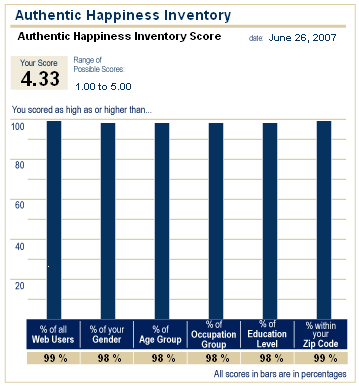
Authentic Happiness Inventory, David Ing

This puts me in a position better than 98% of people taking the test, in every category. But what does this mean?

In a 2003 newsletter by Seligman and Royzman is the most concise description of Authentic Happiness.

Our theory holds that there are three distinct kinds of happiness:

  • the Pleasant Life (pleasures),
  • the Good Life (engagement),
  • and the Meaningful Life.

The first two are subjective, but the third is at least partly objective and lodges in belonging to and serving what is larger and more worthwhile than the just the self’s pleasures and desires.

In this way, Authentic Happiness synthesizes all three traditions:

  • The Pleasant Life is about happiness in Hedonism’s sense.
  • The Good Life is about happiness in Desire’s sense, and
  • the Meaningful Life is about happiness in Objective List’s sense.

To top it off, Authentic Happiness further allows for the “Full Life,” a life that satisfies all three criteria of happiness.

Reading the full article, (a) I have more pleasure than pain in my life — maybe from a happy childhood in Muskoka, and now a good lifestyle living in Toronto; (b) I’m “getting what I want” out of life (which is clearly subjective, and not necessarily what others might like); and (c) I feel that I’m objectively making a difference in the world, both in my day job and in my private life.

The newpaper feature took a larger perspective on happiness. Mark Kingwell wrote about how happiness isn’t particularly well analyzed by economists, reinforcing its reputation as the dismal science. Embedded in another story by Charles Montgomery on the “urban happiness movement in Bogota”, the change in the city resulting from the efforts of ex-mayor Enrique Peñalosa were reviewed.

So what makes societies happy? The past decade has seen an explosion in research aiming to answer that question, and there’s good news for people in places like Bogota: Feelings of well-being are determined as much by status and social connectedness as by income. Richer people are happier than poor people, but societies with wider income gaps are less happy on the whole. People who interact more with friends, family and neighbours are happier than those who don’t.

And what makes people most unhappy? Not work, but commuting to work.

These are the concepts that guided Mr. Peñalosa’s car-bashing campaign.

“There are a few things we can agree on about happiness,” he says. “You need to fulfill your potential as a human being. You need to walk. You need to be with other people. Most of all, you need to not feel inferior. When you talk about these things, designing a city can be a very powerful means to generate happiness.”

The full article makes me want to visit Bogota (or maybe influence planning a conference there).

Mr. Peñalosa offers an eager “Como le va?” – how’s it going – to a pair of dust-caked labourers cruising past on the bike path. He is clearly campaigning: Every commute is a chance to remind Bogotans that their bike routes were his idea, and their parks his doing. But he is also a preacher spreading the word.

“See those guys? Before, cyclists were seen as just a nuisance. They were the poorest of the poor,” he says. “Now, they have respect. So bikeways are important … [because] they show that a citizen on a $30 bike is equally important to someone driving in a $30,000 car.”

This principle of equity led him to hand road space over to public transit and pedestrian areas – a way of making private space public again.

So, not having a regular commute to an office since the early 1990s has been a good contributor to my happiness. What would make me happier? Well, I’m not spending enough time riding my bicycles!

3 Comments

  • Could it be that people who normally take such tests are miserable?! I’m sure the method will have factored that out though …..

  • The math must include the top two percentiles in the error range. I don’t beluieve there is a happier person living.

  • I like the precision of Csikszentmihalyi’s Flow concept as a way to define Bliss/happiness. Optimal experience requires flow..without flow [psychological] entropy ensues.

    If you have not read his books…to follow the FLOW (pun intended) start at:

    http://en.wikipedia.org/wiki/Flow_(psychology)


Leave a Reply

Your email address will not be published. Required fields are marked *

  • fediscience.org/@daviding (Mastodon)

    1. Loading Mastodon feed...
  • RSS feed: on IngBrief on IngBrief

    • 2026/01/07 | Rama Akkiraju | From LLMs to Living Systems: Applying Systems Science to Agentic AI in the Enterprise | HICSS-59 Keynote
      Abstract Enterprise AI is transitioning from simple single-LLM flows to complex agentic ecosystems—adaptive systems composed of multiple agents, tools, governed data, human workflows, and organizational policies. This keynote introduces a systems-science framework for designing and managing such ecosystems using principles of modularity, control, feedback, robustness, and socio-technical alignment. We illustrate these concepts through practical examples […]
    • Timothy F.H. Allen passed away on May 01, 2025
      Timothy F.H. Allen, president of International Society for the Systems Sciences 2008-2009, passed away peacefully in his home, surrounded by his family, on May 1, 2025. With his work on ecosystem ecology, I learned more about living systems than anyone else in the systems community. After his retirement, he was proud of putting together a […]
    • Installing WordPress Studio on Manjaro Linux
      In 2024, WordPress Studio was released, making installation on a local computer simpler. The instructions were modified from MacOS to Ubuntu Linux, by Daniel Kossmann, “How to install WordPress Studio in Ubuntu Linux” | Jun 15, 2024 at https://www.danielkossmann.com/how-to-install-wordpress-studio-ubuntu-linux/ I already had NVM installed, but in Terminal, with the result “command not found”. In the […]
    • Notion of Change in the Yijing | JeeLoo Lin 2017
      The appreciation of change is different in Western philosophy than in classical Chinese philosophy. JeeLoo Lin published a concise contrast on differences. Let me parse the Introduction to the journal article, that is so clearly written. A-theories divide time into past, present and future, and the point of reference is set at “the present.” B-theories, […]
    • World Hypotheses (Stephen C. Pepper) as a pluralist philosophy [Rescher, 1994]
      In trying to place the World Hypotheses work of Stephen C. Pepper (with multiple root metaphors), Nicholas Rescher provides a helpful positioning. — begin paste — Philosophical perspectivism maintains that substantive philosophical positions can be maintained only from a “perspective” of some sort. But what sort? Clearly different sorts of perspectives can be conceived of, […]
    • The Nature and Application of the Daodejing | Ames and Hall (2003)
      Ames and Hall (2003) provide some tips for those studyng the DaoDeJing.
  • Recent Posts

  • Archives

  • RSS feed: on daviding.com on daviding.com

    • 2026/10 Moments October 2026
      Dartmouth, Nova Scotia; Halifax, Nova Scotia; Lunenberg, Nova Scotia; Peggy’s Cove, Nova Scotia; Bible Hill, Nova Scotia; Louisbourg, Nova Scotia; Sydney, Nova Scotia; Baddeck, Nova Scotia; Toronto, Ontario Fraser’s Mills Fish Hatchery: Side trip to hatchery built in 1928 by provincial government, gravity-fed from South River. Water in pen dark, ripples at surface due to […]
    • 2026/09 Moments September 2026
      Vancouver BC; Toronto, Ontario, Burlington, Ontario; Shanghai PR China Serenade of the Seas: From the foredeck of level 12 of the Royal Caribbean Line ship, the panorama west to the Vancouver Convention Centres, turning to the north across Vancouver Harbour. Observed Princess Line ship leaving the dock, a departure we never experienced. Arrived for lunch, […]
    • 2026/08 Moments August 2026
      Toronto, Ontario; Vancouver BC Next Perfect Day Playlist: Korean Town Street Festival, 20260808 Night View O What A Shiny Night Honey Haneum Playlist: Korean Town Street Festival, 20260808 Happiness Prince of Jeju Ieodo Sana Seouje Sori Leida Lay Down Together Star North Sky Beautiful Country Encore Chris Fraser Trio | Meo | 2026-08-30: Nestled in […]
    • 2026/07 Moments July 2026
      Quiet summer mostly at home writing, taking breaks to meet with friends, and exercise on bike rides.
    • 2026/06 Moments June 2026
      Cool summer catching up with family and friends, music festivals
    • 2026/05 Moments May 2026
      Cool spring, busy with Jane's Walk, bathroom renovation, closing out father's apartment, OCADU GradEx, Problematique Dialogue applying the Banathy Conversation Methodology, Qingming.
  • RSS feed: on Media Queue on Media Queue

  • Meta

  • Creative Commons License
    This work is licensed under a Creative Commons Attribution-NonCommercial-ShareAlike 4.0 International License
    Theme modified from DevDmBootstrap4 by Danny Machal