
Coevolving Innovations

… in Business Organizations and Information Technologies

Patterns and Pattern Languages Supporting Cross-boundary Collaboration | Doug Schuler (ST-ON 2021-04-12)

Doug Schuler joined the monthly Systems Thinking Ontario meeting for a conversation about the potential for patterns and pattern languages to help address wicked problems on a large scale, via technology, loose coordination, and social commitments.

Doug was exposed to the original A Pattern Language in the mid-1970s. It aimed to generate towns and buildings that would be alive and life-affirming. That framework and perspective served to orient and structure collaboration under the auspices of Computer Professionals for Social Responsibility (CPSR). The Directions and Implications of Advanced Computing conference in 2001 attracted over 100 pattern proposals. These were ultimately transformed into the Liberating Voices pattern language containing 136 patterns by 75 authors. This body of work is available online and in a book published by MIT Press in 2008.

This pattern language addresses collaboration and civic intelligence, a critical under-developed resource necessary for democratic societies and public problem solving. Doug has led workshops in his teaching at the Evergreen State College, and with community groups designing actions and projects, around the world.

The video file is archived on the Internet Archive .

Video H.264 MP4
April 12
(1h50m)
[220210412_ST-ON_PatternLanguages.m4v]
(FHD 15936kbps 1.33GB) [on the Internet Archive]

Audio playable onto mobile devices was transcoded to MP3 from the video.

Audio
April 12
(1h50m)
[20210412_ST-ON_PatternLanguages.mp3]
(40MB) [on the Internet Archive]

Douglas Schuler is currently chair of ACM SIGCAS and president of the Public Sphere Project as a non-profit organization in the State of Washington.… Read more (in a new tab)
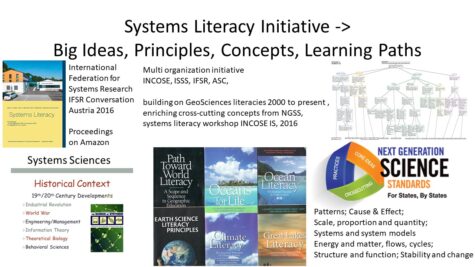
Coexploring Systems Literacy, Peter Tuddenham (ST-ON 2021-03-08)

Literacy has been proposed as an understanding of a small number of pervasive principles appropriate to making informed personal and societal decisions.

  • Systems literacy includes an understanding of systems that influence you, and your influence on systems.

Peter Tuddenham has been leading an initiative on Systems Literacy across a variety of systems organizations, particularly with the International Society for the Systems Sciences, where he was president (2018-2019).

Peter joined Systems Thinking Ontario in conversation, to share his going work, with the College of Exploration.  He also invited participants to join in the monthly scheduled Cafe and Pub.

The video file is archived on the Internet Archive .

Video H.264 MP4
March 8
(1h26M
[20210308_ST-ON_SystemsLiteracy.m4v]
(4K UHD 1226kbps 840MB) [on the Internet Archive]

Audio downloadable onto mobile devices was also produced M4A.

Audio
March 8
(1h26m)
[20210308_ST-ON_SystemsLiteracy.m4a]
(79MB) [on the Internet Archive]

Open access versions of papers by Peter D. Tuddenham may be available on his ResearchGate page and/or his Academia.edu page.

This session was one in the Systems Thinking Ontario series.

Systems Literacy

Creative Systemic Research, Susu Nousala + Jelena Sucic (ST-ON 2021-02-08)

The Creative Systemic Research Platform (CSRP) Institute, led by Susu Nousala and Jelena Sucic, is distinctive in approaching systemic design from a bottom-up, longitudinal perspective.  The co-presidents were able to join us in conversation at a Systems Thinking Ontario session, remotely from Finland and Switzerland, at a significant time disadvantage.

Many approaches to systemic design presume a top-down, abstract predisposition of a world that might be.  The Creative Systemic approach emphasizes learning within communities towards the development of resilience.  Scholarly communities are nurtured at a local level, distributed across multiple peri-urban regional geographies.  The work of mapping and investigating emerging economies is informed by activities that include creative expression in social complexity that produces communal well-being.

  • Susu Nousala is a professor with the College of Design and Innovation, Tongji University, Shanghai (People’s Republic of China).  She has previously had research positions at Aalto University (Finland), University of Melbourne (Australia), and Chiang Mai University (Thailand).
  • Jelena Sucic is a researcher in systemic design and sustainable processes based in Switzerland.  She previously led as the field specialist and project manager in the nascent research group, as she completed a double degree in the PoliTong project, completing a Master of Fine Arts in Product Service Service Design at Tongi University, simultaneously with a Master of Science in Systemic Design at Politecnico di Torino.

For brevity, the usual circle of introduction was requested written in chat, rather as verbal self-introductions.  This meant that our featured speakers start just a few minutes into the web video . … Read more (in a new tab)

The Systems Movement: Engaging Communities with Traditions and Diversity, Gary S. Metcalf (ST-ON 2021-01-11)

To appreciate how systemicists worldwide collaborate, Gary S. Metcalf joined Systems Thinking Ontario for a conversation.  Gary served as president of the International Society for the Systems Sciences 2007-2008, and of the International Federation for Sysrtems Research 2010-2016.  From 2003 to 2018, he was a graduate instructor in Organizational Systems and Research on the faculty of Saybrook University.

The Systems Movement “may be characterized as a loose association of people from different disciplines of science, engineering, philosophy, and other areas, who share a common interest in ideas (concepts, principles, methods, etc.) that are applicable to all systems and that, consequently, transcend the boundaries between traditional disciplines.” (George Klir, Facets of Systems Science, 2001).

After the standard round of introductions, the conversation began with Gary speaking a little about his background, and how he came to the systems community after graduate studies in family therapy (in the web video, at about 22m42s in).  Participants were invited to ask questions and make comments freely.

The video file are archived on the Internet Archive .

Video H.264 MP4
January 11
(2h04m)
[20210111_ST-ON_GarySMetcalf.m4v]
(nHD 281kbps 366MB) [on the Internet Archive]

For those who prefer digital audio on mobile devices, the audio was extracted as M4A from the video.

Audio
January 11
(2h04m)
[20210111_ST-ON_GarySMetcalf.m4a]
(113MB)

Since this talk, Gary has added to his writing and editing scholarly non-fiction works, with a new direction in science fiction. … Read more (in a new tab)

Redesigning Our Theories of Theories of Change, Peter H Jones + Ryan J A Murphy (ST-ON 2020/11/19)

While the term “theory of change” is often used by funders expecting an outcome of systems change for their investment, is there really a theory there?

The November 2020 Systems Thinking Ontario session was an opportunity for Peter H. Jones (OCADU) and Ryan J. A. Murphy (Memorial U. of Newfoundland) to extend talks that they had given over a few days for the Relating Systems Thinking and Design (RSD9) Symposium.

The talks covered some early research and conversation on deepening the understanding of “theories of change”.  After our usual round of self-introductions by meeting attendees, the core content starts in the web video recording after 12m45s.

The video file is also viewable and downloadable at the Internet Archive,

Video H.264 MP4
November 9
(1h56m)
[20201109_ST-ON_Jones_Murphy_TheoriesOfTheoriesOfChange.m4v]
(FHD 203kbps 276MB) [on archive.org]

The digital audio was extracted from the video, and transcoded to MP3.

Audio
November 9
(1h56m)
[20201109_ST-ON_Jones_Murphy_TheoriesOfTheoriesOfChange.mp3]
(40MB) [on archive.org]

Here is the original abstract from the Systems Thinking Ontario November 9, 2020, session.

— begin paste —

Redesigning Our Theories of Theories of Change

Peter Jones presents a customized talk from the RSD9 plenary session for ST ON. Ryan Murphy joins with a full presentation of his RSD9 talk.

We often use the model of “theories of change” to argue for the process by which envisioned change programs might achieve their goals. Essentially these are the working theories by which we explain the logic of system change outcomes, and we often include quasi-systemic logic models to communicate them.… Read more (in a new tab)

Learning With Humility: Systems Thinking and Reordering Priorities (Global Change Days, 2020/10/22)

For the third of three workshops by the Systems Changes Learning Circle in October 2020, Kelly Okamura, Dan Eng and Joanne Dong led a Beacon Event for Global Change Days.

This session was one in a series for global changemakers.  Our expectation was that they would be hands-on practitioners, with relatively low familiarity with systems thinking methods and theory.

The workshop orientations were relatively short, with most of the time dedicated to two breakout periods.   In the web video, the plenary discussions and group readouts are included, with the parallel breakout conversations omitted.

The video file is accessible on the Internet Archive, should viewers want a downloadable version.

Video H.264 MP4
October 22
(58m20s)
[20201022_GCD_LearningWithHumilityReorderingOurPriorities.m4v]
(FWVGA 515kbps 298MB) [on the Internet Archive]

The digital audio is available as MP3 for those with mobile players.

Audio
October 22
(58m20s)
[20201022_GCD_LearningWithHumilityReorderingOurPriorities.mp3]
(54MB)

Here is the original description for the session.

— begin paste —

This interactive beacon session will engage change makers to think differently, to explore their relationship to learning.

The breakout sessions will provide participants an opportunity to explore the Systems Thinking questions: the urgent vs the important, the local vs. the distant, problem solving vs history-making. Finally the audience will be invited to review their self-reflections and the potential re-ordering of their priorities, to make a difference.

— end paste —

Workshop attendees were quite engaged with the challenge of making distinctions that we’ve been discussing within the Systems Changes Learning Circle. … Read more (in a new tab)

  • fediscience.org/@daviding (Mastodon)

    1. Loading Mastodon feed...
  • RSS feed: on IngBrief on IngBrief

    • 2026/01/07 | Rama Akkiraju | From LLMs to Living Systems: Applying Systems Science to Agentic AI in the Enterprise | HICSS-59 Keynote
      Abstract Enterprise AI is transitioning from simple single-LLM flows to complex agentic ecosystems—adaptive systems composed of multiple agents, tools, governed data, human workflows, and organizational policies. This keynote introduces a systems-science framework for designing and managing such ecosystems using principles of modularity, control, feedback, robustness, and socio-technical alignment. We illustrate these concepts through practical examples […]
    • Timothy F.H. Allen passed away on May 01, 2025
      Timothy F.H. Allen, president of International Society for the Systems Sciences 2008-2009, passed away peacefully in his home, surrounded by his family, on May 1, 2025. With his work on ecosystem ecology, I learned more about living systems than anyone else in the systems community. After his retirement, he was proud of putting together a […]
    • Installing WordPress Studio on Manjaro Linux
      In 2024, WordPress Studio was released, making installation on a local computer simpler. The instructions were modified from MacOS to Ubuntu Linux, by Daniel Kossmann, “How to install WordPress Studio in Ubuntu Linux” | Jun 15, 2024 at https://www.danielkossmann.com/how-to-install-wordpress-studio-ubuntu-linux/ I already had NVM installed, but in Terminal, with the result “command not found”. In the […]
    • Notion of Change in the Yijing | JeeLoo Lin 2017
      The appreciation of change is different in Western philosophy than in classical Chinese philosophy. JeeLoo Lin published a concise contrast on differences. Let me parse the Introduction to the journal article, that is so clearly written. A-theories divide time into past, present and future, and the point of reference is set at “the present.” B-theories, […]
    • World Hypotheses (Stephen C. Pepper) as a pluralist philosophy [Rescher, 1994]
      In trying to place the World Hypotheses work of Stephen C. Pepper (with multiple root metaphors), Nicholas Rescher provides a helpful positioning. — begin paste — Philosophical perspectivism maintains that substantive philosophical positions can be maintained only from a “perspective” of some sort. But what sort? Clearly different sorts of perspectives can be conceived of, […]
    • The Nature and Application of the Daodejing | Ames and Hall (2003)
      Ames and Hall (2003) provide some tips for those studyng the DaoDeJing.
  • Recent Posts

  • Archives

  • RSS feed: on daviding.com on daviding.com

    • 2026/10 Moments October 2026
      Dartmouth, Nova Scotia; Halifax, Nova Scotia; Lunenberg, Nova Scotia; Peggy’s Cove, Nova Scotia; Bible Hill, Nova Scotia; Louisbourg, Nova Scotia; Sydney, Nova Scotia; Baddeck, Nova Scotia; Toronto, Ontario Fraser’s Mills Fish Hatchery: Side trip to hatchery built in 1928 by provincial government, gravity-fed from South River. Water in pen dark, ripples at surface due to […]
    • 2026/09 Moments September 2026
      Vancouver BC; Toronto, Ontario, Burlington, Ontario; Shanghai PR China Serenade of the Seas: From the foredeck of level 12 of the Royal Caribbean Line ship, the panorama west to the Vancouver Convention Centres, turning to the north across Vancouver Harbour. Observed Princess Line ship leaving the dock, a departure we never experienced. Arrived for lunch, […]
    • 2026/08 Moments August 2026
      Toronto, Ontario; Vancouver BC Next Perfect Day Playlist: Korean Town Street Festival, 20260808 Night View O What A Shiny Night Honey Haneum Playlist: Korean Town Street Festival, 20260808 Happiness Prince of Jeju Ieodo Sana Seouje Sori Leida Lay Down Together Star North Sky Beautiful Country Encore Chris Fraser Trio | Meo | 2026-08-30: Nestled in […]
    • 2026/07 Moments July 2026
      Quiet summer mostly at home writing, taking breaks to meet with friends, and exercise on bike rides.
    • 2026/06 Moments June 2026
      Cool summer catching up with family and friends, music festivals
    • 2026/05 Moments May 2026
      Cool spring, busy with Jane's Walk, bathroom renovation, closing out father's apartment, OCADU GradEx, Problematique Dialogue applying the Banathy Conversation Methodology, Qingming.
  • RSS feed: on Media Queue on Media Queue

  • Meta

  • Creative Commons License
    This work is licensed under a Creative Commons Attribution-NonCommercial-ShareAlike 4.0 International License
    Theme modified from DevDmBootstrap4 by Danny Machal