
Coevolving Innovations

… in Business Organizations and Information Technologies

Currently Viewing Posts in practices

Problematique Dialogue + Conversation as Process and Connection | Systems Thinking Ontario | 20260209

With a history of Banathy Conversations hosted by the International Federation for Systems Research (IFSR, 1982-2018) and the Creative Systemic Research Platform Institute (CSRP, 2024, 2025), the 139th meeting of Systems Thinking Ontario online was scheduled to provide more background on an upcoming in-person event planned for Toronto.

Since fall 2025, the reinvigoration of the sLab at OCAD University has led to evolving this 5-day co-learning approach.  The event is targeted for May 10-15, 2026, in Toronto.  The original design of secluded residential events (e.g. a converted Austrian monastery, a Swiss cultural centre, an Iowa farmhouse) is being modified for an urban university campus.  Returning closer to the original spirit initiated by Bela H. Banathy, the event has been renamed as a Problematique Dialogue applying the Banathy Conversation Methodology.  For this Systems Thinking Ontario session, I presented an (Advance) Call for Participation, with the formal announcement a few weeks away.

We’re currently in a Connecting phase where contributors to the event are invited.  The 2026 event will be limited to 32 participants, as 4 groups of maximum 8 persons each.  This is a negotiated dance, between candidate participants seeking a topic, and topics seeking candidate participants.  Team leaders are yet to be appointed.  Candidates will be asked to contribute a position paper (e.g. two pages with a brief biography, and interest in a topic).  We expect dialogue teams to then move on to an Agreeing phase.… Read more (in a new tab)
With a history of Banathy Conversations hosted by the International Federation for Systems Research (IFSR, 1982-2018) and the Creative Systemic Research Platform Institute (CSRP, 2024, 2025), the 139th meeting of Systems Thinking Ontario online was scheduled to provide more background on an upcoming in-person event planned for Toronto.

Since fall 2025, the reinvigoration of the sLab at OCAD University has led to evolving this 5-day co-learning approach.  The event is targeted for May 10-15, 2026, in Toronto.  The original design of secluded residential events (e.g. a converted Austrian monastery, a Swiss cultural centre, an Iowa farmhouse) is being modified for an urban university campus.  Returning closer to the original spirit initiated by Bela H. Banathy, the event has been renamed as a Problematique Dialogue applying the Banathy Conversation Methodology.  For this Systems Thinking Ontario session, I presented an (Advance) Call for Participation, with the formal announcement a few weeks away.

We’re currently in a Connecting phase where contributors to the event are invited.  The 2026 event will be limited to 32 participants, as 4 groups of maximum 8 persons each.  This is a negotiated dance, between candidate participants seeking a topic, and topics seeking candidate participants.  Team leaders are yet to be appointed.  Candidates will be asked to contribute a position paper (e.g. two pages with a brief biography, and interest in a topic).  We expect dialogue teams to then move on to an Agreeing phase.… Read more (in a new tab)

Pacing Changes: Seeing Living Systems as Rhythms | Zaid Khan + David Ing | SCiO Finland

An invitation for an online presentation to SCiO Finland came from Janne J. Korhonen, who had seen our September 2025 presentation at SysPrac25 in person.  This allowed a more relaxed presentation (without jet lag!) and extended time for discussion.  In addition, this event described some new techniques in sketching out rhythms in an onsite workshop, piloted in the 8 weeks that had elapsed.

Zaid led the presentation for about 40 minutes.  With animation a better medium to convey the foregrounding of temporality, an animated slide preview (59 seconds) gives some sense of the content.

After the presentation, I led the discussion.  Since I’ve been visiting Finland for academic studies since 2003, some familiar friends came online.

This recording is available on Youtube , as well as on the Internet Archive .

Video H.264 MP4
October 29 (1h24m) [20251029_SCiOFinland_Khan_Ing PacingChanges.m4v]
(1920×900 422kbps 331 MB)
[on the Internet Archive]

The audio was ripped from the online meeting.

Audio
October 29 (1h24m) [20251029_SCiOFinland_Khan_Ing PacingChanges.mp3]
(48 kbps, 32 kHz, 29 MB)
[on the Internet Archive]

Here’s the abstract for the talk.

How do you approach systems change when there’s no “pause” button? This presentation shifts how we see systems: from the default spatial-static to a more processual-dynamic perspective. We integrate concepts drawn from this living systems perspective found in anthropology, architecture, and classical Chinese medicine, amongst others. Pacing Changes is introduced as a method for working with the multiple layers and differing paces of a system.

… Read more (in a new tab)

World Hypotheses, Contextualism, Systems Methods

The first Systems Thinking Ontario session for 2023 is scheduled for January 9, on “Root Metaphors and World Hypotheses”.  This is philosophical content, for which a guided tour and discussion will be better than attempting a solo reading of the World Hypotheses wiki on the Open Learning Commons.  Upon announcing the session on social media, I was honoured to receive a response from Michael C. Jackson, OBE.

Very interesting, David. And great that you are bringing Pepper and Emery/Trist back into centre of debates about systems thinking – where they belong.

Thanks, also, for drawing attention to my 2020 discussion of world hypotheses.

Sociotechnical thinking went through a brief ‘mechanical systems’ phase (Trist and Bamforth) before discovering von Bertalanffy and embracing organicism. It is also true that both Trist and Emery later claimed to have moved beyond organicism and embraced contextualism.

My own view is that they did not succeed and that organicism continued to dominate in the L22 work and even in the later socio-ecological work.

I recently had an exchange with Merrylyn Emery on this who, of course, says I am wrong and that her and Fred’s later work is clearly contextualist.

My argument, which I still adhere to, can be found in the chapter on sociotechnical thinking in my ‘Critical Systems Thinking and the Management of Complexity’. It is this chapter Merrylyn objected to. She is still very active in Australia.

… Read more (in a new tab)

When Unfreeze-Move-Refreeze Isn’t Working: Doing, Thinking and Making via Systems Changes Learning | SCiO 2022-07-11

For their community of systems practitioners, Systems and Complexity in Organisation (SCiO) UK invited a presentation at their Virtual Open Meeting in July. Presenting in a 45-minute slot, the slides at http://coevolving.com/commons/2022-07-11-doing-thinking-making-systems-changes were covered in 38 minutes, leaving time for a few questions and comments.

The agenda mainly focused on “Doing”, with “Thinking” and “Making” referring to others presentations now available as recordings online.

A. What if Systems Changes aren’t Unfreeze-Move-Refreeze?
B. Doing: Briefing, then hub + 4 spokes in workshop
C. Thinking: Action learning for facilitators
D. Making: Systematic methods via multiparadigm inquiry
E. Co-learning with the 10-year journey

The “doing” section provides a minimal briefing on (i) rhythmic shifts, (ii) texture, and (iii) propensity. From there, the practices are depicted as a hub with four spokes.

This video available on Youtube has also been archived on the Internet Archive .

Video H.264 MP4
July 11
(48m39s)
[20220711_SCiO_Ing DoingThinkingMakingSystemsChanges.m4v]
(HDPlus 1920×900 645kbps 268MB)
[on the Internet Archive]

Audio downloadable onto mobile devices was transcoded from the video into MP3.

Audio
July 11
(48m39s)
[20220711_SCiO_Ing DoingThinkingMakingSystemsChanges.mp3]
(46.6MB)

A principal aim for the Systems Changes Learning Circle is provide guidance that is practical in use. While theory and methods have been developed in parallel, this presentation may provide an easier entry into reorienting towards rhythmic shifts as a central focus. Some compatibility of a systems change approach with the rich heritage of systems sciences is retained, and available with a deeper inquiry.… Read more (in a new tab)

Being a scholar-practitioner, humble inquiry, human and non-human systems

With recent invitations to mentor graduate students, I’ve had to more strongly assert my identity as a scholar-practitioner.  It’s now been over 10 years since I “graduated” from a career at IBM of 28 years.  University students are often amused to discover that, besides having spent a lot of time around universities, I first entered a Ph.D. program in 1982.  When I met my future spouse, I was a doctoral student.  Many years later, I’m still a doctoral student.

My colleagues in the Systems Changes Learning Circle have surfaced an interest in humility.  This reminds me that in spring 1982, I met with Edgar Schein in his office at the MIT Sloan School of Management.  (In the end, I was #2 on a list of 1 for admission into the doctoral program on information systems research, so my life took a different path).

The ties from organization development back into systems theory surfaced in a 2021 interview with Ed Schein.

— begin transcript of Rainey and Schein (2021) —

[35:30 Chris Rainey] Ed, I’ve seen you speak quite a few times, now, about diagnosis versus intervention. Could you share more of your thoughts on this, because I found it very interesting.

[35:42 Ed Schein] Well, I think, the thing that we haven’t yet come to terms with, is a phrase that important philosopher by the name of [Sir Geoffrey] Vickers stated, is the human systems are different.… Read more (in a new tab)

Progress on Systems Changes Learning | CSRP Institute | 2022-11-07

The Systems Changes Learning Circle, formed in January 1999, has since been meeting at least once every 3 weeks.  In many respects, the core group has exhibited great patience in our mutual learning towards an agenda of Rethinking Systems Thinking, from talks given in 2012, and published in 2013.

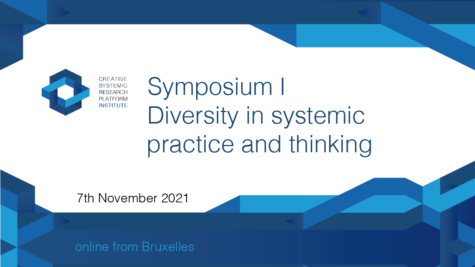
In anticipation of a journal article due in the new year, an outline of work-in-progress was shared at the CSRP Institute Symposium 2021, in Brussels, Belgium. (CSRP is the Creative Systemic Research Platform).

This video has been archived on the Internet Archive .

Video H.264 MP4
November 7
(26m42s)
[20211107_1200_CsrpInstitute_Ing_1050p.m4v]
(WSXGA+ 383kbps 98MB) [on the Internet Archive]

Audio downloadable onto mobile devices was transcoded from the video into MP3.

Audio
November 7
(26m42s)
[20211107_1200_CsrpInstitute_Ing_AAC.m4a]
(M4A 24MB)

The 30-minute presentation was well-received by symposium attendees.  We didn’t cover the full slide deck, with details that would later be revised for the written text for publication.

The scope of rethinking has been described as ambitious. In November 2021, we were approaching the end of the third year of an espoused 10-year journey, so there’s still much to be learned!

CSPR Institute Symposium 2021

  • fediscience.org/@daviding (Mastodon)

    1. Loading Mastodon feed...
  • RSS feed: on IngBrief on IngBrief

    • 2026/01/07 | Rama Akkiraju | From LLMs to Living Systems: Applying Systems Science to Agentic AI in the Enterprise | HICSS-59 Keynote
      Abstract Enterprise AI is transitioning from simple single-LLM flows to complex agentic ecosystems—adaptive systems composed of multiple agents, tools, governed data, human workflows, and organizational policies. This keynote introduces a systems-science framework for designing and managing such ecosystems using principles of modularity, control, feedback, robustness, and socio-technical alignment. We illustrate these concepts through practical examples […]
    • Timothy F.H. Allen passed away on May 01, 2025
      Timothy F.H. Allen, president of International Society for the Systems Sciences 2008-2009, passed away peacefully in his home, surrounded by his family, on May 1, 2025. With his work on ecosystem ecology, I learned more about living systems than anyone else in the systems community. After his retirement, he was proud of putting together a […]
    • Installing WordPress Studio on Manjaro Linux
      In 2024, WordPress Studio was released, making installation on a local computer simpler. The instructions were modified from MacOS to Ubuntu Linux, by Daniel Kossmann, “How to install WordPress Studio in Ubuntu Linux” | Jun 15, 2024 at https://www.danielkossmann.com/how-to-install-wordpress-studio-ubuntu-linux/ I already had NVM installed, but in Terminal, with the result “command not found”. In the […]
    • Notion of Change in the Yijing | JeeLoo Lin 2017
      The appreciation of change is different in Western philosophy than in classical Chinese philosophy. JeeLoo Lin published a concise contrast on differences. Let me parse the Introduction to the journal article, that is so clearly written. A-theories divide time into past, present and future, and the point of reference is set at “the present.” B-theories, […]
    • World Hypotheses (Stephen C. Pepper) as a pluralist philosophy [Rescher, 1994]
      In trying to place the World Hypotheses work of Stephen C. Pepper (with multiple root metaphors), Nicholas Rescher provides a helpful positioning. — begin paste — Philosophical perspectivism maintains that substantive philosophical positions can be maintained only from a “perspective” of some sort. But what sort? Clearly different sorts of perspectives can be conceived of, […]
    • The Nature and Application of the Daodejing | Ames and Hall (2003)
      Ames and Hall (2003) provide some tips for those studyng the DaoDeJing.
  • Recent Posts

  • Archives

  • RSS feed: on daviding.com on daviding.com

    • 2026/10 Moments October 2026
      Dartmouth, Nova Scotia; Halifax, Nova Scotia; Lunenberg, Nova Scotia; Peggy’s Cove, Nova Scotia; Bible Hill, Nova Scotia; Louisbourg, Nova Scotia; Sydney, Nova Scotia; Baddeck, Nova Scotia; Toronto, Ontario Fraser’s Mills Fish Hatchery: Side trip to hatchery built in 1928 by provincial government, gravity-fed from South River. Water in pen dark, ripples at surface due to […]
    • 2026/09 Moments September 2026
      Vancouver BC; Toronto, Ontario, Burlington, Ontario; Shanghai PR China Serenade of the Seas: From the foredeck of level 12 of the Royal Caribbean Line ship, the panorama west to the Vancouver Convention Centres, turning to the north across Vancouver Harbour. Observed Princess Line ship leaving the dock, a departure we never experienced. Arrived for lunch, […]
    • 2026/08 Moments August 2026
      Toronto, Ontario; Vancouver BC Next Perfect Day Playlist: Korean Town Street Festival, 20260808 Night View O What A Shiny Night Honey Haneum Playlist: Korean Town Street Festival, 20260808 Happiness Prince of Jeju Ieodo Sana Seouje Sori Leida Lay Down Together Star North Sky Beautiful Country Encore Chris Fraser Trio | Meo | 2026-08-30: Nestled in […]
    • 2026/07 Moments July 2026
      Quiet summer mostly at home writing, taking breaks to meet with friends, and exercise on bike rides.
    • 2026/06 Moments June 2026
      Cool summer catching up with family and friends, music festivals
    • 2026/05 Moments May 2026
      Cool spring, busy with Jane's Walk, bathroom renovation, closing out father's apartment, OCADU GradEx, Problematique Dialogue applying the Banathy Conversation Methodology, Qingming.
  • RSS feed: on Media Queue on Media Queue

  • Meta

  • Creative Commons License
    This work is licensed under a Creative Commons Attribution-NonCommercial-ShareAlike 4.0 International License
    Theme modified from DevDmBootstrap4 by Danny Machal