
When can learning about system thinking be fun (and when can’t it be)? This was the focus question for the third Systems Thinking Ontario meeting. We had a slight change in format from the reading-oriented prior agendas, as Steve Easterbrook led us through a more experiential approach to systems thinking. As usual, participants were provided with pre-readings, this time from Linda Booth Sweeney. As a change for the in-person meeting, Steve went directly to exercises from the Systems Thinking Playbook, which he has been using in classes such as Systems Thinking for Global Problems. While the exercises are appropriate for students down into the primary school level, Steve has found that graduate students also enjoy and learn from them. In the short time available, we played through two exercises and then broke out into discussion subgroups.
The first exercise was called “Frames”. Steve provided each of us with a piece of paper with a small aperture cut out of the centre.
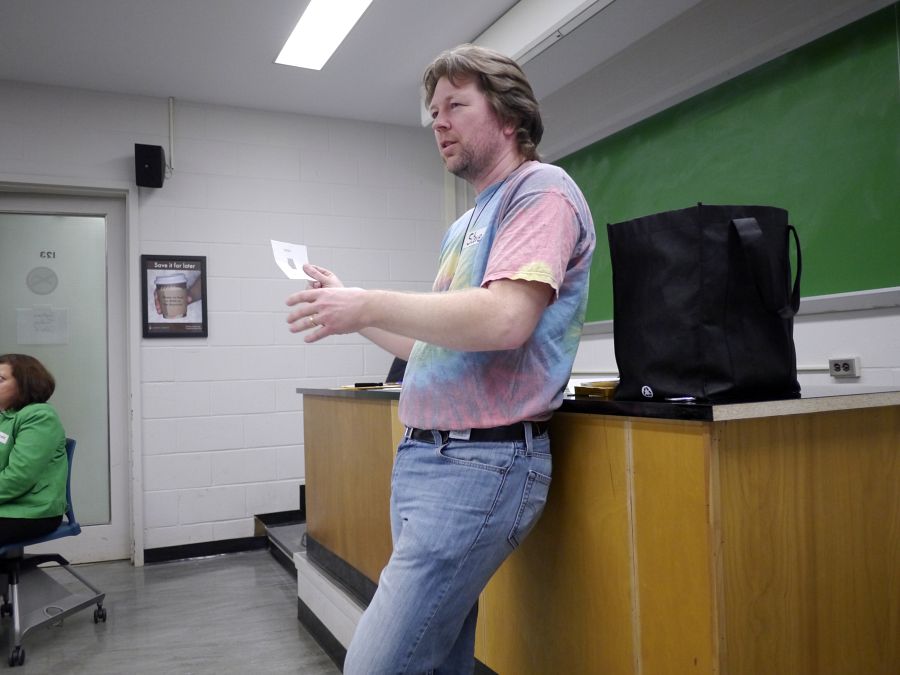
The playbook gives the following directions.
Geographic Framing
Step 1: Ask all participants to hold their viewing holes out at arm’s length.
Ask them to look through the holes and focus on a specific object; for example, a cluster of tennis balls on a table, a poster, you, or whatever object you choose. [….]
Step 2: Ask the following questions, pausing for 10-20 seconds after each, so participants have time to ponder their answer.
- “What do you see within this frame?”
- “What questions could you answer with the information available to you through your frame?”
- “What professions might be interested in the data you are gathering?”
- “What actions could you take to influence the objects or processes that you see?” [Sweeney and Meadows 2010, pp-140-141]
Steve had scattered a variety of toys around the room, on the floor and on a desk. Some people looked at the periodic table on the wall, since we were in a chemistry lab.

After the discussion about the frame at arm’s length, the playbook next directs bringing the aperture closer.
Step 3: Now ask players to bring the hole halfway to toward their eye while keeping the same object centered in the whole. Ask the same four questions above, once more pausing for several seconds after each.
Now ask players to bring the hole as close as they can to their eye while keeping the same object centered in the hole.
Again ask the same four questions, pausing for participants to form a mental answer to each. Point out that the object that each player viewed through his or her hole remained exactly the same during the three different inspections. Explain that you asked the same questions with each inspection, then ask participants whether their responses to the questions changed. Solicit actual responses from the audience. Ask, “Why did your answers change? Which do you think was the best perspective? Which one did you prefer? Of course, no perspective is intrinsically better than another. It depends on the goals and the questions of the person who is looking through the frame. [Sweeney and Meadows 2010, pp-140-141]
Reactions to the change perspective varied. A water bottle that was intriguing in a narrow focus was recognized as garbage left behind by another student. A plastic object that had an interesting texture became more mundane when recognized as a toy.

Following the playbook, the exercise turned from “Geographic Framing” to “Temporal Framing”. Sometimes the frame isn’t “where”, but “when.
For the second exercise, Steve brought out a long pole, and asked participants to queue in two lines.

This second exercise is called “Avalanche”. The playbook reads:
One of your assistants is going to rest a long pole between the two lines across the tops of your fingers. (Make sure your fingers are all at the same height.) On the end of the pole, a washer will be hanging loosely.
Your team’s goal is to lower the pole smoothly to the floor, rest it there, and remove your fingers — all while making sure that the washers stay on the pole ends. There are three rules:
Rule #1: You cannot hold onto the pole; you can only support it with the top of your finger.
Rule #2: You absolutely must not lose contact with the pole at any time. If your finger does lose contact with the pole, raise your free hand. The assistants will seize the pole, and your group will start over.
Rule #3: If one or both washers fall off the pole, the assistants will seize the pole, and your group will start over.
- Imagine that the pole is a complex task that your group needs to accomplish. One washer represents your budget constraints; the other, your quality standards. You need to finish the job withoug “dropping” either. [Sweeney and Meadows 2010, p. 220]
The pole was rested on the fingers of the group.

While the directions to individuals were to try to lower the pole, the collective result was the opposite: the pole started to rise.

In a moment, the pole had risen up so far than the shorter people protested that they were going to lose contact.

One participant had a suggestion: on a count of three, everyone was to lower simultaneously.

The lowering tactic worked. However, the ends were not descending at the same pace. The risk of the ring falling off one end increased.

A few more words of coordination, and the pole evened out.

Lower and lower, everyone had to squat.

With a little more time, they could have let the pole all the way to the ground. The group decided the lesson had been learned.

The full group broke out into two smaller subgroups. One group focused specifically on answering the question. Stephen Davies gave a concise report on the subgroup findings.

When can learning about systems thinking be fun?
- When games are used to make a simple system concrete and participatory.
- When we explore our experience playing the game afterwards or upon reflection.
- When learning occurs though our direct action and we have a chance to discover things empirically. Time in the game is important, as feedback happens in a matter of minutes, not hours, days, or weeks.
- When features of the game make it fun, i.e. the rules, the goals/objectives, emergent behaviour, unexpected challenges, etc.
- When we’re unsure about how many variables need to be considered.
- When the rules of the game are unclear or incomplete.
- When you can’t connect the concept or principle to the game or trust the people who are playing it.
- When the stakes are too high to fail or failure is too likely.

What makes it fun?
- Features of the game make it fun: there’s permission to express oneself and to be “silly”.
- It can be about egos in the room.
- Some people struggle to overcome one another.
- People who do not respond to ego may step back and become a weak link (or, potentially, a stronger link).
- Dominating people may end up competing with one another to try and control the system.
- Aggressive, passive and/or controlling behaviours may emerge.
- A study of the same game could be created, played with (i) all women, (ii) all men, (iii) all friends, (iv) all strangers, etc.
- Is diversity an enabler or an inhibitor?
- Is it necessary for people to be willing to have fun? Might some step back?
- Efficiency can be fun but controllers are not.
- Diversity can be fun but being silenced is not.
- Games can be interesting, engaging and enlightening, and still not necessarily fun.
With the group back together, we had a brief reflection on the meeting process. At prior events, we’ve had three subgroups rather than two subgroups. With sufficient attendees, (at least) three subgroups may be a better pattern, to reduce the possibility of “us versus them” comparisons. The motivation for subgroups is to improve inquiry, as more voices can be followed in smaller groups. The discussions help individuals make sense of the domain for that meeting.
Look out for monthly Systems Thinking Ontario sessions at http://wiki.st-on.org . The group focuses on a different theme each month.
[See the album of 21 ST-ON webphotos (with a slideshow option)]
References
Sweeney, Linda Booth, and Dennis L. Meadows. 2010. The Systems Thinking Playbook. Chelsea Green Publishing. http://books.google.ca/books?id=rNSNtQ8cPYUC.


