
Coevolving Innovations

… in Business Organizations and Information Technologies

Currently Viewing Posts Tagged futures

Scenarios and Design: Instigating Change, Methods Framing, Scenario-Buffered Design

At the Oxford Futures Forum 2014, hosted by the Saïd Business School, I was invited to be a participant in a generative dialogue.  Each of the invitees was requested to submit a 250-word abstract and an image four months ahead of the event.  In two days, we had three group discussion meetings, where individuals were free to go to other groups (or form new groups) according to the ideas emerging from the dialogue.

This event runs on the Chatham House Rule:

When a meeting, or part thereof, is held under the Chatham House Rule, participants are free to use the information received, but neither the identity nor the affiliation of the speaker(s), nor that of any other participant, may be revealed.

Further, in a generative dialogue, ideas flow and merge as participant learn from each other, so representations related to people outside of the involved group don’t get a full appreciation for the unfolding learning.  Having been a participant in a series of prior IFSR Conversations that similarly focus on generative dialogue, any describing of the experience turns out somewhat inadequate.  The most that can be related to others are “proceedings”, where some of the ideas in progress are captured.  As a participant in Oxford Futures Forum, I was involved in three rounds of conversations, which can be roughly framed as:

  • design and scenarios to instigate change (as an introductory clustering to start the first round);
  • methods framing (as the emergent theme from the first round to go into a second round); and
  • scenario-buffered design (as the label that was presented as the conclusion of the third round).
… Read more (in a new tab)

At the Oxford Futures Forum 2014, hosted by the Saïd Business School, I was invited to be a participant in a generative dialogue.  Each of the invitees was requested to submit a 250-word abstract and an image four months ahead of the event.  In two days, we had three group discussion meetings, where individuals were free to go to other groups (or form new groups) according to the ideas emerging from the dialogue.

This event runs on the Chatham House Rule:

When a meeting, or part thereof, is held under the Chatham House Rule, participants are free to use the information received, but neither the identity nor the affiliation of the speaker(s), nor that of any other participant, may be revealed.

Further, in a generative dialogue, ideas flow and merge as participant learn from each other, so representations related to people outside of the involved group don’t get a full appreciation for the unfolding learning.  Having been a participant in a series of prior IFSR Conversations that similarly focus on generative dialogue, any describing of the experience turns out somewhat inadequate.  The most that can be related to others are “proceedings”, where some of the ideas in progress are captured.  As a participant in Oxford Futures Forum, I was involved in three rounds of conversations, which can be roughly framed as:

  • design and scenarios to instigate change (as an introductory clustering to start the first round);
  • methods framing (as the emergent theme from the first round to go into a second round); and
  • scenario-buffered design (as the label that was presented as the conclusion of the third round).
… Read more (in a new tab)

Reframing service systems methods as project-portfolio conversations: Appreciating the shift from structured methods to agile systems development

The Oxford Futures Forum 2014 committee requested an image and an abstract as an application for an Open Space event for 70 participants on May 30-31.  The event description reads:

Purpose and aims

  • Forging and supporting an international community of future-minded practices aimed at stimulating actionable, impactful knowledge;
  • Identifying and investigating academic and practitioner interests at the forefront of scenarios and design, and relating them to each other;
  • Uncovering and pushing the boundaries of scenarios practices and theory, to clarify and extend their effectiveness through critical review and linking with other fields;
  • Enabling networking and publishing  (e.g. two books from first OFF in 2005; a set of sense-making scenarios and two published papers after OFF 2008, which saw another workshop based on the Oxford one organised by Arizona State University; so far one paper from OFF 2011)
  • Leveraging the neutral, highly respected and international convening power of Oxford University.

Theme – scenarios and design

The theme of the fourth Oxford Futures Forum will explore the possible synergies and differences between work on design and the so-called ‘intuitive logics’ school in scenarios.   See “Scoping the Dialogue Space” and OFF2014 supplementary information.

To clarify, in the basic “intuitive logics” method, say Wright, Bradfield, and Cairns (2013):

This model follows the approach developed over many decades by a number of writers … and organizations (e.g. Global Business Networks (GBN; SRI International). It relies upon the application of “intuitive logics” …, and is focused on the development of multiple scenarios that explore the “limits of possibility” for the future, rather than on the development of singular, “normative” scenarios of some ideal future.

Systems Thinking and Futures Studies (Systems Thinking Ontario, 2013-02-21)

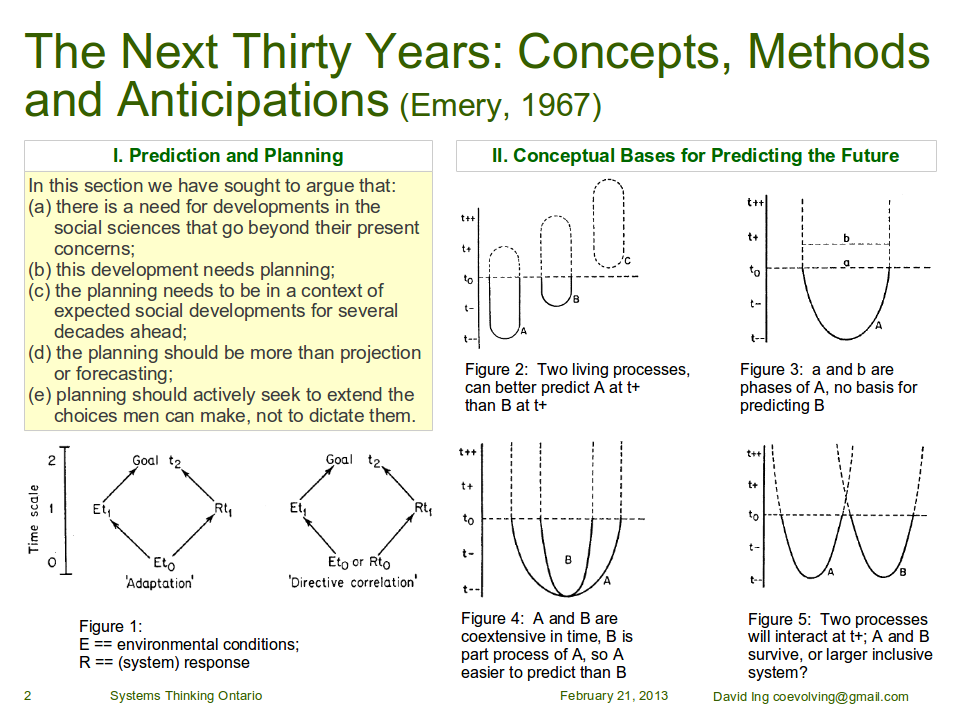
The pre-reading of Emery (1967), “The Next Thirty Years: Concepts, Methods and Anticipations” was introduced as a challenging article for the second meeting of Systems Thinking Ontario on Feb. 21, 2013.  The theme for the evening was “Systems Thinking and Future Studies”, so there was some irony in looking backwards to 1967 to have a discussion on looking forward.

In my role as reviewer in Systems Thinking Ontario sessions, I would prefer to try to stick to the text rather than adding editorializing.  However, since this Emery (1967) article is particular rich, I tried to provide some additional context to make the reading easier.

Fred Emery is especially known for his work with the Tavistock Institute for Human Relations, as one of the pioneers of the field we know today as organization science, including organization development and organization design.  In 1967, systems thinking was new:  The Systems Approach would be published by West Churchman in 1968, and On Purposeful Systems by Ackoff and Emery would follow years later in 1972.  The Club of Rome was founded in 1968.  In this article, Emery was thinking about how systems thinking frames viewing the future.

I. Prediction and Planning; II. Conceptual Bases for Predicting the Future

In I. Prediction and Planning, the systems of interest are in the social sciences.  The longer history of systems thinking prior to 1967 would have been a stronger cybernetics orientation.  The research from the Tavistock Institute on the socio-psychological, socio-technical and socio-ecological systems perspectives would have been fresh.  … Read more (in a new tab)

  • fediscience.org/@daviding (Mastodon)

    1. Loading Mastodon feed...
  • RSS feed: on IngBrief on IngBrief

    • 2026/01/07 | Rama Akkiraju | From LLMs to Living Systems: Applying Systems Science to Agentic AI in the Enterprise | HICSS-59 Keynote
      Abstract Enterprise AI is transitioning from simple single-LLM flows to complex agentic ecosystems—adaptive systems composed of multiple agents, tools, governed data, human workflows, and organizational policies. This keynote introduces a systems-science framework for designing and managing such ecosystems using principles of modularity, control, feedback, robustness, and socio-technical alignment. We illustrate these concepts through practical examples […]
    • Timothy F.H. Allen passed away on May 01, 2025
      Timothy F.H. Allen, president of International Society for the Systems Sciences 2008-2009, passed away peacefully in his home, surrounded by his family, on May 1, 2025. With his work on ecosystem ecology, I learned more about living systems than anyone else in the systems community. After his retirement, he was proud of putting together a […]
    • Installing WordPress Studio on Manjaro Linux
      In 2024, WordPress Studio was released, making installation on a local computer simpler. The instructions were modified from MacOS to Ubuntu Linux, by Daniel Kossmann, “How to install WordPress Studio in Ubuntu Linux” | Jun 15, 2024 at https://www.danielkossmann.com/how-to-install-wordpress-studio-ubuntu-linux/ I already had NVM installed, but in Terminal, with the result “command not found”. In the […]
    • Notion of Change in the Yijing | JeeLoo Lin 2017
      The appreciation of change is different in Western philosophy than in classical Chinese philosophy. JeeLoo Lin published a concise contrast on differences. Let me parse the Introduction to the journal article, that is so clearly written. A-theories divide time into past, present and future, and the point of reference is set at “the present.” B-theories, […]
    • World Hypotheses (Stephen C. Pepper) as a pluralist philosophy [Rescher, 1994]
      In trying to place the World Hypotheses work of Stephen C. Pepper (with multiple root metaphors), Nicholas Rescher provides a helpful positioning. — begin paste — Philosophical perspectivism maintains that substantive philosophical positions can be maintained only from a “perspective” of some sort. But what sort? Clearly different sorts of perspectives can be conceived of, […]
    • The Nature and Application of the Daodejing | Ames and Hall (2003)
      Ames and Hall (2003) provide some tips for those studyng the DaoDeJing.
  • Recent Posts

  • Archives

  • RSS feed: on daviding.com on daviding.com

    • 2026/10 Moments October 2026
      Dartmouth, Nova Scotia; Halifax, Nova Scotia; Lunenberg, Nova Scotia; Peggy’s Cove, Nova Scotia; Bible Hill, Nova Scotia; Louisbourg, Nova Scotia; Sydney, Nova Scotia; Baddeck, Nova Scotia; Toronto, Ontario Fraser’s Mills Fish Hatchery: Side trip to hatchery built in 1928 by provincial government, gravity-fed from South River. Water in pen dark, ripples at surface due to […]
    • 2026/09 Moments September 2026
      Vancouver BC; Toronto, Ontario, Burlington, Ontario; Shanghai PR China Serenade of the Seas: From the foredeck of level 12 of the Royal Caribbean Line ship, the panorama west to the Vancouver Convention Centres, turning to the north across Vancouver Harbour. Observed Princess Line ship leaving the dock, a departure we never experienced. Arrived for lunch, […]
    • 2026/08 Moments August 2026
      Toronto, Ontario; Vancouver BC Next Perfect Day Playlist: Korean Town Street Festival, 20260808 Night View O What A Shiny Night Honey Haneum Playlist: Korean Town Street Festival, 20260808 Happiness Prince of Jeju Ieodo Sana Seouje Sori Leida Lay Down Together Star North Sky Beautiful Country Encore Chris Fraser Trio | Meo | 2026-08-30: Nestled in […]
    • 2026/07 Moments July 2026
      Quiet summer mostly at home writing, taking breaks to meet with friends, and exercise on bike rides.
    • 2026/06 Moments June 2026
      Cool summer catching up with family and friends, music festivals
    • 2026/05 Moments May 2026
      Cool spring, busy with Jane's Walk, bathroom renovation, closing out father's apartment, OCADU GradEx, Problematique Dialogue applying the Banathy Conversation Methodology, Qingming.
  • RSS feed: on Media Queue on Media Queue

  • Meta

  • Creative Commons License
    This work is licensed under a Creative Commons Attribution-NonCommercial-ShareAlike 4.0 International License
    Theme modified from DevDmBootstrap4 by Danny Machal