
Coevolving Innovations

… in Business Organizations and Information Technologies

Currently Viewing Posts Tagged learning

Appreciating Systems Changes via Multiparadigm Inquiry | ISSS 2022 Proceedings

In the ISSS 2022 Plenary talk, the first 25 minutes were a blast through (a) the rising interest in system(s) change(s); (b) appreciative systems (Vickers); (c1) the philosophy of architectural design; (c2) the philosophy of ecological anthropology; (c3) the philosophy of Classical Chinese Medicine; (c4) the philosophy of rhythms; and (d) methods of multiparadigm inquiry, and open theorizing.

The formal publication of the manuscript in the Proceedings of the 66th Annual Meeting of the International Society for the Systems Sciences unpacks the content for those with an interest in really understanding the breadth of domains that the Systems Changes Learning Circle has explored, from 2019 through 2022.

This proceedings release is a milestone, as a coherent work that has been lightly reviewed. In a more thorough process of peer review, a publication may be further refined by anonymous comments requesting clarification of some points, or suggestions that some sections could be abbreviated. My style of writing presumes that readers might not know all of the references, so I’m explicit about sources. (This also helps me remember from whom I’m learning!)

Here’s the abstract, as it appears in the proceedings.


Abstract

In which ways is the subject of systems change(s), as a first-class concept, distinct from a reduction into (i) systems and (ii) changes? For practice, theory, and methods to be authentically rigourous, the philosophy underlying an approach to systems changes can be explicated. Through an appreciative systems framework, presumptions are surfaced as to (i) what are and are not systems changes; (ii) when, where, and for whom, systems changes are prioritized for attention; and (iii) how systems changes should be addressed.… Read more (in a new tab)
In the ISSS 2022 Plenary talk, the first 25 minutes were a blast through (a) the rising interest in system(s) change(s); (b) appreciative systems (Vickers); (c1) the philosophy of architectural design; (c2) the philosophy of ecological anthropology; (c3) the philosophy of Classical Chinese Medicine; (c4) the philosophy of rhythms; and (d) methods of multiparadigm inquiry, and open theorizing.

The formal publication of the manuscript in the Proceedings of the 66th Annual Meeting of the International Society for the Systems Sciences unpacks the content for those with an interest in really understanding the breadth of domains that the Systems Changes Learning Circle has explored, from 2019 through 2022.

This proceedings release is a milestone, as a coherent work that has been lightly reviewed. In a more thorough process of peer review, a publication may be further refined by anonymous comments requesting clarification of some points, or suggestions that some sections could be abbreviated. My style of writing presumes that readers might not know all of the references, so I’m explicit about sources. (This also helps me remember from whom I’m learning!)

Here’s the abstract, as it appears in the proceedings.


Abstract

In which ways is the subject of systems change(s), as a first-class concept, distinct from a reduction into (i) systems and (ii) changes? For practice, theory, and methods to be authentically rigourous, the philosophy underlying an approach to systems changes can be explicated. Through an appreciative systems framework, presumptions are surfaced as to (i) what are and are not systems changes; (ii) when, where, and for whom, systems changes are prioritized for attention; and (iii) how systems changes should be addressed.… Read more (in a new tab)

Types of learning, with panarchical change as (i) incremental, (ii) lurching, and (iii) transformational

In order to appreciate the influence of resilience science and panarchy on ongoing research into systems changes, revisiting foundational works sometimes resurfaces insights.  In the 2002 Panarchy book, Chapter 15 provides a summary of findings.

In the course of the project hat led to this volume, we identified twelve conclusions (Table 15-1) in our search for sustainable futures. Those conclusions are reviewed in this section. [p. 395]

Table 15-1. Summary Findings from the Assessment of Resilience in Ecosystems, Economies, and Institutions [p. 396]
Summary Statement Conclusion
Multistable states are common in many systems. 1. Abrupt shifts among a multiplicity of very different stable domains are plausible in regional ecosystems, some economic systems, and some political systems.
The adaptive cycle is the fundamental unit of dynamic change. 2. An adaptive cycle that aggregates resources and periodically restructures to create opportunities for innovation is a fundamental unit for understanding complex systems from cells to ecosystems to societies to cultures.
Not all adaptive cycles are the same, and some are maladaptive. 3. Variants to the adaptive cycle are present in different systems. These include physical systems with no internal storage, ecosystems strongly influenced by external pulses, and human systems with foresight and adaptive methods to stabilize variability. Some are maladaptive and trigger poverty and rigidity traps.
Sustainability requires both change and persistence. 4. Sustainability is maintained by relationships among a nested set of adaptive cycles arranged as a dynamic hierarchy in space and time-the panarchy.
… Read more (in a new tab)

Rethinking Systems Thinking (article)

An article on “Rethinking Systems Thinking”, evolved from the ISSS San Jose 2012 plenary, is nearing publication.  The speech, as presented in fall 2012, covered a lot of content.  In written form, the narrative may be less colourful, but the citations may be easier to follow.

The peer-reviewed published article will be the definite source for scholars to cite.  For casual readers, a more widely accessible preprint version of the article, archived on the Coevolving Commons, may suffice.

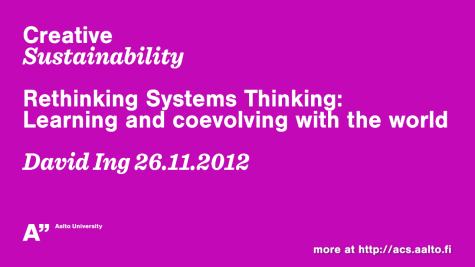
Full version: “Rethinking Systems Thinking: Learning and coevolving with the world”, Aalto University, 2012/11/26

A guest lecture on systems thinking for the Creativity Sustainability program at Aalto University provided an opportunity to stretch out on the plenary presentation that I had given at ISSS 2012.  In San Jose last July, plenary speakers (including myself) were constrained to 45 minute slots preceding dialectic panelists.  In Helsinki in November, the luxury of time allowed me to explain the ideas more fully.  The lecture took 85 minutes, and was then followed by a question and answer session.

Rehinking Systems Thinking

Versions of the web video can be viewed on Youtube, or viewed or downloaded at http://media.isss.org , at 480x272p, 720x400p, and 1280x720p.  The video shoot and post-production editing of the lecture was done by Seungho Lee, on behalf of the Creative Sustainability program.

The presentation on “Rethinking Systems Thinking” is probably the most comprehensive talk that I’ve given (and may ever give).  It is a personal perspective on systems, gained since the attending my first ISSS meeting in 1998 — that’s 14 years with the society.  My focus has recently shifted from the international audience to the local audience around Toronto, with Systems Thinking Ontario.  Systems thinking can be doled out in smaller chunks.  Over the Internet, viewers may choose to use the pause button.

Rethinking Systems Thinking: Learning and coevolving with the world

In a plenary dialectic session, I gave an address — in a position twinned with Rafael Ramirez — at the 56th Annual Meeting of the International Society for the Systems Sciences at San Jose State University.  There’s been ongoing discussion on the Systems Sciences group on Facebook, and on Twitter with the hashtag of #isss2012.

Here’s an abstract of the talk.

Much of systems thinking, as commonly espoused today, was developed by a generation in the context of the 1960s to 1980s. Almost all of the luminaries of that era have passed on. In the 2010s, has system thinking changed with the world in which it is to be applied? Is systems thinking learning and coevolving with the world? Some contemporary systems thinkers continue to push the frontiers of theory, methods and practice. Others situationally increment the traditions of their preferred gurus, where approaches proven successful in prior experiences are replicated for new circumstances. Founded on interactions with a variety of systems communities over the past 15 years, three ways to rethink systems thinking are proposed:

  1. Reorient systems thinking beyond “parts and wholes” towards “learning and coevolving”.
  2. Learn where the service economy and the anthropocene are new, anticipating deutero and trito levels.
  3. Coevolve the episteme, techne and phronesis across systems thinking, for both the living and non-living.

These proposed ways are neither exhaustive nor sufficient. The declaration that systems thinking should be rethought may itself be controversial. If, however, systems thinking is to be authentic, the theory, methods and practices with which we engage a changing world may require attention

The slides are available as a publication on the Coevolving Commons.  … Read more (in a new tab)

Systems thinking, systems that learn, and learning in service systems

Does systems thinking lead to systems that can learn as they evolve (or devolve)? How does a service system continue to learn about purposes (and objectives and goals) in its wholes and its parts? When a service system learns that change is called for, can that system consciously act to evolve (or devolve)?

Focusing on definitions of science and of systems thinking can lead to thinking about a static thing, rather than intellectual virtues that changes over time. Applying systems thinking to science, the intellectual virtues of episteme (know why), techne (know how) and phronesis (know when, know where, know whom) can each or all evolve. Actually, they coevolve, because the why, how, when, where and whom are all changing simultaneously.

Many of today’s services systems are under stress, possibly reaching a point of unsustainability. Does (or would) systems thinking help? To be concise, let’s try some responses to the three questions at the outset of this essay.

  • Does systems thinking lead to systems that can learn as they evolve (or devolve)?
    • A system in which systems thinking has contributed towards its design should have had features or properties included that are appropriate for its environment. If the environment changes, the fitness of the system may or may not degrade. A system intended for volatile environments may be have been designed to respond to change, or to fail — potentially gracefully — with signals that a more appropriate replacement should be put in place.
… Read more (in a new tab)
  • fediscience.org/@daviding (Mastodon)

    1. Loading Mastodon feed...
  • RSS feed: on IngBrief on IngBrief

    • 2026/01/07 | Rama Akkiraju | From LLMs to Living Systems: Applying Systems Science to Agentic AI in the Enterprise | HICSS-59 Keynote
      Abstract Enterprise AI is transitioning from simple single-LLM flows to complex agentic ecosystems—adaptive systems composed of multiple agents, tools, governed data, human workflows, and organizational policies. This keynote introduces a systems-science framework for designing and managing such ecosystems using principles of modularity, control, feedback, robustness, and socio-technical alignment. We illustrate these concepts through practical examples […]
    • Timothy F.H. Allen passed away on May 01, 2025
      Timothy F.H. Allen, president of International Society for the Systems Sciences 2008-2009, passed away peacefully in his home, surrounded by his family, on May 1, 2025. With his work on ecosystem ecology, I learned more about living systems than anyone else in the systems community. After his retirement, he was proud of putting together a […]
    • Installing WordPress Studio on Manjaro Linux
      In 2024, WordPress Studio was released, making installation on a local computer simpler. The instructions were modified from MacOS to Ubuntu Linux, by Daniel Kossmann, “How to install WordPress Studio in Ubuntu Linux” | Jun 15, 2024 at https://www.danielkossmann.com/how-to-install-wordpress-studio-ubuntu-linux/ I already had NVM installed, but in Terminal, with the result “command not found”. In the […]
    • Notion of Change in the Yijing | JeeLoo Lin 2017
      The appreciation of change is different in Western philosophy than in classical Chinese philosophy. JeeLoo Lin published a concise contrast on differences. Let me parse the Introduction to the journal article, that is so clearly written. A-theories divide time into past, present and future, and the point of reference is set at “the present.” B-theories, […]
    • World Hypotheses (Stephen C. Pepper) as a pluralist philosophy [Rescher, 1994]
      In trying to place the World Hypotheses work of Stephen C. Pepper (with multiple root metaphors), Nicholas Rescher provides a helpful positioning. — begin paste — Philosophical perspectivism maintains that substantive philosophical positions can be maintained only from a “perspective” of some sort. But what sort? Clearly different sorts of perspectives can be conceived of, […]
    • The Nature and Application of the Daodejing | Ames and Hall (2003)
      Ames and Hall (2003) provide some tips for those studyng the DaoDeJing.
  • Recent Posts

  • Archives

  • RSS feed: on daviding.com on daviding.com

    • 2026/10 Moments October 2026
      Dartmouth, Nova Scotia; Halifax, Nova Scotia; Lunenberg, Nova Scotia; Peggy’s Cove, Nova Scotia; Bible Hill, Nova Scotia; Louisbourg, Nova Scotia; Sydney, Nova Scotia; Baddeck, Nova Scotia; Toronto, Ontario Fraser’s Mills Fish Hatchery: Side trip to hatchery built in 1928 by provincial government, gravity-fed from South River. Water in pen dark, ripples at surface due to […]
    • 2026/09 Moments September 2026
      Vancouver BC; Toronto, Ontario, Burlington, Ontario; Shanghai PR China Serenade of the Seas: From the foredeck of level 12 of the Royal Caribbean Line ship, the panorama west to the Vancouver Convention Centres, turning to the north across Vancouver Harbour. Observed Princess Line ship leaving the dock, a departure we never experienced. Arrived for lunch, […]
    • 2026/08 Moments August 2026
      Toronto, Ontario; Vancouver BC Next Perfect Day Playlist: Korean Town Street Festival, 20260808 Night View O What A Shiny Night Honey Haneum Playlist: Korean Town Street Festival, 20260808 Happiness Prince of Jeju Ieodo Sana Seouje Sori Leida Lay Down Together Star North Sky Beautiful Country Encore Chris Fraser Trio | Meo | 2026-08-30: Nestled in […]
    • 2026/07 Moments July 2026
      Quiet summer mostly at home writing, taking breaks to meet with friends, and exercise on bike rides.
    • 2026/06 Moments June 2026
      Cool summer catching up with family and friends, music festivals
    • 2026/05 Moments May 2026
      Cool spring, busy with Jane's Walk, bathroom renovation, closing out father's apartment, OCADU GradEx, Problematique Dialogue applying the Banathy Conversation Methodology, Qingming.
  • RSS feed: on Media Queue on Media Queue

  • Meta

  • Creative Commons License
    This work is licensed under a Creative Commons Attribution-NonCommercial-ShareAlike 4.0 International License
    Theme modified from DevDmBootstrap4 by Danny Machal