
Coevolving Innovations

… in Business Organizations and Information Technologies

Digest on Service Systems Science at Tokyo Institute of Technology (2009)

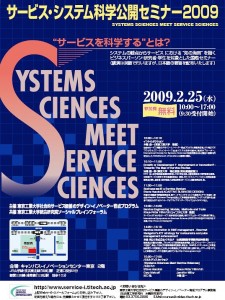
Systems Sciences Meet Service SciencesThe Service Innovation Educational Program at the Tokyo Institute of Technology hosted an “Open Seminar on Service Systems Science” (with a flyer in PDF) — as well as a private “Invited Workshop on Services Science, Management and Engineering” — in February 2009.

I’ve just noticed that much of the content is totally opaque to people who don’t read Japanese, so I’ve posted my (English-language) digest of the meetings on the Coevolving Innovation Commons.  The text is incomplete, but it at least provides a minimal sketch of some of the ideas discussed. (Digital photographs help, too!).  Speakers include:

The 2009 meetings were an annual extension of the 2008 21st Century CoE Symposium, and the first Invited Workshop on SSME.

With many of the researchers coming from a perspective of systems science, the trend has been to work out some of the ideas on an emerging science of service systems.

Extending the legacy of social ecology into an emerging science of service systems

I’ve been approaching the development of an emerging science of service systems from a background of the systems sciences.  Describing and designing service systems — not only in business, but also in the public sector — includes the evolution and development both of human organization and of technology.  A large body of knowledge on social systems science was developed in the post-war industrial age, e.g. research conducted by the Tavistock Institute of Human Relations (1941-1989).  This work has been categorized in three perspectives:

The socio-ecological perspective emerged while facing cases where “von Bertalanffy’s concept of open systems” was not sufficient to deal with the degree of change in the environment.

We gradually realized that if we were usefully to contribute to the problems that faced the cases mentioned above we had to extend our theoretical framework. In particular, we had to discard the  assumption that systems or individuals could not know their environments and the unipolar focus on the system, or individual as system. In a positive sense we had to theorize about the evolution of the environment  and the consequences of this evolution for the constituent  systems.  (Emery 1997, pp. 38-39)

In 1967, Fred Emery summarized needs that the social sciences should have prepared to meet over the next thirty years.  More than a decade beyond that, we now have the Internet, globalization, and the prospect of an instrumented, interconnected and intelligent “smarter planet”.… Read more (in a new tab)

Evolving my web persona and tools

Over the past few months, you may have noticed some changes in this Coevolving Innovations blog, or the Distractions, Reflections blog. It’s been two years since I wrote “the why and how of establish your web persona“, and “installing and customizing WordPress on your own domain“.  Those reflected the state-of-the-art in 2007, which is a long time in technology.  To explain these changes, I’ll relate my thinking in three parts:

  • 1. What do I want with my web persona?
  • 2. How has the technology changed (in ways that I didn’t foresee)?
  • 3. What have I done with my web activity?

These topics are described from the viewpoint of an “advanced blogger”.  New technologies emerge continuously, and I try many of them out.  I use some tools that novices find cumbersome, but that’s the way that I continue to learn.

1. What do I want with my web persona?

My first blog entries date back to October 2005, and they’re still available on the web.  In December 2006, I split my professional persona (mostly serious writing) from my photoblogging (easier on the eyes and brain), particularly for readers who subscribe via e-mail rather than using an RSS reader.  During this period, my perspective on my web persona has been constant in three ways:

(a) I want people to find appropriate information about me

In the test of “googling myself”, I’m pretty satisfied that people can find me. … Read more (in a new tab)

The trajectory of systems research and practice: A Fuschl conversation (2008)

Over the past 28 years, the International Federation for Systems Research has hosted a meeting that has become known as the Fuschl Conversation. The conversation was designed as an “anti-conference” by Bela H. Banathy. Rather than centering on presentations of completed papers, small groups meet in a low-stress setting to engage in generative conversation, creating new knowledge. To focus and energize the conversations, position papers are developed by each individual before the meeting, and proceedings are published following.

For 2008 — my third Fuschl Conversation — I was privileged to spend four days with Gary Metcalf, Jennifer Wilby, Allenna Leonard and Leonie Solomons. Here’s an abstract of our conversation:

For this Fuschl meeting in March 2008, a group was formed based on a call for individuals with experiences in both (a) systems research and practice, and (b) applications in industry, academia and/or public policy. All of the participants in Team 2 have exercised systems thinking applied in the social sciences, both in research/educational contexts and in applied/practice contexts. In the discussion, we shared a rich base of collective experiences working in multiple countries across four continents.

In retrospect, the conversation drew out insights in three areas:

  • 1. Where does systems knowledge figure into the practice of social science practitioners?
  • 2. How is systems knowledge applied with domain-specific knowledge?
  • 3. When are domain-specific issues providing entry points into which systems knowledge becomes valuable?
  • 4. How is the nature of systems knowledge coevolving with institutions (public, private, not-for-profit) and technology (wikis, blogs, voice over Internet)?
… Read more (in a new tab)

How I stay informed: Reading social media with Facebook, Friendfeed, FeedDemon, Twitter

How is reading blogs different from reading e-mail and using search engines?

Most peers at my age — I’m a later era baby boomer, now called Generation Jones — are comfortable receiving e-mail and using search engines. This population hasn’t yet fully embraced social technologies such as blogs. This is changing slowly. Jeremiah Ohyang, in “How Baby Boomers Use Social Media“, describes that:

  • 71% of younger boomers (age 43 to 52) in 2008 were active with social technologies, as compared to 52% in 2007, and
  • 65% of older boomers (age 53 to 63) in 2008 were active with social technologies, as compared to 45% in 2007.

A further breakdown of the social technographic of boomers shows a bimodal (i.e. two-bump) distribution.

  • The largest bump of boomers (67% and 62%) is readers as “spectators” of blogs and forums — probably arriving at the web site via a bookmark or a search engine.
  • Of boomers reading blogs, fewer are “joiners” who maintain a profile on the web, or “collectors” who are receive updates as feeds.
  • Contributing content, boomers show a smaller bump as 35% and 34% as “critics” who leave comments on blogs and forums.
  • Less than half that number are “creators” who upload and publish primary content, which means bloggers under age 43 outnumber bloggers over age 43 in a ratio of 6-to-1.

What are boomers missing? They may not want to become authors (i.e. “creators” or “critics”).… Read more (in a new tab)

Science of service systems as an artifactual science

In his writing, Jim Spohrer has referred to The Sciences of the Artificial, written by Herbert Simon in 1996 as foundational to a science of services systems. Due to other priorities, I’ve been try to dodge following through into Simon’s book. Such work isn’t without controversies, such as described by Jude Chua Soo Meng in “Donald Schön, Herbert Simon and The Sciences of the Artificial” published in Design Studies in January 2009. Chua writes:

Donald Schön[‘s] book The Reflective Practitioner (1983) criticized the very technical view of design influenced by logical positivism, and urged design studies to attend to reflection-in-practice. In great part, Schön’s influential criticism was directed at the 1969, 1st edition of Herbert Simon’s The Sciences of the Artificial.

Chua describes revisions in the 1996 third revision of The Sciences of the Artificial that resolves the issues. This is deeper than I’d like to go.

I have to admit that I didn’t fully understand the use of the word “artificial”. Colloquially, “artificial” can be understood to mean something not genuine or made in imitation. Alternatively, it can be opposed to natural, as something man-made or made with human skill. This second meaning became clearer to me as I was reading Sarasvathy et al. “Designing Organizations that Design Environments”, from Organization Studies 2008:

A science of the artificial (or an artifactual science) studies some subset of human artifacts. [p. 331]

The expression of “artifactual” over “artificial” is significant for me, because it bridges sociological research (i.e.… Read more (in a new tab)

  • fediscience.org/@daviding (Mastodon)

    1. Loading Mastodon feed...
  • RSS feed: on IngBrief on IngBrief

    • 2026/01/07 | Rama Akkiraju | From LLMs to Living Systems: Applying Systems Science to Agentic AI in the Enterprise | HICSS-59 Keynote
      Abstract Enterprise AI is transitioning from simple single-LLM flows to complex agentic ecosystems—adaptive systems composed of multiple agents, tools, governed data, human workflows, and organizational policies. This keynote introduces a systems-science framework for designing and managing such ecosystems using principles of modularity, control, feedback, robustness, and socio-technical alignment. We illustrate these concepts through practical examples […]
    • Timothy F.H. Allen passed away on May 01, 2025
      Timothy F.H. Allen, president of International Society for the Systems Sciences 2008-2009, passed away peacefully in his home, surrounded by his family, on May 1, 2025. With his work on ecosystem ecology, I learned more about living systems than anyone else in the systems community. After his retirement, he was proud of putting together a […]
    • Installing WordPress Studio on Manjaro Linux
      In 2024, WordPress Studio was released, making installation on a local computer simpler. The instructions were modified from MacOS to Ubuntu Linux, by Daniel Kossmann, “How to install WordPress Studio in Ubuntu Linux” | Jun 15, 2024 at https://www.danielkossmann.com/how-to-install-wordpress-studio-ubuntu-linux/ I already had NVM installed, but in Terminal, with the result “command not found”. In the […]
    • Notion of Change in the Yijing | JeeLoo Lin 2017
      The appreciation of change is different in Western philosophy than in classical Chinese philosophy. JeeLoo Lin published a concise contrast on differences. Let me parse the Introduction to the journal article, that is so clearly written. A-theories divide time into past, present and future, and the point of reference is set at “the present.” B-theories, […]
    • World Hypotheses (Stephen C. Pepper) as a pluralist philosophy [Rescher, 1994]
      In trying to place the World Hypotheses work of Stephen C. Pepper (with multiple root metaphors), Nicholas Rescher provides a helpful positioning. — begin paste — Philosophical perspectivism maintains that substantive philosophical positions can be maintained only from a “perspective” of some sort. But what sort? Clearly different sorts of perspectives can be conceived of, […]
    • The Nature and Application of the Daodejing | Ames and Hall (2003)
      Ames and Hall (2003) provide some tips for those studyng the DaoDeJing.
  • Recent Posts

  • Archives

  • RSS feed: on daviding.com on daviding.com

    • 2026/10 Moments October 2026
      Dartmouth, Nova Scotia; Halifax, Nova Scotia; Lunenberg, Nova Scotia; Peggy’s Cove, Nova Scotia; Bible Hill, Nova Scotia; Louisbourg, Nova Scotia; Sydney, Nova Scotia; Baddeck, Nova Scotia; Toronto, Ontario Fraser’s Mills Fish Hatchery: Side trip to hatchery built in 1928 by provincial government, gravity-fed from South River. Water in pen dark, ripples at surface due to […]
    • 2026/09 Moments September 2026
      Vancouver BC; Toronto, Ontario, Burlington, Ontario; Shanghai PR China Serenade of the Seas: From the foredeck of level 12 of the Royal Caribbean Line ship, the panorama west to the Vancouver Convention Centres, turning to the north across Vancouver Harbour. Observed Princess Line ship leaving the dock, a departure we never experienced. Arrived for lunch, […]
    • 2026/08 Moments August 2026
      Toronto, Ontario; Vancouver BC Next Perfect Day Playlist: Korean Town Street Festival, 20260808 Night View O What A Shiny Night Honey Haneum Playlist: Korean Town Street Festival, 20260808 Happiness Prince of Jeju Ieodo Sana Seouje Sori Leida Lay Down Together Star North Sky Beautiful Country Encore Chris Fraser Trio | Meo | 2026-08-30: Nestled in […]
    • 2026/07 Moments July 2026
      Quiet summer mostly at home writing, taking breaks to meet with friends, and exercise on bike rides.
    • 2026/06 Moments June 2026
      Cool summer catching up with family and friends, music festivals
    • 2026/05 Moments May 2026
      Cool spring, busy with Jane's Walk, bathroom renovation, closing out father's apartment, OCADU GradEx, Problematique Dialogue applying the Banathy Conversation Methodology, Qingming.
  • RSS feed: on Media Queue on Media Queue

  • Meta

  • Creative Commons License
    This work is licensed under a Creative Commons Attribution-NonCommercial-ShareAlike 4.0 International License
    Theme modified from DevDmBootstrap4 by Danny Machal