
Coevolving Innovations

… in Business Organizations and Information Technologies

Currently Viewing Posts in design

Problem Solving, Problem Seeking

As teams have been meeting online in preparation for the Problematique Dialogue event in May, there are some questions related to the Banathy Conversation Methodology.  There’s an emphasis on generative dialogue, over strategic dialogue.

In the dialogue scholarship community there is a shared understanding that dialogue is not a new tool for addressing specific issues or problems. Rather, it is a means to help people to think together. Dialogue offers an environment where people can create shared meaning. The type of dialogue discussed heretofore is often called “generative,” meaning that it generates a collective worldview. Beck (1994) contrasts generative dialogue with strategic dialogue. According to Beck, strategic dialogue focuses on specific issues and tasks and it is applied in finding specific solutions in organizational and social systems settings. [Banathy (1996), p. 218]

This distinction may be unfamiliar to participants who presume they’re coming together to work towards a solution.  One of the 10 characteristics of a wicked problem is that “Every wicked problem can be considered to be a symptom of another problem” [Rittel and Webber 1973, p. 165].  In addition, “For wicked planning problems, there are no true or false answers” [Rittel and Webber 1973, p. 163].  This complexity is prominent in the definition of a problematique.

A set of two or more interdependent problems constitutes a system. The French call such a system a problématique; for lack of a corresponding word in English, I call it a mess.
… Read more (in a new tab)

As teams have been meeting online in preparation for the Problematique Dialogue event in May, there are some questions related to the Banathy Conversation Methodology.  There’s an emphasis on generative dialogue, over strategic dialogue.

In the dialogue scholarship community there is a shared understanding that dialogue is not a new tool for addressing specific issues or problems. Rather, it is a means to help people to think together. Dialogue offers an environment where people can create shared meaning. The type of dialogue discussed heretofore is often called “generative,” meaning that it generates a collective worldview. Beck (1994) contrasts generative dialogue with strategic dialogue. According to Beck, strategic dialogue focuses on specific issues and tasks and it is applied in finding specific solutions in organizational and social systems settings. [Banathy (1996), p. 218]

This distinction may be unfamiliar to participants who presume they’re coming together to work towards a solution.  One of the 10 characteristics of a wicked problem is that “Every wicked problem can be considered to be a symptom of another problem” [Rittel and Webber 1973, p. 165].  In addition, “For wicked planning problems, there are no true or false answers” [Rittel and Webber 1973, p. 163].  This complexity is prominent in the definition of a problematique.

A set of two or more interdependent problems constitutes a system. The French call such a system a problématique; for lack of a corresponding word in English, I call it a mess.

… Read more (in a new tab)

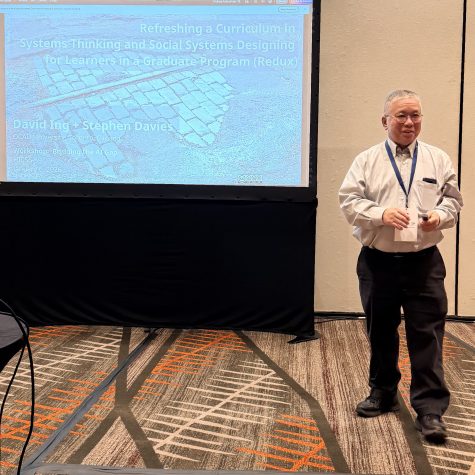
Refreshing a Curriculum (Redux) | HICSS-59 | 2026-01-06

Already registered for the HICSS-59 (Hawaii International Conference on Systems Science) conference in Maui, I signed up for a workshop on “Curriculum Design and Development”.  With a focus on “Bridging the AI Gap: Seamless Integration Across Academia and Industry Sectors”, the organizers offered an opportunity to give a short presentation and join a panel.

Three months ago, I presented a paper on “Refreshing a Curriculum in Systems Thinking and Social Systems Designing for Learners in a Graduate Program” reflecting the experiences with a winter 2025 class.  Just a few weeks from incrementing the course for January 2026, I summarized the earlier presentation, and previewed a plan to deepen the instruction on using Generative AI for research and diagramming.  A recording of the presentation is available on Youtube, as well as on the Internet Archive .

Video H.264 MP4
January 6 (9m46s) [20260106_1000_HICSS-59 Ing_RefreshingACurriculumRedux.m4v]
(HD 1268kbps 102 MB)
[on the Internet Archive]

The original audio was recorded at HICSS-59, as a foundation for reconstructing the visuals.

Audio
January 6 (9m58s) [20260106_1000_HICSS-59 Ing_RefreshingACurriculumRedux.m4a]
(1999 kbps, 48 kHz, 16 MB)
[on the Internet Archive]

With only a 10-minute slot, including questions and comments, the presention was only 6 slides.

Refreshing a Curriculum in Systems Thinking and Social Systems Designing for Learners in a Graduate Program (Redux)

After the break, a panel on “Education in the Time of AI: Challenges, Opportunities and the Road Ahead” was moderated by Eman El-Sheikh from the University of West Florida.  As I represented OCAD University from Canada, the other panelists included Leonard Przybilla from SAP Germany, and Jeremy Straub, from U.… Read more (in a new tab)

Pacing Changes: Seeing Living Systems as Rhythms | Zaid Khan + David Ing | SCiO Finland

An invitation for an online presentation to SCiO Finland came from Janne J. Korhonen, who had seen our September 2025 presentation at SysPrac25 in person.  This allowed a more relaxed presentation (without jet lag!) and extended time for discussion.  In addition, this event described some new techniques in sketching out rhythms in an onsite workshop, piloted in the 8 weeks that had elapsed.

Zaid led the presentation for about 40 minutes.  With animation a better medium to convey the foregrounding of temporality, an animated slide preview (59 seconds) gives some sense of the content.

After the presentation, I led the discussion.  Since I’ve been visiting Finland for academic studies since 2003, some familiar friends came online.

This recording is available on Youtube , as well as on the Internet Archive .

Video H.264 MP4
October 29 (1h24m) [20251029_SCiOFinland_Khan_Ing PacingChanges.m4v]
(1920×900 422kbps 331 MB)
[on the Internet Archive]

The audio was ripped from the online meeting.

Audio
October 29 (1h24m) [20251029_SCiOFinland_Khan_Ing PacingChanges.mp3]
(48 kbps, 32 kHz, 29 MB)
[on the Internet Archive]

Here’s the abstract for the talk.

How do you approach systems change when there’s no “pause” button? This presentation shifts how we see systems: from the default spatial-static to a more processual-dynamic perspective. We integrate concepts drawn from this living systems perspective found in anthropology, architecture, and classical Chinese medicine, amongst others. Pacing Changes is introduced as a method for working with the multiple layers and differing paces of a system.

… Read more (in a new tab)

Tracing sLab’s Journey, and Reinvigoration for the Systemic Design Community | ST-ON x RSD14 | 2025-09-10

The sLab at OCADU has a history dating back to 2008 (even predating the initiation of the M.Des. program on Strategic Foresight and Innovation).  Since the summer, four OCADU systemic designers have been meeting to discuss Reinvigoration of the sLab for 2025.

The 136th meeting of Systems Thinking Ontario coincided with the RSD14 Relating Systems Thinking and Design Symposium, and our evenings lined up with Australians meeting in the mornings for the Pacific Edition.  Greg Van Alstyne and Peter Scott were featured in the conversation on history and prospects for sLab.

The history is a preamble for an in-person workshop on Friday, October 17, 3:30-5:30pm at the RSD14 hub at OCADU, 100 McCaul Street.  A description of the “Where Do Systemic Designers Go To [BLANK]?” workshop is posted in the preprints for the proceedings.

Here’s the original description for the recorded ST-ON session above.

— begin paste —

This session offers a reflection on the history of the Strategic Innovation Lab’s (sLab) at OCADU. We’ll discuss the potential for its renewal in the context of a vibrant systems thinking and design community, both locally and nationally.

sLab, at OCADU, was host to an active community of students, alumni, faculty, and stakeholders from 2002 to 2020. In this time, it produced notable projects such as Digital Governance, Economic Futures of Ontario 2032, Design Jams, amongst others. These projects and workshops used many strategic foresight methods, which have since become more well-known.… Read more (in a new tab)

History of Program Requirements for Strategic Foresight and Innovation

In the term of winter 2025, I became immersed into the “Understanding Systems” (SFIN-6011) course in the master’s program in Strategic Foresight and Innovation at OCAD University.  This is only one course in a multi-year program, and I was curious about the history of the program.  Descriptions of the program are available on the Internet Archive, so I’ve summarizing some of my findings in the case others might be interested.

The 2009 Program Overview for OCAD (i.e. Ontario College of Art and Design, before the institution was granted university status) was designed for those “who may be working full or part time”, with “courses are normally clustered on Thursdays or Fridays”.  It outlined “45 credits of work including the following”:

  • 12 credits of directed studio work
    • SFIN 6C01: Research Methodologies (6 credits)
    • SFIN 6C02: Foresight and Innovation Studio (6 credits)
  • 21 credits of seminar courses (combined studio/academic)
    • SFIN 6B01: Business and Design Thinking (3 credits)
    • SFIN 6B02: Human Systems (3 credits)
    • SFIN 6B03: The Human Factor (3 credits)
    • SFIN 6B04: Non-human Systems (3 credits)
    • SFIN 6B05: Business Modeling and Policy Innovation (3 credits)
    • SFIN 6B06: Strategic Communications (3 credits)
    • SFIN 6B07: Leadership Excellence (3 credits)
  • 12 credits of self-directed major project research and development
    • SFIN 6E01: Major Project (12 credits)

The 2010 Program Requirements showed a little more structuring in terms for the 45 credits.  “Human Systems” became “Social Systems”.  “Non-human systems” became “Understanding Systems”.

  • Year One
    • Fall semester (9 credits)
      • SFIN 6B01: Business and Design Thinking (3)
      • SFIN 6C01: Research Methodologies (6)
    • Winter semester (6 credits)
      • SFIN 6B03: The Human Factor (3)
      • SFIN 6B04: Understanding Systems (3)
    • Summer semester (3 credits)
      • SFIN 6B05: Business Modeling and Policy Innovation (3)
  • Year Two
    • Fall semester (9 credits)
      • SFIN 6B02: Social Systems (3)
        SFIN 6C02: Foresight and Innovation Studio (6)
    • Winter semester (6 credits)
      • SFIN 6B06: Strategic Communications (3)
      • SFIN 6B07: Leadership Excellence (3)
    • Summer semester (12 credits)
      • SFIN 6E01: Major Project (12)

The 2011 Program Requirements shows the Major Project extended in year 2 from summer into the fall.   … Read more (in a new tab)

What Can Systems Thinkers Learn From an Evaluation Mindset? | Cameron D. Norman + Tara Campbell | Systems Thinking Ontario 2024-02-12

At the 118th meeting of Systems Thinking Ontario in February 2024, behavioral scientist Cameron D. Norman and design strategist Tara Campbell were invitied for a conversation guided by Zaid Khan.  The panelists are both alumni of the Strategic Foresight and Innovation program at OCADU.  Some time ago, they had conducted a research project on evaluation together, so this event was an opportunity for them to catch up at a relaxed pace.

As usual, participants had a round of self-introductions.   The panelists were guided through a conversation in three parts with focus questions, and participants were invited to offer their reflections and insights.  One linkage to modes of systems thinking was the distinction in approach by interest, e.g. Principles-Focused Evaluation, c.f. Developmental Evaluation.

This recording of the session is available on Youtube, as well as on the Internet Archive .

Video H.264 MP4
February 12
(1h53m)
[20240212_ST-ON_EvaluationMindset CameronDNorman_TaraCampbell.m4v]
(1920×1080 1333kbps 1.16GB)
[on the Internet Archive]

A standalone audio was also created during the meeting.

Audio
February 12
(1h53m)
[20240212_ST-ON_EvaluationMindset CameronDNorman_TaraCampbell.m4a]
(126kbps, 103 MB)
[on the Internet Archive]

The gist of the description is below, with pre-readings linked on the original abstract.


— begin excerpt —

Systems thinkers often seek to affect systems through their ideas and actions, but how do we know we’ve made a difference? How might we measure what matters in ways that respect the various dynamics at play in often complicated and complex systems?… Read more (in a new tab)

  • fediscience.org/@daviding (Mastodon)

    1. Loading Mastodon feed...
  • RSS feed: on IngBrief on IngBrief

    • 2026/01/07 | Rama Akkiraju | From LLMs to Living Systems: Applying Systems Science to Agentic AI in the Enterprise | HICSS-59 Keynote
      Abstract Enterprise AI is transitioning from simple single-LLM flows to complex agentic ecosystems—adaptive systems composed of multiple agents, tools, governed data, human workflows, and organizational policies. This keynote introduces a systems-science framework for designing and managing such ecosystems using principles of modularity, control, feedback, robustness, and socio-technical alignment. We illustrate these concepts through practical examples […]
    • Timothy F.H. Allen passed away on May 01, 2025
      Timothy F.H. Allen, president of International Society for the Systems Sciences 2008-2009, passed away peacefully in his home, surrounded by his family, on May 1, 2025. With his work on ecosystem ecology, I learned more about living systems than anyone else in the systems community. After his retirement, he was proud of putting together a […]
    • Installing WordPress Studio on Manjaro Linux
      In 2024, WordPress Studio was released, making installation on a local computer simpler. The instructions were modified from MacOS to Ubuntu Linux, by Daniel Kossmann, “How to install WordPress Studio in Ubuntu Linux” | Jun 15, 2024 at https://www.danielkossmann.com/how-to-install-wordpress-studio-ubuntu-linux/ I already had NVM installed, but in Terminal, with the result “command not found”. In the […]
    • Notion of Change in the Yijing | JeeLoo Lin 2017
      The appreciation of change is different in Western philosophy than in classical Chinese philosophy. JeeLoo Lin published a concise contrast on differences. Let me parse the Introduction to the journal article, that is so clearly written. A-theories divide time into past, present and future, and the point of reference is set at “the present.” B-theories, […]
    • World Hypotheses (Stephen C. Pepper) as a pluralist philosophy [Rescher, 1994]
      In trying to place the World Hypotheses work of Stephen C. Pepper (with multiple root metaphors), Nicholas Rescher provides a helpful positioning. — begin paste — Philosophical perspectivism maintains that substantive philosophical positions can be maintained only from a “perspective” of some sort. But what sort? Clearly different sorts of perspectives can be conceived of, […]
    • The Nature and Application of the Daodejing | Ames and Hall (2003)
      Ames and Hall (2003) provide some tips for those studyng the DaoDeJing.
  • Recent Posts

  • Archives

  • RSS feed: on daviding.com on daviding.com

    • 2026/10 Moments October 2026
      Dartmouth, Nova Scotia; Halifax, Nova Scotia; Lunenberg, Nova Scotia; Peggy’s Cove, Nova Scotia; Bible Hill, Nova Scotia; Louisbourg, Nova Scotia; Sydney, Nova Scotia; Baddeck, Nova Scotia; Toronto, Ontario Fraser’s Mills Fish Hatchery: Side trip to hatchery built in 1928 by provincial government, gravity-fed from South River. Water in pen dark, ripples at surface due to […]
    • 2026/09 Moments September 2026
      Vancouver BC; Toronto, Ontario, Burlington, Ontario; Shanghai PR China Serenade of the Seas: From the foredeck of level 12 of the Royal Caribbean Line ship, the panorama west to the Vancouver Convention Centres, turning to the north across Vancouver Harbour. Observed Princess Line ship leaving the dock, a departure we never experienced. Arrived for lunch, […]
    • 2026/08 Moments August 2026
      Toronto, Ontario; Vancouver BC Next Perfect Day Playlist: Korean Town Street Festival, 20260808 Night View O What A Shiny Night Honey Haneum Playlist: Korean Town Street Festival, 20260808 Happiness Prince of Jeju Ieodo Sana Seouje Sori Leida Lay Down Together Star North Sky Beautiful Country Encore Chris Fraser Trio | Meo | 2026-08-30: Nestled in […]
    • 2026/07 Moments July 2026
      Quiet summer mostly at home writing, taking breaks to meet with friends, and exercise on bike rides.
    • 2026/06 Moments June 2026
      Cool summer catching up with family and friends, music festivals
    • 2026/05 Moments May 2026
      Cool spring, busy with Jane's Walk, bathroom renovation, closing out father's apartment, OCADU GradEx, Problematique Dialogue applying the Banathy Conversation Methodology, Qingming.
  • RSS feed: on Media Queue on Media Queue

  • Meta

  • Creative Commons License
    This work is licensed under a Creative Commons Attribution-NonCommercial-ShareAlike 4.0 International License
    Theme modified from DevDmBootstrap4 by Danny Machal