
Coevolving Innovations

… in Business Organizations and Information Technologies

Currently Viewing Posts Tagged innovation

Strategic Communications + The Brand Stack, Zaid Khan + David Akermanis (ST-ON 2020/09/14)

Two Major Research Projects (MRPs) — they might be called master’s theses elsewhere — by Zaid Khan and David Akermanis reflect the Systemic Design agenda within the OCADU program on Strategic Foresight and Innovation (SFI).    To graduate, all SFI students complete an MRP.  With many subjects and techniques covered during SFI studies, only a few exercise Systemic Design at their core.

The September session of Systems Thinking Ontario came shortly after the defence of the two MRPs in August.  As we had suspended convening in person during 2020, our monthly meeting was conducted online.  This afforded recordings to be shared more widely.

The video file is also available on the Internet Archive, for those who prefer a downloadable option.

Video H.264 MP4
September 14
(1h27m)
[20200914_ST-ON_Khan_Akermanis.mp4]
(FHD 785kbps 293MB) [on archive.org]

The digital audio originally in M4A format has also been transcoded to MP3.

Audio
September 14
(1h27m)
[20200914_ST-ON_Khan_Akermanis.m4a]
(43MB)
20200914_ST-ON_Khan_Akermanis.mp3]
(38MB)

Here is the original description for the Systems Thinking Ontario September 14, 2020, session.

— begin paste —

Strategic Communications + The Brand Stack

A Major Research Project at OCADU is roughly equivalent to a Master’s Degree thesis (with some administrative differences). To start off the new academic year, we will have fresh presentations following the successful defences in the Strategic Foresight & Innovation Program at OCADU over the last month, by Zaid Khan and David Akermanis.

(1) A Systems-Oriented Approach to Strategic Communications — Zaid Khan

Systemic Design has emerged as both a theory and a practice that integrates design thinking and systems thinking to help designers cope with complex social systems.… Read more (in a new tab)
Two Major Research Projects (MRPs) — they might be called master’s theses elsewhere — by Zaid Khan and David Akermanis reflect the Systemic Design agenda within the OCADU program on Strategic Foresight and Innovation (SFI).    To graduate, all SFI students complete an MRP.  With many subjects and techniques covered during SFI studies, only a few exercise Systemic Design at their core.

The September session of Systems Thinking Ontario came shortly after the defence of the two MRPs in August.  As we had suspended convening in person during 2020, our monthly meeting was conducted online.  This afforded recordings to be shared more widely.

The video file is also available on the Internet Archive, for those who prefer a downloadable option.

Video H.264 MP4
September 14
(1h27m)
[20200914_ST-ON_Khan_Akermanis.mp4]
(FHD 785kbps 293MB) [on archive.org]

The digital audio originally in M4A format has also been transcoded to MP3.

Audio
September 14
(1h27m)
[20200914_ST-ON_Khan_Akermanis.m4a]
(43MB)
20200914_ST-ON_Khan_Akermanis.mp3]
(38MB)

Here is the original description for the Systems Thinking Ontario September 14, 2020, session.

— begin paste —

Strategic Communications + The Brand Stack

A Major Research Project at OCADU is roughly equivalent to a Master’s Degree thesis (with some administrative differences). To start off the new academic year, we will have fresh presentations following the successful defences in the Strategic Foresight & Innovation Program at OCADU over the last month, by Zaid Khan and David Akermanis.

(1) A Systems-Oriented Approach to Strategic Communications — Zaid Khan

Systemic Design has emerged as both a theory and a practice that integrates design thinking and systems thinking to help designers cope with complex social systems.… Read more (in a new tab)

Envisioning Innovation in Service Systems: Induction, Abduction and Deduction

In engagements with clients/customers, my work often includes system envisioning: facilitating the description of a collective desirable future (on a horizon of maybe 1 to 3 years out).  Once a group has converged on a future state or vision, moving forward is merely a matter of will.  Defining that future state, however, is more art than science.  In addition, with many more businesses operating as service systems, getting a handle on the invisible work that will be performed can be a challenge.  Work practices will coevolve with new technologies in ways unfamiliar to experiences to date.

In discussions with my colleagues, differences between their engagement approach and mine became clearer.  I understand and appreciate the process-based methods (e.g. process consultation by Ed Schein) used by large consulting teams, but my typical engagement is now timeboxed to a few weeks elapsed time, with just a few interviewers.  Some executive sponsors may ask for an interview guide in advance of coming onsite, but I don’t use a formally-structured guide.  The context for 60-to-90 minute interviews are light — we want people to talk about time-intensive activities and annoyances in their jobs — and generally find that interviewees would be happy if small adjustment could be made so that each would have to do less work.

Reflecting on these methods, I’ve seen a pattern of three stages in this approach:

  • (1) Induction: Rather than coming in with a preconceived model of how work gets done in a particular business, let those closest to the activities speak freely. 
… Read more (in a new tab)

Digest on Service Systems Science at Tokyo Institute of Technology (2009)

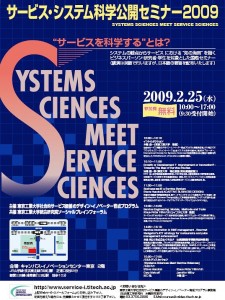
Systems Sciences Meet Service SciencesThe Service Innovation Educational Program at the Tokyo Institute of Technology hosted an “Open Seminar on Service Systems Science” (with a flyer in PDF) — as well as a private “Invited Workshop on Services Science, Management and Engineering” — in February 2009.

I’ve just noticed that much of the content is totally opaque to people who don’t read Japanese, so I’ve posted my (English-language) digest of the meetings on the Coevolving Innovation Commons.  The text is incomplete, but it at least provides a minimal sketch of some of the ideas discussed. (Digital photographs help, too!).  Speakers include:

The 2009 meetings were an annual extension of the 2008 21st Century CoE Symposium, and the first Invited Workshop on SSME.

With many of the researchers coming from a perspective of systems science, the trend has been to work out some of the ideas on an emerging science of service systems.

Innovation as open, collaborative, multidisciplinary, global

On more than one occasion, I’ve heard IBM executives assert:

The nature of innovation has changed. In the 21st century, innovation is open, collaborative, multidisciplinary and global.

The ideas of open, collaborative, multidisciplinary and global appeared in the Global Innovation Outlook 2.0 report that was published in mid-2006. These words appeared on IBM-internal slides presented by Nick Donofrio at an Consulting Leadership Exchange in September 2005, and at the external-facing conference on Education for the 21st Century in October 2006 … with lots of other occasions in between. But what do these four words mean?

To make some sense for myself, I’ve extended these words into phrases and contrasted their contexts in a table .

  Industrial age nature of innovation   21st century nature of innovation
Strategy Private methods and development enabling autonomous control over designs + Open standards and interfaces leveraging expedient platforms for advancing designs
Relationship Transactional production chains linked by inter-organizational contracting + Collaborative alliances coproducing accelerated learning
Method Analytical problem-solving + Multidisciplinary conversations
Economics Colonial trade + Global talent

I’ve been listening to audio recordings of Donofrio in conversation, as well as following Irving Wladawsky-Berger’s blog. While I believe that my reasoning is consistent with theirs, this is not something they’ve endorsed. When I present the right column to audiences, I generally see nods in agreement. At the same time, the implications of a contrasting left column on current business practices provokes some deeper reflections.… Read more (in a new tab)

  • fediscience.org/@daviding (Mastodon)

    1. Loading Mastodon feed...
  • RSS feed: on IngBrief on IngBrief

    • 2026/01/07 | Rama Akkiraju | From LLMs to Living Systems: Applying Systems Science to Agentic AI in the Enterprise | HICSS-59 Keynote
      Abstract Enterprise AI is transitioning from simple single-LLM flows to complex agentic ecosystems—adaptive systems composed of multiple agents, tools, governed data, human workflows, and organizational policies. This keynote introduces a systems-science framework for designing and managing such ecosystems using principles of modularity, control, feedback, robustness, and socio-technical alignment. We illustrate these concepts through practical examples […]
    • Timothy F.H. Allen passed away on May 01, 2025
      Timothy F.H. Allen, president of International Society for the Systems Sciences 2008-2009, passed away peacefully in his home, surrounded by his family, on May 1, 2025. With his work on ecosystem ecology, I learned more about living systems than anyone else in the systems community. After his retirement, he was proud of putting together a […]
    • Installing WordPress Studio on Manjaro Linux
      In 2024, WordPress Studio was released, making installation on a local computer simpler. The instructions were modified from MacOS to Ubuntu Linux, by Daniel Kossmann, “How to install WordPress Studio in Ubuntu Linux” | Jun 15, 2024 at https://www.danielkossmann.com/how-to-install-wordpress-studio-ubuntu-linux/ I already had NVM installed, but in Terminal, with the result “command not found”. In the […]
    • Notion of Change in the Yijing | JeeLoo Lin 2017
      The appreciation of change is different in Western philosophy than in classical Chinese philosophy. JeeLoo Lin published a concise contrast on differences. Let me parse the Introduction to the journal article, that is so clearly written. A-theories divide time into past, present and future, and the point of reference is set at “the present.” B-theories, […]
    • World Hypotheses (Stephen C. Pepper) as a pluralist philosophy [Rescher, 1994]
      In trying to place the World Hypotheses work of Stephen C. Pepper (with multiple root metaphors), Nicholas Rescher provides a helpful positioning. — begin paste — Philosophical perspectivism maintains that substantive philosophical positions can be maintained only from a “perspective” of some sort. But what sort? Clearly different sorts of perspectives can be conceived of, […]
    • The Nature and Application of the Daodejing | Ames and Hall (2003)
      Ames and Hall (2003) provide some tips for those studyng the DaoDeJing.
  • Recent Posts

  • Archives

  • RSS feed: on daviding.com on daviding.com

    • 2026/10 Moments October 2026
      Dartmouth, Nova Scotia; Halifax, Nova Scotia; Lunenberg, Nova Scotia; Peggy’s Cove, Nova Scotia; Bible Hill, Nova Scotia; Louisbourg, Nova Scotia; Sydney, Nova Scotia; Baddeck, Nova Scotia; Toronto, Ontario Fraser’s Mills Fish Hatchery: Side trip to hatchery built in 1928 by provincial government, gravity-fed from South River. Water in pen dark, ripples at surface due to […]
    • 2026/09 Moments September 2026
      Vancouver BC; Toronto, Ontario, Burlington, Ontario; Shanghai PR China Serenade of the Seas: From the foredeck of level 12 of the Royal Caribbean Line ship, the panorama west to the Vancouver Convention Centres, turning to the north across Vancouver Harbour. Observed Princess Line ship leaving the dock, a departure we never experienced. Arrived for lunch, […]
    • 2026/08 Moments August 2026
      Toronto, Ontario; Vancouver BC Next Perfect Day Playlist: Korean Town Street Festival, 20260808 Night View O What A Shiny Night Honey Haneum Playlist: Korean Town Street Festival, 20260808 Happiness Prince of Jeju Ieodo Sana Seouje Sori Leida Lay Down Together Star North Sky Beautiful Country Encore Chris Fraser Trio | Meo | 2026-08-30: Nestled in […]
    • 2026/07 Moments July 2026
      Quiet summer mostly at home writing, taking breaks to meet with friends, and exercise on bike rides.
    • 2026/06 Moments June 2026
      Cool summer catching up with family and friends, music festivals
    • 2026/05 Moments May 2026
      Cool spring, busy with Jane's Walk, bathroom renovation, closing out father's apartment, OCADU GradEx, Problematique Dialogue applying the Banathy Conversation Methodology, Qingming.
  • RSS feed: on Media Queue on Media Queue

  • Meta

  • Creative Commons License
    This work is licensed under a Creative Commons Attribution-NonCommercial-ShareAlike 4.0 International License
    Theme modified from DevDmBootstrap4 by Danny Machal