
Coevolving Innovations

… in Business Organizations and Information Technologies

Misinterpreting Jane Jacobs

I, like many other Torontonians, went on a Jane’s Walk yesterday, an annual event honouring the legacy and ideas of Jane Jacobs.  DY and I joined the Regent Park Revitalized walk, scheduled for 2 hours in length.  With tour leaders from Toronto Community Housing (the legacy property owner), The Daniels Corporation (the developer leading the public-private partnership), and volunteers from the Regent Park community, we spent over 3 hours immersed in experiencing the transition-in-progress of a 28 hectare (69-acre) neighbourhood.
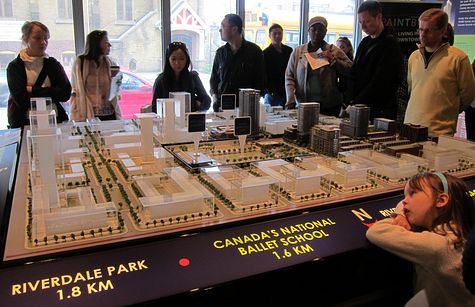
Model of

Catching up my reading, I was intrigued by “Jane Jacobs: Honoured in the breach“, an article by Stephen Wickens in the Saturday Globe and Mail.  Jane Jacobs had contacted him in 2005 to acknowledge some fact-finding on the right track, elaborating that “lot sizes and building heights often matter less to density than the land used for driving and parking”.  This people-centered view of city life was typical of Jacobs.  Wickens writes:

While her ideas are cited continually in discussions of urban affairs, their realization is arguably as far off as ever – in part because her followers are finding there are no shortcuts through her complex system of thought. […]

She had no time for ideology – left, right or whatever – and felt that many who invoke her name “cherry-pick ideas to suit their purposes.”

I was fortunate to meet Jacobs in a session of the ISSS 2000 meeting in Toronto (and was invited to her house for wine and cheese, afterwards).  She was truly a systems thinker, with a system of ideas and view on problematiques (systems of problems) that is both commonsense and complex.

On the Globe and Mail web site is a video clip of Harvard economist Edward Glaeser saying that Jane Jacobs got it wrong.

Web video: Edward Glaeser | Jane Jacobs got it wrong | globeandmail.com
Edward Glaeser | Jane Jacobs got it wrong | globeandmail.com

Wickens writes:

Harvard economist Edward Glaeser, author of last year’s Triumph of the City, says [Jacob’s] central idea that “cities are what real people make of them,” not buildings and infrastructure, “has, by and large, gotten through in the planning community.”

But Mr. Glaeser also argues that for the environment and the economy, urban density must get vertical: “She was too afraid of new buildings, too afraid of height and high density.”

His comments have sparked debate. In a speech in Toronto, New York-based critic Roberta Brandes Gratz called his criticisms an “outrage.” And [John] Sewell says he “has so misinterpreted Jane’s beliefs on density and tall buildings, it’s stunning.”  […]

Ms. Jacobs, however, felt that gentrification issues proved her right about which areas work: “Until the car became a factor, we built primarily for pedestrians,” she told me in 2004. “Those places are capable of self-regeneration.” Since then, however, costs in “unslummed” neighbourhoods have soared because “we stopped building places worth gentrifying, so demand far and increasingly outstrips supply.”

This idea of self-regeneration was is surfaced by Jane Jacobs in 2001 as self-refueling in Chapter 4 in The Nature of Economies.  Isomorphies between ecologies and economies might have been better developed if James Kay had been able to continue his research, as outlined in notes to an Environment and Resources course circa 2001.

Wickens refreshes our reading of Jacobs:

… page 150 [of The Death and Life of Great American Cities] … lists four conditions for any part of a city to generate “exuberant diversity”:

  • that districts have a mix of primary uses;
  • that most blocks be short;
  • that buildings be of various ages; and
  • that the area have sufficient density.

It was indispensable that these areas accommodate various levels of income and commercial rents.

But simply to list the factors without the examples and complicated dynamics found in the book is almost to miss the point.

“If you’ve read to the last chapter,” she told me, “you know cities – their parks, transportation planning, development policy, density ratios … are, like the life sciences, problems of organized complexity. It’s no good wishing it were any other way.”  [editorial paragraphing added]

Organized complexity is a central theme in the systems sciences.  It’s a background driver for my having developed new courses in Systemic Thinking for Sustainable Communities, and for Planners and Designers in the master’s program in Creative Sustainability at Aalto University in Finland.

References

Stephen Wickens, 2011.  Jane Jacobs: Honoured in the breach. Toronto Globe and Mail, May 7, page F4, [at globeandmail.com].

Jane Jacobs, 1961. The death and life of great American cities. Random House of Canada. [at Google Books].

Jane Jacobs, 2001. The Nature of Economies. Toronto: Vintage. [at Google Books].

2 Comments

  • David,
    I am a little confused here because of my lack of expertise on these social media tools. Did you write that (except for the insets)? Really interesting. I didn’t know you were active in community plannning/architecture area. I am ashamed to say that I have Jane’s magna opus but haven’t read it. And I am so envious of your having met her. Let me know when you are planning architectural tours/other and I will try to join. I usually go on some FLW tours during the year and am particularly interested in modern domestic architecture but also in livable cities. How right Jane was about block size.. also at the lower level of store/building size. It is so disheartening to see the NYC streetscape of small stores eaten up by chain megastores that belong in malls (if anywhere) taking up full blocks. And how often do I travel to cities where there are long blocks and huge buildings turned totally inward (Columbus OH as an example). It even infuriates me to see the chain drugstores on the corners of every little strip mall, with their door on the corner and long blank walls to either side to discourage people from also dropping into another store.
    Margaret
    P.s. Need to tell you sometime about my first little self-supported adventure (in Catalonia) on my Bike Friday.

  • @MargaretNeuer I’m interested in cities and architecture, and came into planning in my day job and teaching systems thinking.

    I was intrigued on reading, before Jane Jacobs’ passing in 2006, that she had been studying suburbs. As much as I love cities, relatively few people live in the central core, so there’s still opportunities for improving liveability where people have chosen to put down a stake. Perhaps the direction would be to establish neighbourhood mixed-used mini-centers. I have a sense of the directions that the systems sciences would suggest, but not that of the urbanists. Jane Jacobs bridged those communities.


Leave a Reply

Your email address will not be published. Required fields are marked *

  • fediscience.org/@daviding (Mastodon)

    1. Loading Mastodon feed...
  • RSS feed: on IngBrief on IngBrief

    • 2026/01/07 | Rama Akkiraju | From LLMs to Living Systems: Applying Systems Science to Agentic AI in the Enterprise | HICSS-59 Keynote
      Abstract Enterprise AI is transitioning from simple single-LLM flows to complex agentic ecosystems—adaptive systems composed of multiple agents, tools, governed data, human workflows, and organizational policies. This keynote introduces a systems-science framework for designing and managing such ecosystems using principles of modularity, control, feedback, robustness, and socio-technical alignment. We illustrate these concepts through practical examples […]
    • Timothy F.H. Allen passed away on May 01, 2025
      Timothy F.H. Allen, president of International Society for the Systems Sciences 2008-2009, passed away peacefully in his home, surrounded by his family, on May 1, 2025. With his work on ecosystem ecology, I learned more about living systems than anyone else in the systems community. After his retirement, he was proud of putting together a […]
    • Installing WordPress Studio on Manjaro Linux
      In 2024, WordPress Studio was released, making installation on a local computer simpler. The instructions were modified from MacOS to Ubuntu Linux, by Daniel Kossmann, “How to install WordPress Studio in Ubuntu Linux” | Jun 15, 2024 at https://www.danielkossmann.com/how-to-install-wordpress-studio-ubuntu-linux/ I already had NVM installed, but in Terminal, with the result “command not found”. In the […]
    • Notion of Change in the Yijing | JeeLoo Lin 2017
      The appreciation of change is different in Western philosophy than in classical Chinese philosophy. JeeLoo Lin published a concise contrast on differences. Let me parse the Introduction to the journal article, that is so clearly written. A-theories divide time into past, present and future, and the point of reference is set at “the present.” B-theories, […]
    • World Hypotheses (Stephen C. Pepper) as a pluralist philosophy [Rescher, 1994]
      In trying to place the World Hypotheses work of Stephen C. Pepper (with multiple root metaphors), Nicholas Rescher provides a helpful positioning. — begin paste — Philosophical perspectivism maintains that substantive philosophical positions can be maintained only from a “perspective” of some sort. But what sort? Clearly different sorts of perspectives can be conceived of, […]
    • The Nature and Application of the Daodejing | Ames and Hall (2003)
      Ames and Hall (2003) provide some tips for those studyng the DaoDeJing.
  • Recent Posts

  • Archives

  • RSS feed: on daviding.com on daviding.com

    • 2026/10 Moments October 2026
      Dartmouth, Nova Scotia; Halifax, Nova Scotia; Lunenberg, Nova Scotia; Peggy’s Cove, Nova Scotia; Bible Hill, Nova Scotia; Louisbourg, Nova Scotia; Sydney, Nova Scotia; Baddeck, Nova Scotia; Toronto, Ontario Fraser’s Mills Fish Hatchery: Side trip to hatchery built in 1928 by provincial government, gravity-fed from South River. Water in pen dark, ripples at surface due to […]
    • 2026/09 Moments September 2026
      Vancouver BC; Toronto, Ontario, Burlington, Ontario; Shanghai PR China Serenade of the Seas: From the foredeck of level 12 of the Royal Caribbean Line ship, the panorama west to the Vancouver Convention Centres, turning to the north across Vancouver Harbour. Observed Princess Line ship leaving the dock, a departure we never experienced. Arrived for lunch, […]
    • 2026/08 Moments August 2026
      Toronto, Ontario; Vancouver BC Next Perfect Day Playlist: Korean Town Street Festival, 20260808 Night View O What A Shiny Night Honey Haneum Playlist: Korean Town Street Festival, 20260808 Happiness Prince of Jeju Ieodo Sana Seouje Sori Leida Lay Down Together Star North Sky Beautiful Country Encore Chris Fraser Trio | Meo | 2026-08-30: Nestled in […]
    • 2026/07 Moments July 2026
      Quiet summer mostly at home writing, taking breaks to meet with friends, and exercise on bike rides.
    • 2026/06 Moments June 2026
      Cool summer catching up with family and friends, music festivals
    • 2026/05 Moments May 2026
      Cool spring, busy with Jane's Walk, bathroom renovation, closing out father's apartment, OCADU GradEx, Problematique Dialogue applying the Banathy Conversation Methodology, Qingming.
  • RSS feed: on Media Queue on Media Queue

  • Meta

  • Creative Commons License
    This work is licensed under a Creative Commons Attribution-NonCommercial-ShareAlike 4.0 International License
    Theme modified from DevDmBootstrap4 by Danny Machal