
Coevolving Innovations

… in Business Organizations and Information Technologies

Reframing service systems methods as project-portfolio conversations: Appreciating the shift from structured methods to agile systems development

The Oxford Futures Forum 2014 committee requested an image and an abstract as an application for an Open Space event for 70 participants on May 30-31.  The event description reads:

Purpose and aims

  • Forging and supporting an international community of future-minded practices aimed at stimulating actionable, impactful knowledge;
  • Identifying and investigating academic and practitioner interests at the forefront of scenarios and design, and relating them to each other;
  • Uncovering and pushing the boundaries of scenarios practices and theory, to clarify and extend their effectiveness through critical review and linking with other fields;
  • Enabling networking and publishing  (e.g. two books from first OFF in 2005; a set of sense-making scenarios and two published papers after OFF 2008, which saw another workshop based on the Oxford one organised by Arizona State University; so far one paper from OFF 2011)
  • Leveraging the neutral, highly respected and international convening power of Oxford University.

Theme – scenarios and design

The theme of the fourth Oxford Futures Forum will explore the possible synergies and differences between work on design and the so-called ‘intuitive logics’ school in scenarios.   See “Scoping the Dialogue Space” and OFF2014 supplementary information.

To clarify, in the basic “intuitive logics” method, say Wright, Bradfield, and Cairns (2013):

This model follows the approach developed over many decades by a number of writers … and organizations (e.g. Global Business Networks (GBN; SRI International). It relies upon the application of “intuitive logics” …, and is focused on the development of multiple scenarios that explore the “limits of possibility” for the future, rather than on the development of singular, “normative” scenarios of some ideal future.
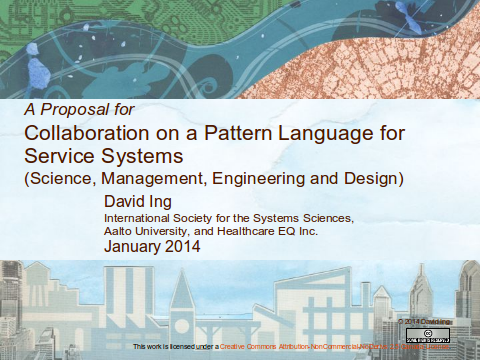
A Proposal for Collaboration on a Pattern Language for Service Systems

A meeting of systems scientists and systems engineers together as the Systems Science Working Group at the INCOSE International Workshop 2014 provided a forum for “a proposal for collaboration on a pattern language for service systems (science, management, engineering and design)”.  The title is deliberately long, and required some hours to unpack the content in the slide deck.

A Proposal for Collaboration on a Pattern Language for Service Systems (Science, Management, Engineering and Design)

The initiative has been presented as ambitious.  Writing a (good) pattern language is non-trivial.  The originator of the pattern language, Christopher Alexander, published his first work in 1968, and then spent 9 years in collaboration until the 1977 release of the landmark A Pattern Language: Towns, Building, Construction.  In a 2010 interview, Alexander was asked about his perception on similar efforts.

[Rob Hoskins]: What’s been your opinion of subsequent peoples’ attempts at doing Pattern Languages – I’ve seen a couple of different ones, have you seen many?

[Christopher Alexander]:  Some. They’re not that good. The reason I say that is that the people who’ve attempted to work with Pattern Languages, think about them, but are not conscious of the role of morphological elegance in the unfolding. In a biological case, they always are elegant and the unfolding morphology is a sort of magic. But it’s very simple.  It’s not as if it’s magic because it’s complicated, it’s just … like that.

[Rob Hoskins]:  I guess when we were talking before about how a Pattern Language goes from the large down to the small, maybe when we were talking about it as going outwards maybe it is more like an unfolding process?

… Read more (in a new tab)

What is a system? (and the challenges of definition)

When asked “what is a system?”, a deep systems thinker may hesitate to respond.  He or she may be reflecting on whether the response should be “what does a system mean to you?”, or “what should a system mean to me”?  The systems thinker recognizes that meaning comes in a context, and is therefore associated with a system of ideas held by an individual (i.e. me or you) occurs within an environment (i.e. my experience or your experience).

In parallel, consider the question “what is a mother”?  If the questioner is asking for a thoroughly researched answer, perhaps the Oxford Dictionary definition for mother will be helpful.

mother

1. a woman in relation to a child or children to whom she has given birth:
‘a mother penguin’
‘a mother of three’

2. (Mother, Mother Superior, or Reverend Mother) (especially as a title or form of address) the head of a female religious community.

3. vulgar slang , chiefly North American short for motherfucker.

On the other hand, the responses to “what does a mother mean to you?” and “what does a mother mean to me?” draws on human experience. Every baby knows what a mother means to him or her, before language — or even coherent thought — develops. For that question, perhaps a poem serves better. Here’s one from Francis Cardinal Spelling (who was first named as Francis Joseph Spellman) .

What is a mother?

… Read more (in a new tab)

Filling in a non-editable PDF form

Have you ever been asked to fill in a PDF form given not as editable electronically?  The frustrated respondent may print out the form, fill in the fields — either by hand, or with a typewriter (!) — and then transmit the result as a fax. A more persistent respondent looks for a free program that enables annotating the form and preserving an end-to-end electronic format.

One way is to “Open and edit PDF files in OpenOffice“.  This way invokes the Draw program — not the Writer word processor in OpenOffice (or LibreOffice).  The PDF Import extension converts the field labels as well as entry fields.  The import tries to match up the field label fonts, but there may be some shifting.

Another way uses Jarnal — the Java Notetaker and PDF Annotator.  This feature was demonstrated in a Jarnal demonstration video, some time after the basic pen-based sketching features.

Jarnal is a cross-platform application written in Java, that runs on Linux, Windows and Mac.

I subsequently discovered that Xournal offers similar features and is simpler to install as an Ubuntu app.

Xournal is also written in Java, and thus also installable on Linux, Windows and Mac.

Both software projects are open source, and have similar features.  Why choose one over the other?

… Read more (in a new tab)

Why do power failures seem rare in our Toronto neighbourhood?

At our home in South Riverdale of Toronto, we rarely seem to have power outages when others report them. Why might that be so?

(1) We live within walking distance of 8 electric substations.

Electric substations in Toronto, South Riverdale

From a link on “Toronto Hydro’s not-so-hidden residential substations” | Derek Place | Oct. 13, 2010 | blogto.com, I found a list of assets for Toronto Hydro from By-law No. 374-1999 at http://www.toronto.ca/legdocs/bylaws/1999/law0374.htm , and mapped out the addresses close to us.

(2) At least some of the TTC is powered by equipment in a electric substation near us, on Carlaw Avenue.  There was a procurement order in 2004 as “Procurement Authorization – Replacement Of TTC Traction Power Equipment In Toronto Hydro Owned Substations“, so maintenance should have been performed relatively recently.

(3) Toronto Hydro has a 12-acre Service Centre at 500 Commissioner’s Road.  The Toronto Portlands Company saw this development as so important that it produced two videos on the project that started in 1994, originally a Shell Canada site since the 1930s.

Conclusion:  If the power is on for Toronto Hydro and for the TTC, Riverside (South Riverdale) should also have power!

General Systems Yearbook 2013: Service Systems, Natural Systems – Sciences in synthesis

The fifth issue of Systems Research and Behavioral Science for 2013 has now been officially published.  The special issue features the content of the General Systems Yearbook, including publication of presentations derived from the ISSS San Jose 2012 meeting.  In addition to the hardcopy and official electronic version, authors are allowed to distribute preprint versions of the content.  Thus, two new articles are available:

… in addition to the earlier article:

Here’s an index to the full issue:

Service Systems, Natural Systems—Sciences in Synthesis (pages 519–521) David Ing and Jennifer Wilby DOI: 10.1002/sres.2230
An Overview of International Society for the Systems Sciences 2012 Plenary Presentations: A Supplement to the Editorial (pages 522–526) Gary Metcalf and Pamela Buckle Henning DOI: 10.1002/sres.2212
Rethinking Systems Thinking: Learning and Coevolving with the World (pages 527–547) David Ing DOI: 10.1002/sres.2229
Seizing the Opportunities Opened by the ‘Peak oil’ Effect to Reorient ‘Services’ and ‘Systems’ Research Towards ‘Value Co-Production Systems’ Scholarship (pages 548–560) Rafael Ramírez and Mikael Paltschik DOI: 10.1002/sres.2214
Service Science: Reframing Progress with Universities (pages 561–569) Jim Spohrer, Alessio Giuiusa, Haluk Demirkan and David Ing DOI: 10.1002/sres.2213
Insights into the Relationship Between Products and Services Coming from Biology (pages 570–579) Timothy F.H.
… Read more (in a new tab)
  • fediscience.org/@daviding (Mastodon)

    1. Loading Mastodon feed...
  • RSS feed: on IngBrief on IngBrief

    • 2026/01/07 | Rama Akkiraju | From LLMs to Living Systems: Applying Systems Science to Agentic AI in the Enterprise | HICSS-59 Keynote
      Abstract Enterprise AI is transitioning from simple single-LLM flows to complex agentic ecosystems—adaptive systems composed of multiple agents, tools, governed data, human workflows, and organizational policies. This keynote introduces a systems-science framework for designing and managing such ecosystems using principles of modularity, control, feedback, robustness, and socio-technical alignment. We illustrate these concepts through practical examples […]
    • Timothy F.H. Allen passed away on May 01, 2025
      Timothy F.H. Allen, president of International Society for the Systems Sciences 2008-2009, passed away peacefully in his home, surrounded by his family, on May 1, 2025. With his work on ecosystem ecology, I learned more about living systems than anyone else in the systems community. After his retirement, he was proud of putting together a […]
    • Installing WordPress Studio on Manjaro Linux
      In 2024, WordPress Studio was released, making installation on a local computer simpler. The instructions were modified from MacOS to Ubuntu Linux, by Daniel Kossmann, “How to install WordPress Studio in Ubuntu Linux” | Jun 15, 2024 at https://www.danielkossmann.com/how-to-install-wordpress-studio-ubuntu-linux/ I already had NVM installed, but in Terminal, with the result “command not found”. In the […]
    • Notion of Change in the Yijing | JeeLoo Lin 2017
      The appreciation of change is different in Western philosophy than in classical Chinese philosophy. JeeLoo Lin published a concise contrast on differences. Let me parse the Introduction to the journal article, that is so clearly written. A-theories divide time into past, present and future, and the point of reference is set at “the present.” B-theories, […]
    • World Hypotheses (Stephen C. Pepper) as a pluralist philosophy [Rescher, 1994]
      In trying to place the World Hypotheses work of Stephen C. Pepper (with multiple root metaphors), Nicholas Rescher provides a helpful positioning. — begin paste — Philosophical perspectivism maintains that substantive philosophical positions can be maintained only from a “perspective” of some sort. But what sort? Clearly different sorts of perspectives can be conceived of, […]
    • The Nature and Application of the Daodejing | Ames and Hall (2003)
      Ames and Hall (2003) provide some tips for those studyng the DaoDeJing.
  • Recent Posts

  • Archives

  • RSS feed: on daviding.com on daviding.com

    • 2026/10 Moments October 2026
      Dartmouth, Nova Scotia; Halifax, Nova Scotia; Lunenberg, Nova Scotia; Peggy’s Cove, Nova Scotia; Bible Hill, Nova Scotia; Louisbourg, Nova Scotia; Sydney, Nova Scotia; Baddeck, Nova Scotia; Toronto, Ontario Fraser’s Mills Fish Hatchery: Side trip to hatchery built in 1928 by provincial government, gravity-fed from South River. Water in pen dark, ripples at surface due to […]
    • 2026/09 Moments September 2026
      Vancouver BC; Toronto, Ontario, Burlington, Ontario; Shanghai PR China Serenade of the Seas: From the foredeck of level 12 of the Royal Caribbean Line ship, the panorama west to the Vancouver Convention Centres, turning to the north across Vancouver Harbour. Observed Princess Line ship leaving the dock, a departure we never experienced. Arrived for lunch, […]
    • 2026/08 Moments August 2026
      Toronto, Ontario; Vancouver BC Next Perfect Day Playlist: Korean Town Street Festival, 20260808 Night View O What A Shiny Night Honey Haneum Playlist: Korean Town Street Festival, 20260808 Happiness Prince of Jeju Ieodo Sana Seouje Sori Leida Lay Down Together Star North Sky Beautiful Country Encore Chris Fraser Trio | Meo | 2026-08-30: Nestled in […]
    • 2026/07 Moments July 2026
      Quiet summer mostly at home writing, taking breaks to meet with friends, and exercise on bike rides.
    • 2026/06 Moments June 2026
      Cool summer catching up with family and friends, music festivals
    • 2026/05 Moments May 2026
      Cool spring, busy with Jane's Walk, bathroom renovation, closing out father's apartment, OCADU GradEx, Problematique Dialogue applying the Banathy Conversation Methodology, Qingming.
  • RSS feed: on Media Queue on Media Queue

  • Meta

  • Creative Commons License
    This work is licensed under a Creative Commons Attribution-NonCommercial-ShareAlike 4.0 International License
    Theme modified from DevDmBootstrap4 by Danny Machal