Coevolving Innovations

… in Business Organizations and Information Technologies

Learning about teaching: systems thinking and sustainability course in Finland

[Frank] Oppenheimer had a provocative approach to learning, which can be summarized by saying that …

the best way to learn is to teach, the best way to teach is to keep learning, and that what counts in the end is having had a shared, reflected experience.  (Delacote, 1998)

At the beginning of October, I had blogged about starting the first of two courses in the master’s program in Creative Sustainability at Aalto University.  I’ve been maintaining the content online as open courseware, and have now added an index page.  The context map and the course outline have evolved, and should now have mostly stabilized with the conclusion of the lectures.
The course isn’t quite done yet, as the students have to write research papers.  I took responsibility for the course content, and Aija Staffans and Katri-Liisa Pulkkinen have taken responsibility for guiding the students through the university practicalities and evaluating their learning.

While I have previously instructed at the master’s and doctoral level before, I don’t claim to be the greatest teacher.  I see myself as a researcher who can share content with students, whom may have more or less interest in the topics.  Teaching this first class on Systemic Thinking of Sustainable Communities (with a follow on of Systemic Thinking for Planners and Designers scheduled five months later) has led me to some of my own learning, with overall conclusions that include:

  • 01. Sustainability is a topical theme that can be complemented by the systems sciences
  • 02.
… Read more (in a new tab)

Systemic Thinking of Sustainable Communities, Aalto University, Finland

At Aalto University — the institution resulting from the merger of the former Helsinki University of Technology, Helsinki School of Economics, and University of Art and Design Helsinki — there’s a new master’s program in Creative Sustainability.  I’m here to launch a pair of new courses:  Systemic Thinking of Sustainable Communities (CS0004) in October 2010, and Systemic Thinking for Planners and Designers (CS0005) scheduled for February 2011.

The design and delivery of this course has been in the agile Finnish style.  I’ve been working with Aija Staffans and Katri-Liisa Pulkkinen in transforming the reading list into a learning style suitable for a class of 24 to 30 students.

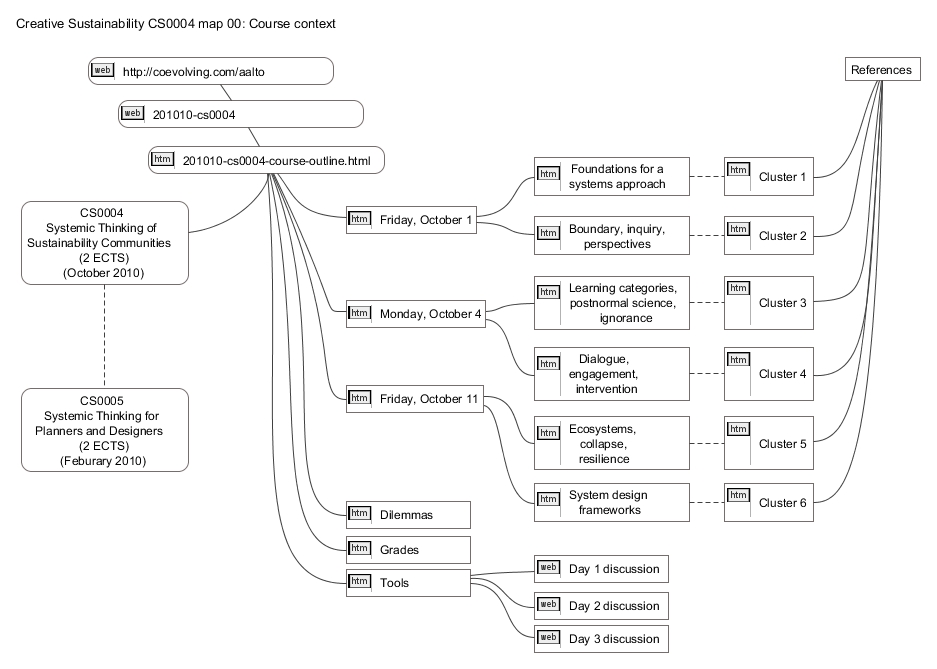
As an alternative to creating content in the traditional Powerpoint style, I’ve been putting content directly on the web.  Visual maps help to reduce confusion.  Here’s a map outlining the course.

http://coevolving.com/aalto/201010-cs0004/201010-cs0004-map00-context.png

The details are available in a course outline in long form text.  (This continues to evolve over the duration of the class).

The first lecture is on Foundations for a systems approach.

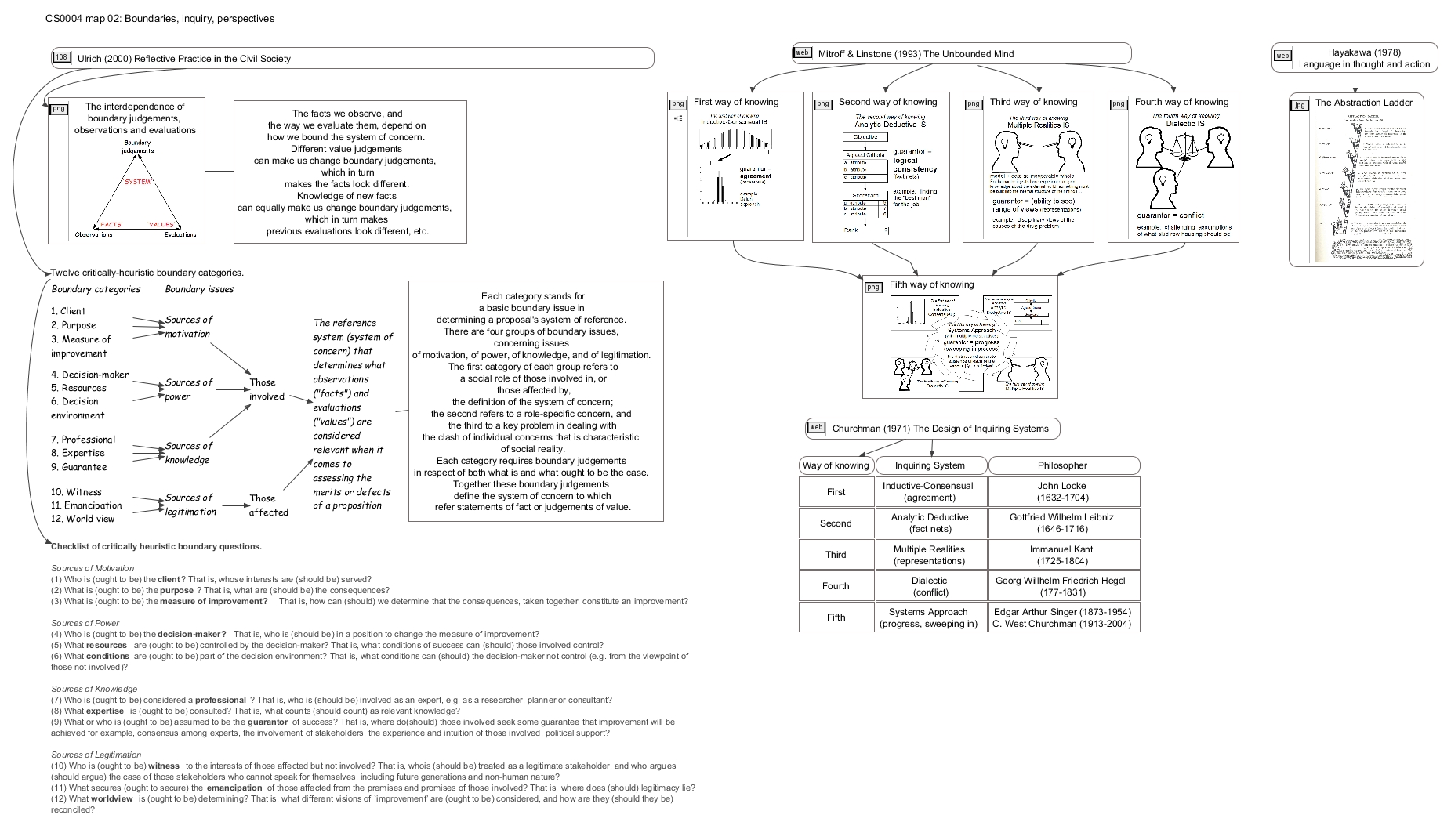
The second lecture is on Perspectives and diversity.

The students will be encouraged to join the Systems Community of Inquiry, where access and visibility will be extended from this classroom in Helsinki to the larger world of systems thinkers.  The style of education is open and fluid, appropriate for bringing new people into the systems movement.

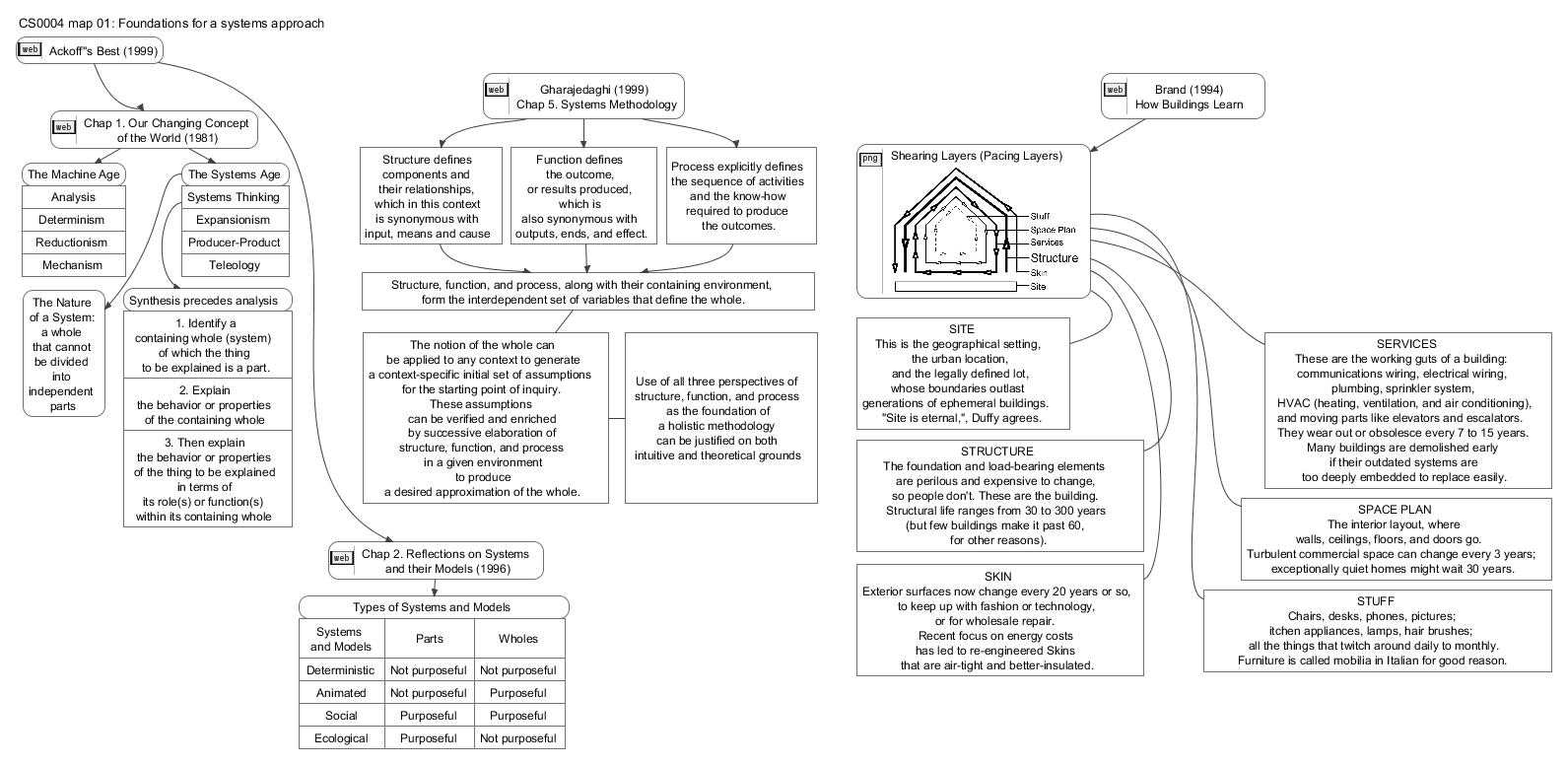
The producer-product relation, and coproducers in systems theory

In appreciating the systems sciences, it can be important to appreciate distinctions around the producer-product relation and coproducers.  A system — which is conceptually bounded by observer(s) defining a boundary — does not exist independently of its environment.  A system may draw on inputs or resources in its environment.  Changes in the environment may be associated with reactions, responses or proactive reformation (i.e. changes in structure(s)) or transformation (i.e. changes in structure(s) and function(s)).

The most rigourous description of these distinctions is in Ackoff and Emery (1972), but this is a derivation of Ackoff’s original dissertation, and relatively difficult to read.  I happened across a more readable, and helpful summary in Ackoff (1981).

The Machine Age’s commitment to cause and effect was the source of many dilemmas, including the one involving free will. At the turn of the century the American philosopher E. A. Singer, Jr., showed that science had, in effect, been cheating.  It was using two different relationships but calling both cause and effect.  He pointed out, for example, that acorns do not cause oaks because they are not sufficient, even though they are necessary, for oaks.  An acorn thrown into the ocean, or planted in the desert or an Arctic ice cap does not yield an oak.  To call the relationship between an acorn and an oak ‘probabilistic’ or ‘non deterministic causality,’ as many scientists did, was cheating because it is not possible to have a probability other than 1.0 associated with a cause; a cause completely determines its effect. 

… Read more (in a new tab)

Socio-Technical-Systems, Sustainable Work, Open Systems Theory

I’ve received news about an Aalto University course on  “Socio-Technical Systems Paradigm: History and Further Developments” [see pdf], led by Frans M. van Eijnatten (Eindhoven University of Technology) and Mari Kira (Academy Research Fellow at sustain.tkk.fi), scheduled  for September 27-28 in Espoo, Finland.

The course is associated with the Sustain Research Program that “focuses on creating sustainable work in contemporary working life”.  I also noticed a book on Creating sustainable work systems:  developing social sustainability, edited by Peter Docherty, Mari Kira and Abraham B. Shani (Taylor & Francis 2008) [preview at Google Books].

We would seem to be at the leading edge of research with this topic.  Since I’m active in the systems community, I was intrigued by a reference to an article in 2008 article in Systems Research and Behavioral Science by Mari Kira, and Frans M. van Eijnatten, “Socially sustainable work organizations: A chaordic systems approach”.

This 2008 article has led to a yet-to-be-printed (in 2010) SRBS research note by Merrelyn Emery, “Refutation of Kira & van Eijnatten’s critique of the Emery’s open systems theory” [available in early release].  She points out that the Emery variant of Open Systems Theory (OST) comes with a history of divergence in Social-Technical Systems (STS) thinking.  Emery cites continuing work with OST in a 2007 chapter by Emery and DeGuerre “Evolution of Open Systems Theory” [preview at Google Books in The change handbook:
the definitive resource on today’s best methods for engaging whole systems
, (Peggy Holman, Tom Devane, Steven Cady, editors)].… Read more (in a new tab)

Systems Community of Inquiry: online social networking in the open

Earlier this year during the Russell Ackoff memorial, I reconnected with some members of the systems community in Philadelphia.  This event was taken as an opportunity to reinvigorate the systems community, in honour of Russ.  With his colleagues and former students scattered around the world, an Internet-based presence seemed appropriate.

Systems Community of InquiryWe’ve now formally launched SysCOI.com — the Systems Community of Inquiry.  It is intended as open, worldwide network of individuals interested in systems thinking, the systems sciences and/or systems practice.

Inquiry is “an activity which produces knowledge” (Churchman, 1971).  The shared foundations and perspective in systems suggests more than a community of interest, but less than a community of practice (Wenger, 1999).  The interactions as a community aim to (i) foster interactions contributing knowledge and wisdom to the online world, and (ii) cultivate social relationships between systemicists.

The web interface follows an activity stream style of interaction, as has become popular with Facebook.  In the interest of completely open communications,  content posted on SysCOI.com is visible anywhere the Internet is accessible, and actively crawled by search engines.  There is no ambiguity about privacy with this online community: all communications are public.  The feature of choosing your “friends” on this web site enables following a smaller set of contributors, as the size of the social network increases.  Discussions with longer-running threads can be organized with groups and forums provided on the site.

Pre-announcement of the new web site occurred in April at the Systems Research Conversation at Pernegg, sponsored by the IFSR. … Read more (in a new tab)

Learning 21st century skills, including systems thinking, through game-based education

An article on NPR about the Quest to Learn program in New York City led by Katie Salen cites systems thinking as one of the foundations for 21st century literacy. I found this article on a lead from Erika von Hoyer on the Systems Community of Inquiry via her Twitter feed.

The learning model at Quest to Learn says: “Games and other forms of digital media serve another useful purpose at Quest: they serve to model the complexity and promise of ‘systems.’ Understanding and accounting for this complexity is a fundamental literacy of the 21st century”.   Reading the CV of Katie Salen, I notice that she was working on the Spaceship Earth Game at the Buckminister Fuller Institute in 2005.

This led to finding an interview about the three-year study on “Grinding New Lenses: A Design Project to Support a Systems View of the World” conducted by Kylie Pepper and Melissa Gresalfi at Indiana University.  The funding by the MacArthur Foundation seems to be part of the research on assessing learning with new media as part of the 21st century assessment project.

In a panel at the Digital Media & Learning conference, Valerie Shute says “What attributes of the students are important for success in the 21st century? Systems thinking, collaborating, resource-management skills”.  This is related to worked examples and evidence-centered design.

This direction on systems thinking in middle school is compatible with the proposed design for K-12 education on Smarter Planet Service Systems proposed by Jim Spohrer. … Read more (in a new tab)

  • fediscience.org/@daviding (Mastodon)

    1. Loading Mastodon feed...
  • RSS feed: on IngBrief on IngBrief

    • 2026/01/07 | Rama Akkiraju | From LLMs to Living Systems: Applying Systems Science to Agentic AI in the Enterprise | HICSS-59 Keynote
      Abstract Enterprise AI is transitioning from simple single-LLM flows to complex agentic ecosystems—adaptive systems composed of multiple agents, tools, governed data, human workflows, and organizational policies. This keynote introduces a systems-science framework for designing and managing such ecosystems using principles of modularity, control, feedback, robustness, and socio-technical alignment. We illustrate these concepts through practical examples […]
    • Timothy F.H. Allen passed away on May 01, 2025
      Timothy F.H. Allen, president of International Society for the Systems Sciences 2008-2009, passed away peacefully in his home, surrounded by his family, on May 1, 2025. With his work on ecosystem ecology, I learned more about living systems than anyone else in the systems community. After his retirement, he was proud of putting together a […]
    • Installing WordPress Studio on Manjaro Linux
      In 2024, WordPress Studio was released, making installation on a local computer simpler. The instructions were modified from MacOS to Ubuntu Linux, by Daniel Kossmann, “How to install WordPress Studio in Ubuntu Linux” | Jun 15, 2024 at https://www.danielkossmann.com/how-to-install-wordpress-studio-ubuntu-linux/ I already had NVM installed, but in Terminal, with the result “command not found”. In the […]
    • Notion of Change in the Yijing | JeeLoo Lin 2017
      The appreciation of change is different in Western philosophy than in classical Chinese philosophy. JeeLoo Lin published a concise contrast on differences. Let me parse the Introduction to the journal article, that is so clearly written. A-theories divide time into past, present and future, and the point of reference is set at “the present.” B-theories, […]
    • World Hypotheses (Stephen C. Pepper) as a pluralist philosophy [Rescher, 1994]
      In trying to place the World Hypotheses work of Stephen C. Pepper (with multiple root metaphors), Nicholas Rescher provides a helpful positioning. — begin paste — Philosophical perspectivism maintains that substantive philosophical positions can be maintained only from a “perspective” of some sort. But what sort? Clearly different sorts of perspectives can be conceived of, […]
    • The Nature and Application of the Daodejing | Ames and Hall (2003)
      Ames and Hall (2003) provide some tips for those studyng the DaoDeJing.
  • Recent Posts

  • Archives

  • RSS feed: on daviding.com on daviding.com

    • 2026/10 Moments October 2026
      Dartmouth, Nova Scotia; Halifax, Nova Scotia; Lunenberg, Nova Scotia; Peggy’s Cove, Nova Scotia; Bible Hill, Nova Scotia; Louisbourg, Nova Scotia; Sydney, Nova Scotia; Baddeck, Nova Scotia; Toronto, Ontario Fraser’s Mills Fish Hatchery: Side trip to hatchery built in 1928 by provincial government, gravity-fed from South River. Water in pen dark, ripples at surface due to […]
    • 2026/09 Moments September 2026
      Vancouver BC; Toronto, Ontario, Burlington, Ontario; Shanghai PR China Serenade of the Seas: From the foredeck of level 12 of the Royal Caribbean Line ship, the panorama west to the Vancouver Convention Centres, turning to the north across Vancouver Harbour. Observed Princess Line ship leaving the dock, a departure we never experienced. Arrived for lunch, […]
    • 2026/08 Moments August 2026
      Toronto, Ontario; Vancouver BC Next Perfect Day Playlist: Korean Town Street Festival, 20260808 Night View O What A Shiny Night Honey Haneum Playlist: Korean Town Street Festival, 20260808 Happiness Prince of Jeju Ieodo Sana Seouje Sori Leida Lay Down Together Star North Sky Beautiful Country Encore Chris Fraser Trio | Meo | 2026-08-30: Nestled in […]
    • 2026/07 Moments July 2026
      Quiet summer mostly at home writing, taking breaks to meet with friends, and exercise on bike rides.
    • 2026/06 Moments June 2026
      Cool summer catching up with family and friends, music festivals
    • 2026/05 Moments May 2026
      Cool spring, busy with Jane's Walk, bathroom renovation, closing out father's apartment, OCADU GradEx, Problematique Dialogue applying the Banathy Conversation Methodology, Qingming.
  • RSS feed: on Media Queue on Media Queue

  • Meta

  • Creative Commons License
    This work is licensed under a Creative Commons Attribution-NonCommercial-ShareAlike 4.0 International License
    Theme modified from DevDmBootstrap4 by Danny Machal