Coevolving Innovations

… in Business Organizations and Information Technologies

Misinterpreting Jane Jacobs

I, like many other Torontonians, went on a Jane’s Walk yesterday, an annual event honouring the legacy and ideas of Jane Jacobs.  DY and I joined the Regent Park Revitalized walk, scheduled for 2 hours in length.  With tour leaders from Toronto Community Housing (the legacy property owner), The Daniels Corporation (the developer leading the public-private partnership), and volunteers from the Regent Park community, we spent over 3 hours immersed in experiencing the transition-in-progress of a 28 hectare (69-acre) neighbourhood.
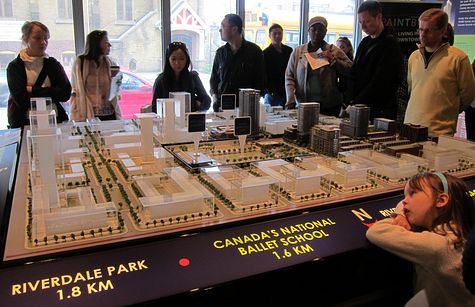
Model of

Catching up my reading, I was intrigued by “Jane Jacobs: Honoured in the breach“, an article by Stephen Wickens in the Saturday Globe and Mail.  Jane Jacobs had contacted him in 2005 to acknowledge some fact-finding on the right track, elaborating that “lot sizes and building heights often matter less to density than the land used for driving and parking”.  This people-centered view of city life was typical of Jacobs.  Wickens writes:

While her ideas are cited continually in discussions of urban affairs, their realization is arguably as far off as ever – in part because her followers are finding there are no shortcuts through her complex system of thought. […]

She had no time for ideology – left, right or whatever – and felt that many who invoke her name “cherry-pick ideas to suit their purposes.”

I was fortunate to meet Jacobs in a session of the ISSS 2000 meeting in Toronto (and was invited to her house for wine and cheese, afterwards). … Read more (in a new tab)
Systemic Thinking for Planners and Designers (CS0005), Aalto University, Finland

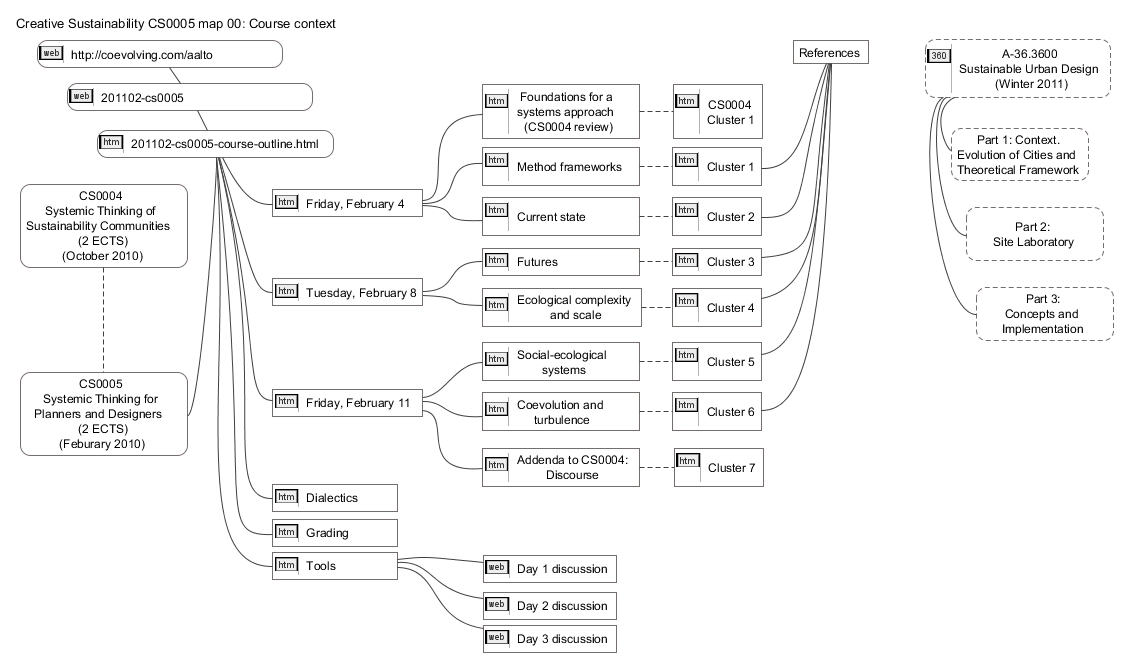
In February, I returned to Finland to teach the Systemic Thinking for Planners and Designers CS0005 course in the master’s program in Creative Sustainability at Aalto University.  I had previously blogged about teaching and learning from the Systemic Thinking for Sustainable Communities CS0004 course in October.  The February course was again intensive, this time on a Friday-Tuesday-Friday schedule.

All of the course content is available as open source in a directory at http://coevolving.com/aalto/201102-cs0005/ .  Here’s a map outlining the course.

The style of the classes again centered on a list of references from which students could select according to personal interests, supplemented by lectures outlined with context maps.  The course outline was provided as long form text that evolved online during the week.  Written responses from students were most frequently posted on public blogs, with notifications and responses on the Systemicists Forum on the Systems Community of Inquiry, with separate threads for Day 1, Day 2, Day 3, and the final essays.

The first lecture for CS0005 was a quick review of the first topic for CS0004 in October, foundations for a systems approach.  This turned out to be a worthwhile activity, as the students (and my co-instructors!) had mulled over the basic ideas of systems for four months, resulting in more reflection and questions than I was expecting.

This background in the first lecture continued with a discussion of method frameworks.

The Systems Sciences and Systems Engineering

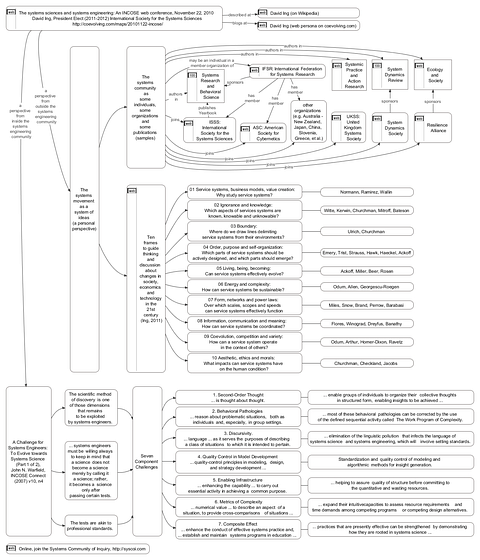
How are (or can or should) the systems sciences and systems engineering (be) related?  For the web conference for the INCOSE (International Council on Systems Engineering) Complex Systems Working Group on November 22, 2010, I decided to present a personal perspective on linkages.  The ideas were essentially in two parts, with

  • the systems movement as a system of ideas, including …
    • the systems science community as some individuals, some organizations and some publications; and
    • ten frames to guide thinking and discussion about changes in society, economics and technology in the 21st century (based on Ing (2011)); and
  • John N. Warfield’s “A Challenge for Systems Engineers: To Evolve towards Systems Science”, published in INCOSE Insight (2007).

The first point reflects my view of the breadth and diversity of the system sciences.  The second point reviewed the some challenges presented by John N. Warfield, who was both a pioneer in the systems engineering community and a luminary in the systems sciences community.  As a guide for the web conference, I provided a context map.

View the full-sized context map or listen to the digital audio recording.

The web conference was recorded, producing a movie that emphasizes key points on the context map.

Watch the larger 844x528px video, the original size 720x448px video, or the smaller 480x304px video hosted on coevolving.com. These were converted from the original 844x528px WMV recording.

The systems engineers and systems scientists are working towards cooperation, with the intersecting domains and interests continuing to be developed. … Read more (in a new tab)

Panel on Service Systems and Systems Sciences in the Twenty-First Century, INCOSE International Symposium 2010

Since 2008, I’ve been conducting research on service systems and the systems sciences, with my core collaborators Gary Metcalf, Jennifer Wilby and Kyoichi (Jim) Kijima.  As senior members of the International Society for the Systems Sciences, we’ve been working towards a more formal association with the International Council on Systems Engineering, and with the Systems Science Working Group in particular.  Our organizations came together for the first time in the INCOSE International Symposium 2010, in Chicago.

For the International Symposium, our contribution was a panel on our progress in researching service systems and the systems sciences, with position papers and presentation slides discussed in Chicago in July.  After that meeting, a summary of the session was reported in an article published in INCOSE Insight in October.

The publications page on this web site includes links to the:

Our core group will be continuing our research into 2011, with a two-day co-learning workshop at the International Workshop 2011 in Phoenix, Arizona.  The linkages between the systems sciences and systems engineering should continue to develop.

HD video: on my own domain, archive.org, blip.tv, Vimeo or Youtube?

There’s so much video content available on the web today, with many different styles for sharing.  The variety of considerations can lead one person to favour an approach that isn’t quite right for someone else.  After months of trial-and-error, I’ve compiled a comparison of web movies hosted on (1) my own domain, (2) Community Video on archive.org, (3) blip.tv, (4) Vimeo, and (5) Youtube.  I was motivated to share the experience of the Beat, Breaks & Culture festival at Harbourfront Centre in Toronto on July 11, in which my third son Noah performed in the final battle between Ground Illusionz and The F.A.M.

I’ve summarized my assessments in a table near the bottom of the (long) page.  The essential considerations include:

(a) Website blocking / Internet filtering? Is web site blocking (more formally known as Internet filtering) by national governments (e.g. by China and other countries); in public libraries (e.g. content judged offensive or inappropriate); or in workplaces (e.g non-work-related use) a concern?
(b) Media containers? The H.264 (MPEG-4) standard is emerging as a new leader, with Flash Video common as a plugin to most browsers but not supported on Apple products.  Digital cameras may produce AVI, MOV (Quicktime) or other formats, while different browsers natively support Theora (Ogg Video) and WebM.
(c) Browser embedding and linking? Once the web movie is on the Internet, how easy is embedding into a blog post, and/or creating a web link?
… Read more (in a new tab)

Conversations on an emerging science of service systems (IFSR Pernegg 2010)

Earlier this year, in April, the International Federation for Systems Research hosted its biannual research conversation, this time in Pernegg, Austria.  This meeting was a four-day opportunity to continue developing ideas on the emerging science of service systems begun in July 2009.

The proceedings from the meeting have now been published.  I’ve extracted the chapter for our team as a separate downloadable document.  The report starts with a description of our activities, and an outline of our progress.

The conversation began with self-reflections on personal experiences leading each of the individuals to the systems sciences, acknowledging the influence of those trajectories on their perspectives on service systems.  In recognition of this science of service systems as a potentially a new paradigm, much of the time together was spent in sensemaking about the intersection between ongoing services research and systems sciences perspectives.  This sensemaking led the team to focus the dialogue more on posing the right questions to clarify thinking broadly, as opposed to diving deeply towards solutions that would be tied up as issues within a problematique.

During the conversation, the progress on ideas was recorded on flipcharts.  Nearing the end of our time together, the team cut up the flipcharts with scissors, and collated the discussion threads into five clusters:  (i) philosophy; (ii) science; (iii) models; (iv) education; (v) development.  With service systems as a new domain, the team found all five clusters underdeveloped.  Recognizing that all five clusters are coevolving, the phenomenon of service systems was listed in order from the most concrete (i.e.

… Read more (in a new tab)
  • fediscience.org/@daviding (Mastodon)

    1. Loading Mastodon feed...
  • RSS feed: on IngBrief on IngBrief

    • 2026/01/07 | Rama Akkiraju | From LLMs to Living Systems: Applying Systems Science to Agentic AI in the Enterprise | HICSS-59 Keynote
      Abstract Enterprise AI is transitioning from simple single-LLM flows to complex agentic ecosystems—adaptive systems composed of multiple agents, tools, governed data, human workflows, and organizational policies. This keynote introduces a systems-science framework for designing and managing such ecosystems using principles of modularity, control, feedback, robustness, and socio-technical alignment. We illustrate these concepts through practical examples […]
    • Timothy F.H. Allen passed away on May 01, 2025
      Timothy F.H. Allen, president of International Society for the Systems Sciences 2008-2009, passed away peacefully in his home, surrounded by his family, on May 1, 2025. With his work on ecosystem ecology, I learned more about living systems than anyone else in the systems community. After his retirement, he was proud of putting together a […]
    • Installing WordPress Studio on Manjaro Linux
      In 2024, WordPress Studio was released, making installation on a local computer simpler. The instructions were modified from MacOS to Ubuntu Linux, by Daniel Kossmann, “How to install WordPress Studio in Ubuntu Linux” | Jun 15, 2024 at https://www.danielkossmann.com/how-to-install-wordpress-studio-ubuntu-linux/ I already had NVM installed, but in Terminal, with the result “command not found”. In the […]
    • Notion of Change in the Yijing | JeeLoo Lin 2017
      The appreciation of change is different in Western philosophy than in classical Chinese philosophy. JeeLoo Lin published a concise contrast on differences. Let me parse the Introduction to the journal article, that is so clearly written. A-theories divide time into past, present and future, and the point of reference is set at “the present.” B-theories, […]
    • World Hypotheses (Stephen C. Pepper) as a pluralist philosophy [Rescher, 1994]
      In trying to place the World Hypotheses work of Stephen C. Pepper (with multiple root metaphors), Nicholas Rescher provides a helpful positioning. — begin paste — Philosophical perspectivism maintains that substantive philosophical positions can be maintained only from a “perspective” of some sort. But what sort? Clearly different sorts of perspectives can be conceived of, […]
    • The Nature and Application of the Daodejing | Ames and Hall (2003)
      Ames and Hall (2003) provide some tips for those studyng the DaoDeJing.
  • Recent Posts

  • Archives

  • RSS feed: on daviding.com on daviding.com

    • 2026/10 Moments October 2026
      Dartmouth, Nova Scotia; Halifax, Nova Scotia; Lunenberg, Nova Scotia; Peggy’s Cove, Nova Scotia; Bible Hill, Nova Scotia; Louisbourg, Nova Scotia; Sydney, Nova Scotia; Baddeck, Nova Scotia; Toronto, Ontario Fraser’s Mills Fish Hatchery: Side trip to hatchery built in 1928 by provincial government, gravity-fed from South River. Water in pen dark, ripples at surface due to […]
    • 2026/09 Moments September 2026
      Vancouver BC; Toronto, Ontario, Burlington, Ontario; Shanghai PR China Serenade of the Seas: From the foredeck of level 12 of the Royal Caribbean Line ship, the panorama west to the Vancouver Convention Centres, turning to the north across Vancouver Harbour. Observed Princess Line ship leaving the dock, a departure we never experienced. Arrived for lunch, […]
    • 2026/08 Moments August 2026
      Toronto, Ontario; Vancouver BC Next Perfect Day Playlist: Korean Town Street Festival, 20260808 Night View O What A Shiny Night Honey Haneum Playlist: Korean Town Street Festival, 20260808 Happiness Prince of Jeju Ieodo Sana Seouje Sori Leida Lay Down Together Star North Sky Beautiful Country Encore Chris Fraser Trio | Meo | 2026-08-30: Nestled in […]
    • 2026/07 Moments July 2026
      Quiet summer mostly at home writing, taking breaks to meet with friends, and exercise on bike rides.
    • 2026/06 Moments June 2026
      Cool summer catching up with family and friends, music festivals
    • 2026/05 Moments May 2026
      Cool spring, busy with Jane's Walk, bathroom renovation, closing out father's apartment, OCADU GradEx, Problematique Dialogue applying the Banathy Conversation Methodology, Qingming.
  • RSS feed: on Media Queue on Media Queue

  • Meta

  • Creative Commons License
    This work is licensed under a Creative Commons Attribution-NonCommercial-ShareAlike 4.0 International License
    Theme modified from DevDmBootstrap4 by Danny Machal