
Coevolving Innovations

… in Business Organizations and Information Technologies

T-shaped professionals, T-shaped skills, hybrid managers

The science, management and engineering of service systems is associated with a call for T-shaped people. The most recent emphasis is on T-shaped professionals, which was preceded by T-shaped skills, with linkages back to a 1990 study on hybrid managers. Some insight can be gained by working backwards through the nuanced terms.

The 2008 Cambridge (IfM and IBM) report issues a challenge to universities for developing skills, and then seeks to enlist support from business and government.

Developing T-shaped professionals
Discipline-based education remains a vital role of modern universities. In order to close the skill gap, however, universities should also offer students the opportunity to gain qualifications in the interdisciplinary requirements of SSME. Such qualifications would equip graduates with the concepts and vocabulary to discuss the design and improvement of service systems with peers from other disciplines. Industry refers to these people as T-shaped professionals, who are deep problem solvers in their home discipline but also capable of interacting with and understanding specialists from a wide range of disciplines and functional areas.

Widely recognised SSME programmes would help ensure the availability of a large population of T-shaped professionals (from many home disciplines) with the ability to collaborate to create service innovations. SSME qualifications would indicate that these graduates could communicate with scientists, engineers, managers, designers, and many others involved in service systems. Graduates with SSME qualifications would be well prepared to ‘hit the ground running’, able to become immediately productive and make significant contributions when joining a service innovation project.
… Read more (in a new tab)

Innovation as open, collaborative, multidisciplinary, global

On more than one occasion, I’ve heard IBM executives assert:

The nature of innovation has changed. In the 21st century, innovation is open, collaborative, multidisciplinary and global.

The ideas of open, collaborative, multidisciplinary and global appeared in the Global Innovation Outlook 2.0 report that was published in mid-2006. These words appeared on IBM-internal slides presented by Nick Donofrio at an Consulting Leadership Exchange in September 2005, and at the external-facing conference on Education for the 21st Century in October 2006 … with lots of other occasions in between. But what do these four words mean?

To make some sense for myself, I’ve extended these words into phrases and contrasted their contexts in a table .

  Industrial age nature of innovation   21st century nature of innovation
Strategy Private methods and development enabling autonomous control over designs + Open standards and interfaces leveraging expedient platforms for advancing designs
Relationship Transactional production chains linked by inter-organizational contracting + Collaborative alliances coproducing accelerated learning
Method Analytical problem-solving + Multidisciplinary conversations
Economics Colonial trade + Global talent

I’ve been listening to audio recordings of Donofrio in conversation, as well as following Irving Wladawsky-Berger’s blog. While I believe that my reasoning is consistent with theirs, this is not something they’ve endorsed. When I present the right column to audiences, I generally see nods in agreement. At the same time, the implications of a contrasting left column on current business practices provokes some deeper reflections.… Read more (in a new tab)

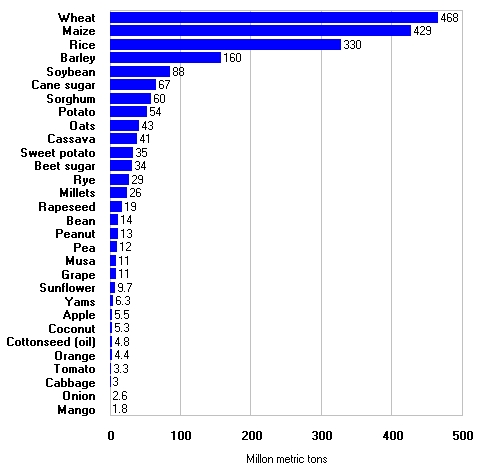
World diet is concentrated on a few cereal grains

I normally focus on industrial and service businesses, but recently headlines on rising food prices have me looking into agricultural businesses. Here some statistics to ponder: the world’s top 4 crops — wheat, corn, rice and barley — weigh more than the next 26 crops combined.

1999_WorldRevNutrDiet_Cordain_Table1.jpg The world’s top 30 food crops (estimated edible dry matter) [following Cordain (1999) Table 1]

Our diet really is quite limited in scope, according to Cordain (1999):

Conversations for action, commitment management protocol

In the interest of furthering a science of service systems, the language-action perspective may be relevant. Business-oriented researchers have an appreciation of the gap between what people say and what they do, but may not be familiar with the development of this framework coming from computer science. Two decades of the language-action perspective were recently marked since the publication of Understanding Computers and Cognition in 1986 by Terry Winograd and Fernando Flores. It’s been almost three decades since “Doing and Speaking in the Office” by Fernando Flores and Juan Ludlow first appeared in an IIASA conference proceedings in 1980. This approach was foundational to the Commitment Management Protocol, as described in Adaptive Enterprise: Creating and Leading Sense-and-Respond Organizations by Steve Haeckel in 1999. The language-action perspective can provide some clarity in describing coordination within a service system.

Let’s trace the development of ideas, following milestones in three major sections:

  • 1. What’s the linkage between language and action at work? Doing and speaking in the office
  • 2. How do computers fit into collaborative work? Understanding computers and cognition
  • 3. How can empowered workers coordinate outcomes and roles? Commitment management protocol

These works were published in 1980, 1986 and 1999. The viewpoints are all complementary, with each oriented towards slightly different issues.

Coproduction, interactive value, offering, value constellation

In the pursuit of gaining a stronger understanding of a science of service systems through systems science, I’ve been working my way through the works of Richard Normann, Rafael Ramirez and Johan Wallin. There’s a long evolution of thought there, with a depth that may not be obvious to readers who aren’t systems scientists. Thus, phrases such as coproduction, interactive value, offering and value constellation have a specific meaning within the systems science community that the layman may not appreciate. Let me try to bring together some of the ideas, across the references.

  • 1. A service system includes a supplier with a customer (and possibly subcontractors) as coproducers of outcomes
  • 2. Interactive value is actualized not in coproduction of the supplier with customer, but in coproduction of the customer with his/her customer / counterparts
  • 3. Offerings are interactions that provide benefits in the form of (a) physical product, (b) service and infrastructure and (c) interpersonal relationship
  • 4. An offering can be either an output of coproduction, or input into coproduction
  • 5. A value constellation includes the supplier, customer and subcontractors as coproducers

The systems flavour comes out not only in recognizing parts within the service system, but in emphasizing the interactions between parts. It’s worth re-examining these writings in the context of a new science of service systems.

Talent in the (new) service economy: creative class occupations?

I had previously written that “the (new) service economy is not the same as the service sector“. There’s an deep problem in trying to define and measure something new, when we have to rely on government statistics that have an anchor point of 1980, 1971, or even 1945. Using old definitions doesn’t necessary invalidate the measurements, but is problem if we’re dealing with a paradigm shift in a scientific revolution.

In quantifying economic systems, many of the approaches take an output-oriented (i.e. GDP or value-added) approach. Another alternative is to take an input-oriented approach (i.e. labour). Looking into labour has brought me back to Richard Florida’s research. In The Rise of the Creative Class (2002) appears a breakdown of U.S. statistics that contrast to the three-sector view.

Appendix Table 1 Counting the Classes, 1999 [p. 330]1

Share Employees (OES data) Percent Share Employees (Emp. & Earnings data) Percent Share
Creative Class 38,278,110 30.0% 38,453,000 28.8%
  Super-Creative Core 14.932,420 11.7% 14,133,000 10.6%
  Other Creative Class 23.345,690 18.3% 24,320,000 18.2%
Working Class 33,238,810 26.1% 32.760,000 24.5%
Service Class 55,293,720 43.4% 58,837,000 44.1%
Agriculture 463,360 0.4% 3,426,000 2.6%
  Total 127,274,000   133,488,000  

Why does the view of occupations as super-creative core and other creative class matter? From The Flight of the Creative Class in 2004, creative class occupations are shown to drive disproportionate amounts of wealth generation in the U.S. (Their creative sector I’ll frame as “new” service economy occupations, to contrast from their service sector as traditional service economy occupations).

  • fediscience.org/@daviding (Mastodon)

    1. Loading Mastodon feed...
  • RSS feed: on IngBrief on IngBrief

    • 2026/01/07 | Rama Akkiraju | From LLMs to Living Systems: Applying Systems Science to Agentic AI in the Enterprise | HICSS-59 Keynote
      Abstract Enterprise AI is transitioning from simple single-LLM flows to complex agentic ecosystems—adaptive systems composed of multiple agents, tools, governed data, human workflows, and organizational policies. This keynote introduces a systems-science framework for designing and managing such ecosystems using principles of modularity, control, feedback, robustness, and socio-technical alignment. We illustrate these concepts through practical examples […]
    • Timothy F.H. Allen passed away on May 01, 2025
      Timothy F.H. Allen, president of International Society for the Systems Sciences 2008-2009, passed away peacefully in his home, surrounded by his family, on May 1, 2025. With his work on ecosystem ecology, I learned more about living systems than anyone else in the systems community. After his retirement, he was proud of putting together a […]
    • Installing WordPress Studio on Manjaro Linux
      In 2024, WordPress Studio was released, making installation on a local computer simpler. The instructions were modified from MacOS to Ubuntu Linux, by Daniel Kossmann, “How to install WordPress Studio in Ubuntu Linux” | Jun 15, 2024 at https://www.danielkossmann.com/how-to-install-wordpress-studio-ubuntu-linux/ I already had NVM installed, but in Terminal, with the result “command not found”. In the […]
    • Notion of Change in the Yijing | JeeLoo Lin 2017
      The appreciation of change is different in Western philosophy than in classical Chinese philosophy. JeeLoo Lin published a concise contrast on differences. Let me parse the Introduction to the journal article, that is so clearly written. A-theories divide time into past, present and future, and the point of reference is set at “the present.” B-theories, […]
    • World Hypotheses (Stephen C. Pepper) as a pluralist philosophy [Rescher, 1994]
      In trying to place the World Hypotheses work of Stephen C. Pepper (with multiple root metaphors), Nicholas Rescher provides a helpful positioning. — begin paste — Philosophical perspectivism maintains that substantive philosophical positions can be maintained only from a “perspective” of some sort. But what sort? Clearly different sorts of perspectives can be conceived of, […]
    • The Nature and Application of the Daodejing | Ames and Hall (2003)
      Ames and Hall (2003) provide some tips for those studyng the DaoDeJing.
  • Recent Posts

  • Archives

  • RSS feed: on daviding.com on daviding.com

    • 2026/10 Moments October 2026
      Dartmouth, Nova Scotia; Halifax, Nova Scotia; Lunenberg, Nova Scotia; Peggy’s Cove, Nova Scotia; Bible Hill, Nova Scotia; Louisbourg, Nova Scotia; Sydney, Nova Scotia; Baddeck, Nova Scotia; Toronto, Ontario Fraser’s Mills Fish Hatchery: Side trip to hatchery built in 1928 by provincial government, gravity-fed from South River. Water in pen dark, ripples at surface due to […]
    • 2026/09 Moments September 2026
      Vancouver BC; Toronto, Ontario, Burlington, Ontario; Shanghai PR China Serenade of the Seas: From the foredeck of level 12 of the Royal Caribbean Line ship, the panorama west to the Vancouver Convention Centres, turning to the north across Vancouver Harbour. Observed Princess Line ship leaving the dock, a departure we never experienced. Arrived for lunch, […]
    • 2026/08 Moments August 2026
      Toronto, Ontario; Vancouver BC Next Perfect Day Playlist: Korean Town Street Festival, 20260808 Night View O What A Shiny Night Honey Haneum Playlist: Korean Town Street Festival, 20260808 Happiness Prince of Jeju Ieodo Sana Seouje Sori Leida Lay Down Together Star North Sky Beautiful Country Encore Chris Fraser Trio | Meo | 2026-08-30: Nestled in […]
    • 2026/07 Moments July 2026
      Quiet summer mostly at home writing, taking breaks to meet with friends, and exercise on bike rides.
    • 2026/06 Moments June 2026
      Cool summer catching up with family and friends, music festivals
    • 2026/05 Moments May 2026
      Cool spring, busy with Jane's Walk, bathroom renovation, closing out father's apartment, OCADU GradEx, Problematique Dialogue applying the Banathy Conversation Methodology, Qingming.
  • RSS feed: on Media Queue on Media Queue

  • Meta

  • Creative Commons License
    This work is licensed under a Creative Commons Attribution-NonCommercial-ShareAlike 4.0 International License
    Theme modified from DevDmBootstrap4 by Danny Machal