Coevolving Innovations

… in Business Organizations and Information Technologies

Science of service systems, service sector, service economy

As Service Science, Management and Engineering (SSME) has been developing, I’ve noticed a refinement of language. Rather than just abbreviating the long clause to service science, I’m now careful to use the phrase of a science of service systems, following Spohrer, Maglio et. al (2007). There’s a clear definition of service system in the final April 2008 revision of the report by the University of Cambridge Institute for Manufacturing.

What is a service system?
A service system can be defined as a dynamic configuration of resources (people, technology, organisations and shared information) that creates and delivers value between the provider and the customer through service. In many cases, a service system is a complex system in that configurations of resources interact in a non-linear way. Primary interactions take place at the interface between the provider and the customer. However, with the advent of ICT, customer-to-customer and supplier-to-supplier interactions have also become prevalent. These complex interactions create a system whose behaviour is difficult to explain and predict. [p. 6]

I’ve been sorting through the significance of this service system orientation, and have reached the following personal points-of-view.

  • 1. The definition of a service system as a system is earnest
  • 2. A service system creating and delivering value emphasizes a value constellation perspective over a value chain perspective
  • 3. Research into service systems is muddled in the ideas of coproduction and (value) cocreation
  • 4. A service system creates value with an offering as a platform for co-production
  • 5.
… Read more (in a new tab)

Research perspectives in service engineering and management, volume 1

In November 2007, Research Perspectives in Service Engineering and Management, Volume 1 was published. I’ve now posted a copy of my chapter on “Service Engineering and Management, Value Coproduction, and Situated Practices” online.

The paper was the result of participation in the Service Engineering and Management Summer School at the Helsinki University of Technology, in August 2006. Prior to attending, I had submitted a completely different presentation — on “Innovation in Service Business Ecosystems” — and spoke on that at the seminar. When it came time to write the paper, however, I had to get over a reflection that my viewpoint was completely different from the other attendees. I essentially threw out the content I had presented, and started over again. I’m grateful to the multiple reviews on my paper from the editor, Saara Brax, as we wrestled through content to make it understandable.

I have a copy of the book in hardcopy form. Here’s the table of contents.

ICT capital and the services sector in OECD reports

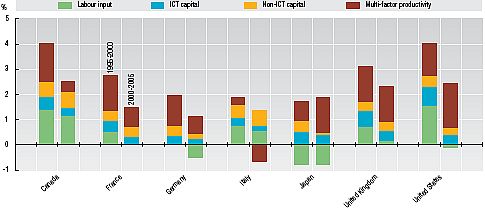
I happened to be looking at the 2007 OECD Science, Technology and Industry Scorecard, and noticed a chart on “Growth Accounts for OECD Countries”. I’ve never thought of a breakdown this way, so I was intrigued by the legend.

2007_OECD_ScienceTechnologyIndustryScoreboard_legend.jpg

We naturally think of labour inputs, and capital inputs, but I didn’t realize that there were statistics that break out ICT capital (in blue) from non-ICT capital (in orange). Information and Communications Technologies (ICT) isn’t something that Karl Marx specifically thought about. The OECD reports acknowledges that breaking economic growth down into factors of production is tricky thing.

Economic growth can be increased by increasing the amount and types of labour and capital used in production, and by attaining greater overall efficiency in how these factors of production are used together, i.e. higher multifactor productivity. Growth accounting involves breaking down growth of GDP into the contribution of labour input, capital input and MFP. The growth accounting model is based on the microeconomic theory of production and rests on a number of assumptions ….1

Assuming that we really can break down factors contributing to growth by labour, ICT capital, and non-ICT capital — as well as some multi-factor productivity that can’t be broken down — what does it look like? Look at the blue bar in the view of the G7 countries …

Contributions to GDP growth, G7 countries, 1995-2000 and 2000-05
(percentage points)

2007_OECD_ScienceTechnologyIndustryScoreboard_G7.jpg

Value capture in a global innovation network

With the primaries in the United States making headlines, Americans have been making noises about revisiting NAFTA. Michael Hart and William Dymond provided a Canadian perspective1, with a global perspective on the larger trends.

If our neighbours elect a Democratic president, Senate and House on Nov. 4, things could get ugly, as a falling U.S. dollar, the credit crunch and serious troubles in the housing market add to recession anxieties.

The target for much of that ugliness will be China and other low-cost suppliers to the U.S. consumer market. Most Americans do not have much understanding of the role of these suppliers in maintaining U.S. economic activity. Both politicians and the public fail to realize the benefit of Chinese manufacturing goods produced to U.S. design and using U.S. technology. A recent University of California study found that, of an Apple iPod sold in the U.S. for $299, $160 goes to American companies that design, transport and retail iPods. Only $4 stays in China with the firms that assemble the devices.

I was curious about that $4, and tracked down the report to the Personal Computer Industry Center (PCIC), part of the Alfred P. Sloan Foundation. The paper by Dedrick, Kramer and Linden2 has some interesting tables. Here’s a breakdown from the $299 retail price of the iPod.

Table 5. Derivation of Apple’s Gross Margin on 30GB Video iPod

Retail Price $299  
Distributor Discount
(10%)
($30)  
Retailer Discount
(15%)
($45)  
Sub-Total (estimated
wholesale price)
  $224
Factory Cost ($148)  
Remaining Balance
(estimated Apple gross margin)
  $76

Source: Authors’ calculations; see text

Coevolutionary understanding: a larger system

The word coevolving as the domain name for this blog is based mostly on the idea that business organizations and information technologies continually develop in inter-related ways. From a systems perspective, it’s worth checking the how the term is used more formally. To check on alignment, I obtained a copy of News That Stayed News 1974-1984: Ten Year of Coevolution Quarterly1. In the introduction to the first article of the volume, Stewart Brand wrote:

CoEvolution got its title and its bent partly because I was bit early on by a series of biologists — Ed Ricketts (via John Steinbeck’s Monterey books), Aldous Huxley (in print and in person), Paul Ehrlich, and last and deepest, Gregory Bateson. Assistant Professor Ehrlich supervised my tarantula “research” at Stanford in 1959, when the Stanford Biology Department was still mostly molecular biology and an ecologist was hard to find. (In truth, they’re still hard to find, amid the proliferation of “ecologists.”) [….]

This latest paper of Ehrlich’s* is still one of the best scans of coevolution as idea and as natural history that I’ve seen, and it sounds like Paul talking, that is, like Walter Winchell. How better to start this book than with its founding metaphor, from Issue 1 (Spring 1974) 2

The new economy: from products to services, and from material to information

The “new economy” of the 21st century can be interpreted in many ways. One foreshadowing view appeared in 1973 with The Coming of Post-Industrial Society by Daniel Bell. It can take academics years to accumulate enough data as evidence of real societal change. I had seen some cool diagrams in a presentation by Uday Karmakar in April 2007, so I searched for some more background. On the Papers & Articles page at The Business and Information Technologies (BIT) Project, I found a June 2007 paper1. The tables at the end of the publication say three things:

  • The distribution of GNP (in the U.S.) has shifted from delivery forms of products to services; and from end products of material to information.
  • The annual growth rates of value added are much higher in end products of information than material.
  • Services dominate employment, and information workers are better paid.

To make these ideas more digestible, I’ve reoriented and colour-coded the data.

Distribution of GNP

Read this chart in the following way: the trends (i.e. the direction in which the lines are moving) have been a shrinking brown box in the upper left, with an expanding green box in the lower right.

  • fediscience.org/@daviding (Mastodon)

    1. Loading Mastodon feed...
  • RSS feed: on IngBrief on IngBrief

    • 2026/01/07 | Rama Akkiraju | From LLMs to Living Systems: Applying Systems Science to Agentic AI in the Enterprise | HICSS-59 Keynote
      Abstract Enterprise AI is transitioning from simple single-LLM flows to complex agentic ecosystems—adaptive systems composed of multiple agents, tools, governed data, human workflows, and organizational policies. This keynote introduces a systems-science framework for designing and managing such ecosystems using principles of modularity, control, feedback, robustness, and socio-technical alignment. We illustrate these concepts through practical examples […]
    • Timothy F.H. Allen passed away on May 01, 2025
      Timothy F.H. Allen, president of International Society for the Systems Sciences 2008-2009, passed away peacefully in his home, surrounded by his family, on May 1, 2025. With his work on ecosystem ecology, I learned more about living systems than anyone else in the systems community. After his retirement, he was proud of putting together a […]
    • Installing WordPress Studio on Manjaro Linux
      In 2024, WordPress Studio was released, making installation on a local computer simpler. The instructions were modified from MacOS to Ubuntu Linux, by Daniel Kossmann, “How to install WordPress Studio in Ubuntu Linux” | Jun 15, 2024 at https://www.danielkossmann.com/how-to-install-wordpress-studio-ubuntu-linux/ I already had NVM installed, but in Terminal, with the result “command not found”. In the […]
    • Notion of Change in the Yijing | JeeLoo Lin 2017
      The appreciation of change is different in Western philosophy than in classical Chinese philosophy. JeeLoo Lin published a concise contrast on differences. Let me parse the Introduction to the journal article, that is so clearly written. A-theories divide time into past, present and future, and the point of reference is set at “the present.” B-theories, […]
    • World Hypotheses (Stephen C. Pepper) as a pluralist philosophy [Rescher, 1994]
      In trying to place the World Hypotheses work of Stephen C. Pepper (with multiple root metaphors), Nicholas Rescher provides a helpful positioning. — begin paste — Philosophical perspectivism maintains that substantive philosophical positions can be maintained only from a “perspective” of some sort. But what sort? Clearly different sorts of perspectives can be conceived of, […]
    • The Nature and Application of the Daodejing | Ames and Hall (2003)
      Ames and Hall (2003) provide some tips for those studyng the DaoDeJing.
  • Recent Posts

  • Archives

  • RSS feed: on daviding.com on daviding.com

    • 2026/10 Moments October 2026
      Dartmouth, Nova Scotia; Halifax, Nova Scotia; Lunenberg, Nova Scotia; Peggy’s Cove, Nova Scotia; Bible Hill, Nova Scotia; Louisbourg, Nova Scotia; Sydney, Nova Scotia; Baddeck, Nova Scotia; Toronto, Ontario Fraser’s Mills Fish Hatchery: Side trip to hatchery built in 1928 by provincial government, gravity-fed from South River. Water in pen dark, ripples at surface due to […]
    • 2026/09 Moments September 2026
      Vancouver BC; Toronto, Ontario, Burlington, Ontario; Shanghai PR China Serenade of the Seas: From the foredeck of level 12 of the Royal Caribbean Line ship, the panorama west to the Vancouver Convention Centres, turning to the north across Vancouver Harbour. Observed Princess Line ship leaving the dock, a departure we never experienced. Arrived for lunch, […]
    • 2026/08 Moments August 2026
      Toronto, Ontario; Vancouver BC Next Perfect Day Playlist: Korean Town Street Festival, 20260808 Night View O What A Shiny Night Honey Haneum Playlist: Korean Town Street Festival, 20260808 Happiness Prince of Jeju Ieodo Sana Seouje Sori Leida Lay Down Together Star North Sky Beautiful Country Encore Chris Fraser Trio | Meo | 2026-08-30: Nestled in […]
    • 2026/07 Moments July 2026
      Quiet summer mostly at home writing, taking breaks to meet with friends, and exercise on bike rides.
    • 2026/06 Moments June 2026
      Cool summer catching up with family and friends, music festivals
    • 2026/05 Moments May 2026
      Cool spring, busy with Jane's Walk, bathroom renovation, closing out father's apartment, OCADU GradEx, Problematique Dialogue applying the Banathy Conversation Methodology, Qingming.
  • RSS feed: on Media Queue on Media Queue

    • Xunzi, wuwei, wei
      The History of Philosophy Without Any Gaps provides a concise summary of Xunzi’s perspective on nature … and human nature. Mengzi saw human nature as good. Xunzi challenged that position empirically. Over time, there was much scholarly debate on whether…Read more ›
    • Software development education, professional work, LLMs
      [9:10] ... once upon a time, writing code from scratch comprised generously 20% of a programmer's professional responsibilities, but like 90% of their education, all the homework, everything we ask them to do is always writing things from scratch. And it doesn't prepare them for that 80% of their time in the editor that's spent […]
    • Classical Chinese philosophy, with Xunzi and the Jixia Academy in a modern context
      I have a curiosity to read more about Xunzi., a Chinese philosopher from the classical era. From the days of the Jixia Academy (associated with the Hundred Schools of Thought), the four most documented philosophies in the Warring States period…Read more ›
    • Systems Thinkers in the AI era | Elizabeth Stone (Netflix) | 2026-07-19
      Elizabeth Stone, Chief Product and Technology Officer at Netflix, says that she looks for professionals with skills in systems thinking. In the interview with Lenny Rachitsky, the points on systems thinking start around 13m27s.Read more ›
    • Russell L. Ackoff seminars | The Deming Cooperative | 2003, 2004, 2005, 2006
      The 14 video of lectures by Russell Ackoff (2003-2006), released by The Deming Cooperative, benefit with some abstracts aided through AI summaries.Read more ›
    • 2025-05-15 The Future of Open AI (not as LLMs) | Yann LeCun
      Yann LeCun, interviewed by Anthony Annunziata, says that LLMs are incapable of four essential characteristics of intelligent behaviour.Read more ›
  • Meta

  • Creative Commons License
    This work is licensed under a Creative Commons Attribution-NonCommercial-ShareAlike 4.0 International License
    Theme modified from DevDmBootstrap4 by Danny Machal