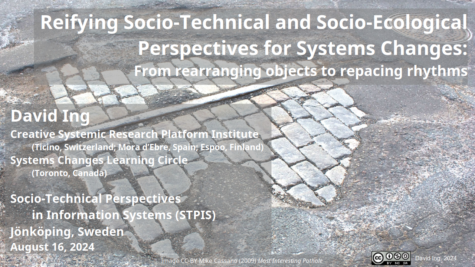
The Socio-Technical Systems (STS) perspective, dating back to the studies of Eric L. Trist and Fred E. Emery, was on the reading list of organizational behaviour classes in my undergraduate and master’s degree programs. It wasn’t until 15 years later, when I got involved with the systems sciences and David L. Hawk, that the Socio-Ecological Systems (SES) perspective became more prominent in my worldview. This emphasis is likely true for most audiences, where Socio-Technical is prominent, and Socio-Ecological is in the background or out of mind.
For the 10th International Conference on Socio-Technical Perspectives in Information Systems (STPIS’24) scheduled in Jönköping, Sweden, for mid-August, I was invited to contribute a paper, My travel plans didn’t take me to the Nordics this summer, so the organizers scheduled me for a remote online presentation.
Since the STPIS workshop has official proceedings, my thinking was mostly on completing a manuscript, that is available as a preprint. The manuscript reviews the Trist and Emery histories, and then gets philosophical in proposing a shift from mainstream principles into a process-first approach regrounded with a postocolonial bridge to Classical Chinese foundations. My concern on the short presentation was getting a message across to workshop attendees, with only a short slot. My colleague Peter Bednar reported what I couldn’t see online.
Dear David, thank you for your amazing and thorough presentation. It was interesting, and deep. I always learn something from your stuff. It was a pleasure to have you involved. People did enjoy and like your presentation it was intense and deep. Participants would have asked questions but at the moment of your presentation people were still thinking about your story. But certainly they were talking and reflecting over your presentation later on during conference dinner. You would have enjoyed it, maybe next time. But in the meantime I wanted to say how good your topic was and also very very interesting and well grounded.
I do take pleasure in the conversations over conference dinners and coffee breaks to share ideas with other attendees. An online presentation has an externality of aynchronous availability to online audiences. I would hope that the web video might encourage the diligent to check out the preprint.
This recording of the presentation segments is available on Youtube , as well as on the Internet Archive .
| Video | H.264 MP4 |
| August 16 (15m32s) |
[20240816_STPIS_Ing ReifyingSocioTechnicalSocioEcological_1182kpbs.m4v] (HD 1184kbps 153MB) [on the Internet Archive] |
Here is the structured abstract for the manuscript preprint.
Reifying Socio-Technical and Socio-Ecological Perspectives for Systems Changes: From rearranging objects to repacing rhythms
Purpose: The rise of Socio-Technical Systems (STS) and Socio-Ecological Systems (SES) perspectives originated in the industrialization of the 1950s and 1960s. With ubiquitous computing and globalization compressing time and space, interests in systems thinking by the 2020s have turned towards systems changes. This refocusing on changes has encouraged hypothesizing an alternative world theory of (con)texturalism-dyadicism with a root metaphor of yinyang dancing through [eight] seasons. Through post-colonial sciencing in constructionist philosophizing across Western and Classical Chinese traditions, SES alongside STS are recast as kairotic rhythms casting on and binding off weaves in time.
Approach: This inquiry began with behavioral histories of open-sourcing-while-private-sourcing, in an inductive approach to theory building. Curiosity on the origins of causal texture theory led to plunging into the history of pragmatism, and its associated metaphilosophy. An exploration of processual philosophies revealed a better appreciation through a non-Western approach, via yinyang at the foundation of Classical Chinese Medicine. Developing a (con)textural-dyadic world theory enables conjoining SES and STS as diachronic complements.
Findings: Changes in SES and STS based on Western philosophy presuppose functions and structures as primordial, evoking systems conceptions of rearranging objects. Clarifying root metaphors, changes in SES and STS that foreground processes and behaviors elevate the repacing of rhythms in systems concepts. Systems practice approaches involving action learning can be adapted for the altered foundations..
Originality: In organizational theory, SES and STS have been expressed as different perspectives on systems of interest. Tracing back to metaphilosophy from the 1940s, an alternative branch of pragmatism incorporating yinyang enlarges the scope of systems thinking from its Anglo-American traditions.
Keywords: Socio-Ecological Systems, Socio-Technical Systems, Systems Change, Systems Thinking
Addendum
For those interest in a more detailed history of the Socio-Technical Systems perspective, David Hawk contributed a paper to STPIS 2020, Socio-Technical Perspective in IS Development 2020.
- Hawk, David L. 2020. “Socio-Technical-Natural Systems Thinking (STN) Technological Dreams, Sociological Repairs, Natural Cleanup?” In Proceedings of the 6th International Workshop on Socio-Technical Perspective in IS Development (STPIS 2020), edited by Peter Bednar, Alexander Nolte, Mikko Rajanen, Anna Sigridur Islind, and Federico Pigni, 206–18. Grenoble, France: CEUR Workshop Proceedings. https://ceur-ws.org/Vol-2789/paper27.pdf .