
Coevolving Innovations

… in Business Organizations and Information Technologies

Currently Viewing Posts Tagged education

What Can Systems Thinkers Learn from Educational Game Studies | Scott DeJong + Geoff Evamy-Hill | Systems Thinking Ontario 2024-01-15

For the January 2024 Systems Thinking Ontario session, educational game designer Scott DeJong and innovation designer Geoff Evamy Hill joined a conversation moderated by Zaid Khan.  Mutual interests in the new field of educational design and games were at the core of the discussion.  This was an opportunity for systems thinkers to expand their knowledge on developments that were not in present in the 20th century.

After the usual round of self-introduction by web conference participants, Scott and Geoff described their experiences in the field, and ongoing research questions.  The conversation was segmented into three parts, so that participants had the opportunity to inject questions and comments.

This recording of the session is available on Youtube, as well as on the Internet Archive .

Video H.264 MP4
January 15
(1h48m)
[20240115_ST-ON_EducationalGameStudies ScottDeJong_GeoffEvamyHill.m4v
(1920×1080 921kbps 814MB)
[on the Internet Archive]

A standalone audio was also created during the meeting.

Audio
January 14
(1h48m)
[20240115_ST-ON_EducationalGameStudies ScottDeJong_GeoffEvamyHill.m4a]
(126kbps, 99 MB)
[on the Internet Archive]

Here is the core of original abstract sent in advance.


— begin excerpt —

‘Learning’ is a central focus for systems thinkers. Whether it’s an attitude, a feature of a system, or an outcome. ‘Learning’ runs through systems thinking. So what might systems thinkers learn from games that are designed for, well, learning?

Enter “Educational Game Studies”, an emerging field that focuses on how games and their systems can inform the public about various issues.… Read more (in a new tab)
For the January 2024 Systems Thinking Ontario session, educational game designer Scott DeJong and innovation designer Geoff Evamy Hill joined a conversation moderated by Zaid Khan.  Mutual interests in the new field of educational design and games were at the core of the discussion.  This was an opportunity for systems thinkers to expand their knowledge on developments that were not in present in the 20th century.

After the usual round of self-introduction by web conference participants, Scott and Geoff described their experiences in the field, and ongoing research questions.  The conversation was segmented into three parts, so that participants had the opportunity to inject questions and comments.

This recording of the session is available on Youtube, as well as on the Internet Archive .

Video H.264 MP4
January 15
(1h48m)
[20240115_ST-ON_EducationalGameStudies ScottDeJong_GeoffEvamyHill.m4v
(1920×1080 921kbps 814MB)
[on the Internet Archive]

A standalone audio was also created during the meeting.

Audio
January 14
(1h48m)
[20240115_ST-ON_EducationalGameStudies ScottDeJong_GeoffEvamyHill.m4a]
(126kbps, 99 MB)
[on the Internet Archive]

Here is the core of original abstract sent in advance.


— begin excerpt —

‘Learning’ is a central focus for systems thinkers. Whether it’s an attitude, a feature of a system, or an outcome. ‘Learning’ runs through systems thinking. So what might systems thinkers learn from games that are designed for, well, learning?

Enter “Educational Game Studies”, an emerging field that focuses on how games and their systems can inform the public about various issues.… Read more (in a new tab)

Conversations on an emerging science of service systems (IFSR Pernegg 2010)

Earlier this year, in April, the International Federation for Systems Research hosted its biannual research conversation, this time in Pernegg, Austria.  This meeting was a four-day opportunity to continue developing ideas on the emerging science of service systems begun in July 2009.

The proceedings from the meeting have now been published.  I’ve extracted the chapter for our team as a separate downloadable document.  The report starts with a description of our activities, and an outline of our progress.

The conversation began with self-reflections on personal experiences leading each of the individuals to the systems sciences, acknowledging the influence of those trajectories on their perspectives on service systems.  In recognition of this science of service systems as a potentially a new paradigm, much of the time together was spent in sensemaking about the intersection between ongoing services research and systems sciences perspectives.  This sensemaking led the team to focus the dialogue more on posing the right questions to clarify thinking broadly, as opposed to diving deeply towards solutions that would be tied up as issues within a problematique.

During the conversation, the progress on ideas was recorded on flipcharts.  Nearing the end of our time together, the team cut up the flipcharts with scissors, and collated the discussion threads into five clusters:  (i) philosophy; (ii) science; (iii) models; (iv) education; (v) development.  With service systems as a new domain, the team found all five clusters underdeveloped.  Recognizing that all five clusters are coevolving, the phenomenon of service systems was listed in order from the most concrete (i.e.

… Read more (in a new tab)

Learning 21st century skills, including systems thinking, through game-based education

An article on NPR about the Quest to Learn program in New York City led by Katie Salen cites systems thinking as one of the foundations for 21st century literacy. I found this article on a lead from Erika von Hoyer on the Systems Community of Inquiry via her Twitter feed.

The learning model at Quest to Learn says: “Games and other forms of digital media serve another useful purpose at Quest: they serve to model the complexity and promise of ‘systems.’ Understanding and accounting for this complexity is a fundamental literacy of the 21st century”.   Reading the CV of Katie Salen, I notice that she was working on the Spaceship Earth Game at the Buckminister Fuller Institute in 2005.

This led to finding an interview about the three-year study on “Grinding New Lenses: A Design Project to Support a Systems View of the World” conducted by Kylie Pepper and Melissa Gresalfi at Indiana University.  The funding by the MacArthur Foundation seems to be part of the research on assessing learning with new media as part of the 21st century assessment project.

In a panel at the Digital Media & Learning conference, Valerie Shute says “What attributes of the students are important for success in the 21st century? Systems thinking, collaborating, resource-management skills”.  This is related to worked examples and evidence-centered design.

This direction on systems thinking in middle school is compatible with the proposed design for K-12 education on Smarter Planet Service Systems proposed by Jim Spohrer. … Read more (in a new tab)

Lifelong education on service systems: a perspective for STEM learners

One of the benefits of the IBM’s Smarter Planet vision(s) is its encouragement to think about the 21st century world from a fresh perspective.  The rise of the service economy — which is not the same as the service sector — calls for the nurturing of talents with different emphases.  While curricula typically have a strong grasp of agricultural systems (developed since, say, 1600 A,.D.), and industrial systems (since, say, 1850 A.D.), the science of service systems is still emerging.

A study on Science, Technology, Engineering and Mathematics (STEM) education by a 2007 National Academies committee published recommendations in 2008 for professional science master’s education that is interdisciplinary in character.  Such an investment in curriculum change has been proposed as a good use of stimulus funding in the U.S. In concert, 8 of 10 students expressed a wish for universities to revamp their traditional learning environments in the Smarter Planet University Jam conducted in spring 2009 .

In 2008 and 2009, the focus has shifted to primary and secondary school education, convening another National Academies committee centered on K-12, with a report due in 2010.  Jim Spohrer — formerly the Director of Almaden Services Research, and now the Director of IBM Global University Programs — updated me on his current thinking about a potential design for education on Smarter Planet Service Systems.

Systems that move, store, harvest, process Kindergarten Transportation
1 Water and waste management
2 Food and global supply chain
3 Energy and energy grid
4 Information and communications technology (ICT) infrastructure
Systems that enable healthy, wealthy and wise people 5 Building and construction
6 Banking and finance
7 Retail and hospitality
8 Healthcare
9 Education (including universities)
Systems that govern 10 Government (cities)
11 Government (regions / states)
12 Government (nations)
Higher education Specific service systems
Professional life Specific service systems

Jim is following confirmation of the effectiveness of a Challenge-Based Learning approach by the New Media Consortium as “a strategy to engage kids in any class by giving them the opportunity to work on significant problems that have real-world implications”. … Read more (in a new tab)

Digest on Service Systems Science at Tokyo Institute of Technology (2009)

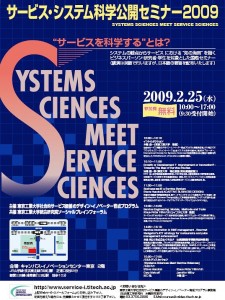
Systems Sciences Meet Service SciencesThe Service Innovation Educational Program at the Tokyo Institute of Technology hosted an “Open Seminar on Service Systems Science” (with a flyer in PDF) — as well as a private “Invited Workshop on Services Science, Management and Engineering” — in February 2009.

I’ve just noticed that much of the content is totally opaque to people who don’t read Japanese, so I’ve posted my (English-language) digest of the meetings on the Coevolving Innovation Commons.  The text is incomplete, but it at least provides a minimal sketch of some of the ideas discussed. (Digital photographs help, too!).  Speakers include:

The 2009 meetings were an annual extension of the 2008 21st Century CoE Symposium, and the first Invited Workshop on SSME.

With many of the researchers coming from a perspective of systems science, the trend has been to work out some of the ideas on an emerging science of service systems.

Curriculum in a coevolving world

If the world is changing so that co-evolution of organizations and technology is required, what is the content that students should be trained in?

Here’s an interesting high-level view of “New ICT Curricula for the 21st Century“:

… the Career Space consortium recommends that ICT Curricula should consist of the following core elements:

  • a scientific base of 30%,
  • a technology base of 30%,
  • an application base and systems thinking of 25% and,
  • a personal and business skills element of up to 15%.

It’s probably something that should be noted, given the “brand name” recognition of sponsors associated with the consortium.

I’m active in the systems science community, so I find it interesting that “systems thinking” is named on the list. This requirement is less surprising, given the origins of the initiative in Europe.

So, should we have a similar interest in “systems thinking” in North America?

  • fediscience.org/@daviding (Mastodon)

    1. Loading Mastodon feed...
  • RSS feed: on IngBrief on IngBrief

    • 2026/01/07 | Rama Akkiraju | From LLMs to Living Systems: Applying Systems Science to Agentic AI in the Enterprise | HICSS-59 Keynote
      Abstract Enterprise AI is transitioning from simple single-LLM flows to complex agentic ecosystems—adaptive systems composed of multiple agents, tools, governed data, human workflows, and organizational policies. This keynote introduces a systems-science framework for designing and managing such ecosystems using principles of modularity, control, feedback, robustness, and socio-technical alignment. We illustrate these concepts through practical examples […]
    • Timothy F.H. Allen passed away on May 01, 2025
      Timothy F.H. Allen, president of International Society for the Systems Sciences 2008-2009, passed away peacefully in his home, surrounded by his family, on May 1, 2025. With his work on ecosystem ecology, I learned more about living systems than anyone else in the systems community. After his retirement, he was proud of putting together a […]
    • Installing WordPress Studio on Manjaro Linux
      In 2024, WordPress Studio was released, making installation on a local computer simpler. The instructions were modified from MacOS to Ubuntu Linux, by Daniel Kossmann, “How to install WordPress Studio in Ubuntu Linux” | Jun 15, 2024 at https://www.danielkossmann.com/how-to-install-wordpress-studio-ubuntu-linux/ I already had NVM installed, but in Terminal, with the result “command not found”. In the […]
    • Notion of Change in the Yijing | JeeLoo Lin 2017
      The appreciation of change is different in Western philosophy than in classical Chinese philosophy. JeeLoo Lin published a concise contrast on differences. Let me parse the Introduction to the journal article, that is so clearly written. A-theories divide time into past, present and future, and the point of reference is set at “the present.” B-theories, […]
    • World Hypotheses (Stephen C. Pepper) as a pluralist philosophy [Rescher, 1994]
      In trying to place the World Hypotheses work of Stephen C. Pepper (with multiple root metaphors), Nicholas Rescher provides a helpful positioning. — begin paste — Philosophical perspectivism maintains that substantive philosophical positions can be maintained only from a “perspective” of some sort. But what sort? Clearly different sorts of perspectives can be conceived of, […]
    • The Nature and Application of the Daodejing | Ames and Hall (2003)
      Ames and Hall (2003) provide some tips for those studyng the DaoDeJing.
  • Recent Posts

  • Archives

  • RSS feed: on daviding.com on daviding.com

    • 2026/10 Moments October 2026
      Dartmouth, Nova Scotia; Halifax, Nova Scotia; Lunenberg, Nova Scotia; Peggy’s Cove, Nova Scotia; Bible Hill, Nova Scotia; Louisbourg, Nova Scotia; Sydney, Nova Scotia; Baddeck, Nova Scotia; Toronto, Ontario Fraser’s Mills Fish Hatchery: Side trip to hatchery built in 1928 by provincial government, gravity-fed from South River. Water in pen dark, ripples at surface due to […]
    • 2026/09 Moments September 2026
      Vancouver BC; Toronto, Ontario, Burlington, Ontario; Shanghai PR China Serenade of the Seas: From the foredeck of level 12 of the Royal Caribbean Line ship, the panorama west to the Vancouver Convention Centres, turning to the north across Vancouver Harbour. Observed Princess Line ship leaving the dock, a departure we never experienced. Arrived for lunch, […]
    • 2026/08 Moments August 2026
      Toronto, Ontario; Vancouver BC Next Perfect Day Playlist: Korean Town Street Festival, 20260808 Night View O What A Shiny Night Honey Haneum Playlist: Korean Town Street Festival, 20260808 Happiness Prince of Jeju Ieodo Sana Seouje Sori Leida Lay Down Together Star North Sky Beautiful Country Encore Chris Fraser Trio | Meo | 2026-08-30: Nestled in […]
    • 2026/07 Moments July 2026
      Quiet summer mostly at home writing, taking breaks to meet with friends, and exercise on bike rides.
    • 2026/06 Moments June 2026
      Cool summer catching up with family and friends, music festivals
    • 2026/05 Moments May 2026
      Cool spring, busy with Jane's Walk, bathroom renovation, closing out father's apartment, OCADU GradEx, Problematique Dialogue applying the Banathy Conversation Methodology, Qingming.
  • RSS feed: on Media Queue on Media Queue

  • Meta

  • Creative Commons License
    This work is licensed under a Creative Commons Attribution-NonCommercial-ShareAlike 4.0 International License
    Theme modified from DevDmBootstrap4 by Danny Machal