
Coevolving Innovations

… in Business Organizations and Information Technologies

Multiparadigm Inquiry Generating Service Systems Thinking

What if a pattern language was opened up to contemporaneous research into wicked problems, the systems approach, ecological epistemology, hierarchy theory, and interactive value?  This 30-minute presentation at Purplsoc 2017 last October aimed to provide a broader context to a social change community focused on works of Christopher Alexander.

This talk was a complement to “Pattern Manual for Service Systems Thinking” presented a year earlier, at PUARL 2016.  Last year, the agenda was centered on the approach from Christopher Alexander, and divergences due to the changing in domain from the built environment to service systems.

The slides on the Coevolving Commons are dense.  I had showed them at the poster session in the day preceding, and promised to spend more time speaking to them in the workshop scheduled for the next day.

For 2017, the view looked beyond Alexander, to related research both at Berkeley, and elsewhere in the systems community.  The agenda was in 3 major sections (here expanded with more detailed overview of the middle section):

  • 1. What is multiparadigm inquiry?
  • 2. Where have (and might have) (1960s-2010s) paradigms influenced generative pattern language?
    • a. Over 50 years, Christopher Alexander and coauthors evolved concepts and language in built environments
    • b. At Berkeley: Churchman, Rittel and Alexander taught in 1960-1970s
      • i. “Systems Generating Systems”, Alexander (1968)
      • ii. “The Systems Approach and Its Enemies”, (Churchman, 1979)
      • iii. “Dilemmas in a General Theory of Planning”, (Rittel + Weber, 1973)
    • c. Architecture ~ problem-seeking. Design ~ problem-solving
    • d. Wicked problems led to IBIS and argumentation schemes
    • e. Systems approach led to assumption surfacing, postnormal science
    • f. Pattern language has risen in agile, groups, public sphere
    • g. Ecological epistemology led to interaction design + affordances
    • h. Hierarchy theory led to panarchy and resilience science
    • i. Interactive value is in the shift to a service economy
  • 3. Why might a pattern language project or community pay more attention to its paradigm?

The slides have now been matched up with the digital audio recording, for viewing as a web video.

The classroom was acoustically favourable, and audio recordings are downloadable.

Audio
Digital audio
(31m04s)
[20171020_Purplsoc_Ing mp3] (29MB)
[20171020_Purplsoc_Ing 3db mp3] (volume boosted 3db, 29MB)

Downloadable video files may be better for devices that disconnect from the Internet.

Video H.264 MP4 WebM
Digital video
(31m14s)
[20171020 Purplsoc Ing HD  m4v]
(HD 592Kbps 134MB) [on the Internet Archive]
[20171020 Purplsoc Ing nHD m4v]
(nHD 495Kkps 111MB)
[20171020 Purplsoc Ing HD webm]
(HD 430Kbps 96MB)
[20171020 Purplsoc Ing nHD webm]
(nHD 196Kbps 44MB)

My speaking was rapid, covering a lot in 30 minutes.  For the more patient, the paper written for the proceedings may be easier to follow.
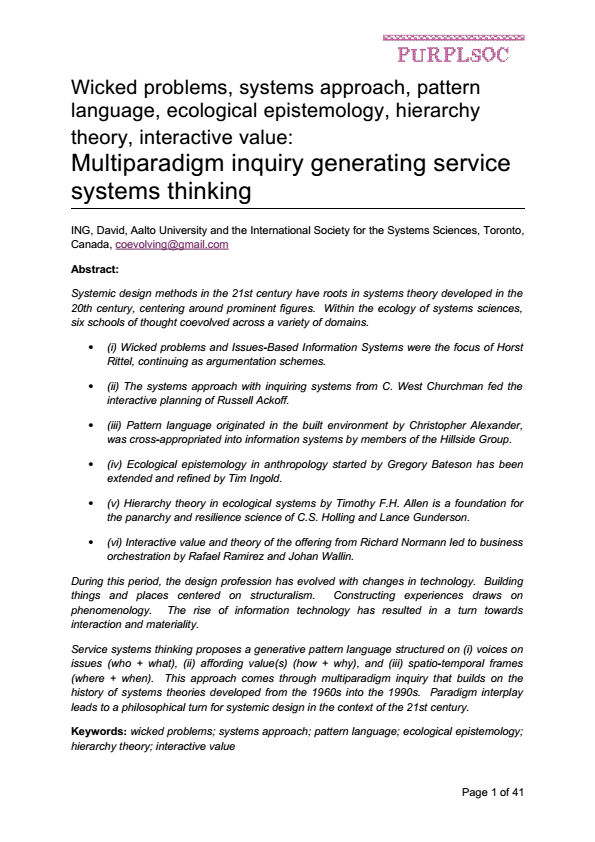
Purplsoc 2017 Proceedings paper

Approaching service systems from a multiparadigm approach expands the relevant body of research for pattern language beyond the original domain in just built environments.


Leave a Reply

Your email address will not be published. Required fields are marked *

  • fediscience.org/@daviding (Mastodon)

    1. Loading Mastodon feed...
  • RSS feed: on IngBrief on IngBrief

    • 2026/01/07 | Rama Akkiraju | From LLMs to Living Systems: Applying Systems Science to Agentic AI in the Enterprise | HICSS-59 Keynote
      Abstract Enterprise AI is transitioning from simple single-LLM flows to complex agentic ecosystems—adaptive systems composed of multiple agents, tools, governed data, human workflows, and organizational policies. This keynote introduces a systems-science framework for designing and managing such ecosystems using principles of modularity, control, feedback, robustness, and socio-technical alignment. We illustrate these concepts through practical examples […]
    • Timothy F.H. Allen passed away on May 01, 2025
      Timothy F.H. Allen, president of International Society for the Systems Sciences 2008-2009, passed away peacefully in his home, surrounded by his family, on May 1, 2025. With his work on ecosystem ecology, I learned more about living systems than anyone else in the systems community. After his retirement, he was proud of putting together a […]
    • Installing WordPress Studio on Manjaro Linux
      In 2024, WordPress Studio was released, making installation on a local computer simpler. The instructions were modified from MacOS to Ubuntu Linux, by Daniel Kossmann, “How to install WordPress Studio in Ubuntu Linux” | Jun 15, 2024 at https://www.danielkossmann.com/how-to-install-wordpress-studio-ubuntu-linux/ I already had NVM installed, but in Terminal, with the result “command not found”. In the […]
    • Notion of Change in the Yijing | JeeLoo Lin 2017
      The appreciation of change is different in Western philosophy than in classical Chinese philosophy. JeeLoo Lin published a concise contrast on differences. Let me parse the Introduction to the journal article, that is so clearly written. A-theories divide time into past, present and future, and the point of reference is set at “the present.” B-theories, […]
    • World Hypotheses (Stephen C. Pepper) as a pluralist philosophy [Rescher, 1994]
      In trying to place the World Hypotheses work of Stephen C. Pepper (with multiple root metaphors), Nicholas Rescher provides a helpful positioning. — begin paste — Philosophical perspectivism maintains that substantive philosophical positions can be maintained only from a “perspective” of some sort. But what sort? Clearly different sorts of perspectives can be conceived of, […]
    • The Nature and Application of the Daodejing | Ames and Hall (2003)
      Ames and Hall (2003) provide some tips for those studyng the DaoDeJing.
  • Recent Posts

  • Archives

  • RSS feed: on daviding.com on daviding.com

    • 2026/10 Moments October 2026
      Dartmouth, Nova Scotia; Halifax, Nova Scotia; Lunenberg, Nova Scotia; Peggy’s Cove, Nova Scotia; Bible Hill, Nova Scotia; Louisbourg, Nova Scotia; Sydney, Nova Scotia; Baddeck, Nova Scotia; Toronto, Ontario Fraser’s Mills Fish Hatchery: Side trip to hatchery built in 1928 by provincial government, gravity-fed from South River. Water in pen dark, ripples at surface due to […]
    • 2026/09 Moments September 2026
      Vancouver BC; Toronto, Ontario, Burlington, Ontario; Shanghai PR China Serenade of the Seas: From the foredeck of level 12 of the Royal Caribbean Line ship, the panorama west to the Vancouver Convention Centres, turning to the north across Vancouver Harbour. Observed Princess Line ship leaving the dock, a departure we never experienced. Arrived for lunch, […]
    • 2026/08 Moments August 2026
      Toronto, Ontario; Vancouver BC Next Perfect Day Playlist: Korean Town Street Festival, 20260808 Night View O What A Shiny Night Honey Haneum Playlist: Korean Town Street Festival, 20260808 Happiness Prince of Jeju Ieodo Sana Seouje Sori Leida Lay Down Together Star North Sky Beautiful Country Encore Chris Fraser Trio | Meo | 2026-08-30: Nestled in […]
    • 2026/07 Moments July 2026
      Quiet summer mostly at home writing, taking breaks to meet with friends, and exercise on bike rides.
    • 2026/06 Moments June 2026
      Cool summer catching up with family and friends, music festivals
    • 2026/05 Moments May 2026
      Cool spring, busy with Jane's Walk, bathroom renovation, closing out father's apartment, OCADU GradEx, Problematique Dialogue applying the Banathy Conversation Methodology, Qingming.
  • RSS feed: on Media Queue on Media Queue

  • Meta

  • Creative Commons License
    This work is licensed under a Creative Commons Attribution-NonCommercial-ShareAlike 4.0 International License
    Theme modified from DevDmBootstrap4 by Danny Machal