
Coevolving Innovations

… in Business Organizations and Information Technologies

Currently Viewing Posts Tagged ocadu-sfi

Systems Approaches (Project Language + Literature Reviews with Generative AI) | OCADU | 2025-01-20

The “Understanding Systems” SFIN-6011 course is a requirement in the master’s program in Strategic Foresight and Innovation at OCADU.   For winter 2025, the class is now led by Stephen Davies, breaking the incremental evolving of content since 2008.  While still on faculty at OCADU, the original course designer Peter H. Jones is now a Distinguished University Professor at Tecnologico de Monterrey, spending more time in Mexico City than Toronto.  In the fall, Stephen and I discussed ways that the legacy course might be updated, since the field of systemic design has emerged and matured over 15+ years.  I was one of the instructors with Peter of SFIN-6011 in winter 2020, and have prior experiences of writing systems thinking courses in 2018 for the UToronto iSchool, and at Aalto U. in 2016, in 2011, and in 2010.

From week 3 on, groups of students will lead short presentations on some systems approaches (e.g. system dynamics, soft systems methodology, viable system model).  With short lead times to prepare literature reviews, the primary class activity for these master’s students is the facilitation of peer discussions that will surface key ideas.  They aren’t expected to become experts on these topics at this point.  They can get a sense of when and where a specific systems approach might be prioritized as useful, or deselected in favour of alternatives.  After the presentation leaders have concluded with their slides, the instructors can fill in a few blanks.… Read more (in a new tab)
The “Understanding Systems” SFIN-6011 course is a requirement in the master’s program in Strategic Foresight and Innovation at OCADU.   For winter 2025, the class is now led by Stephen Davies, breaking the incremental evolving of content since 2008.  While still on faculty at OCADU, the original course designer Peter H. Jones is now a Distinguished University Professor at Tecnologico de Monterrey, spending more time in Mexico City than Toronto.  In the fall, Stephen and I discussed ways that the legacy course might be updated, since the field of systemic design has emerged and matured over 15+ years.  I was one of the instructors with Peter of SFIN-6011 in winter 2020, and have prior experiences of writing systems thinking courses in 2018 for the UToronto iSchool, and at Aalto U. in 2016, in 2011, and in 2010.

From week 3 on, groups of students will lead short presentations on some systems approaches (e.g. system dynamics, soft systems methodology, viable system model).  With short lead times to prepare literature reviews, the primary class activity for these master’s students is the facilitation of peer discussions that will surface key ideas.  They aren’t expected to become experts on these topics at this point.  They can get a sense of when and where a specific systems approach might be prioritized as useful, or deselected in favour of alternatives.  After the presentation leaders have concluded with their slides, the instructors can fill in a few blanks.… Read more (in a new tab)

How do Systems Changes become natural practice?

The 1995 article by Spinosa, Flores & Dreyfus on “Disclosing New Worlds” was assigned reading preceding the fourth of four lectures for the Systemic Design course in the Master’s program in Strategic Foresight and Innovation at OCAD University.  In previous years, this topic was a detail practically undiscussed, as digging into social theory and the phenomenology following Heidegger is deep.  Peter Jones and I are fans of ideas expanded into the 1999 book. I was privileged to visit personally with Fernando Flores in Berkeley in 2012, as I was organizing the ISSS 2012 meeting.  Contextualizing this body of work for a university course led into correlated advances in situated learning and communities of practice.

A preface to the lecture included The Practice Turn in Contemporary Theory, and revisiting Change as Three Steps to clarify what Kurt Lewin did and did not write.

The agenda was in four sections. In the timebox available, the lecture covered the first two:

  • A. Situated Learning + History-making
    • Legitimate Peripheral Participation + Practices (Lave, Wenger)
    • Skill Acquisition + Disclosing New Worlds (Dreyfus, Spinosa)
  • B. Commitment + Language-Action Perspective
    • Conversations for Action (Flores)
    • Deliverables, procedures, capacities, relationships

Slides for the last two sections were ready to go, but foregone in favour of other course work priorities.

  • C. Argumentation + Pattern Language
    • IBIS (Rittel), Timeless Way of Building (Alexancer)
    • Architectural Programming c.f. Designing
  • [postscript] (Open Innovation Learning)
    • Quality-generating sequencing; Affordances wayfaring; Anticipatory appreciating
    • Innovation learning for; Innovation learning by; Innovation learning alongside

This fourth lecture is available on Youtube as streaming web video.… Read more (in a new tab)

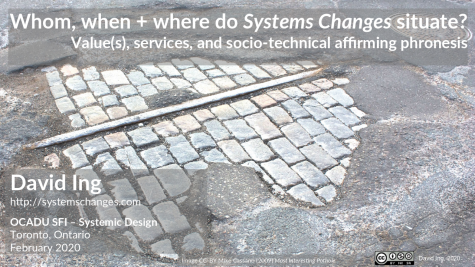
Whom, when + where do Systems Changes situate?

Covering practical wisdom (phronesis), the third of four lectures again was compressed for the Systemic Design course in the Master’s program in Strategic Foresight and Innovation at OCAD University. The students in the part-time session on February 7 extended their discussion period longer than those in the full-time session on February 5. I again jumped slides in the sequence to stay within the timebox.

The agenda was in four sections:

  • [preamble] Episteme, Techne, Phronesis (reordered)
    • Intellectual Pursuits (Rethinking Systems Thinking)
    • Systems changes as situated c.f. ideal-seeking
  • A. Value(s), Judgment, Soft Systems Thinking
    • Appreciative Systems (Vickers, Checkland)
    • Policy, impacts and consequences of systems changes
  • B. Service Systems (c.f. Production Systems)
    • Science of Service Systems (Spohrer, Kijima)
    • Material-products c.f. information-services as systems changes
  • C. Socio-Technical Systems Perspective
    • Tavistock Institute + Legacy (Trist, Emery, Ramirez)
    • Coproduction and design principles guiding systems changes

The web video can be streamed on Youtube.

Copies of the video files are downloadable for disconnected viewing.

Video H.264 MP4 WebM
February 7
(1h21m)
[20200207_OCADU_Ing HD m4v]
(HD 2477kbps 1.6GB)
[20200207_OCADU_Ing nHD m4v]
(nHD 1344kps 866MB)
[20200207_OCADU_Ing HD webm]
(HD VP8 375kbps 349MB)
[20200207_OCADU_Ing nHD webm]
(nHD VP8 139kbps 206MB)

Readers who want to follow through on web link references may want to review the slides directly.

Whom, when + where do Systems Changes situated?

The same presentation slides were used for both lectures.  The questions from the students were considerably different across the class sections, so the diligent listener might want to compare them. … Read more (in a new tab)

Why (Intervene in) Systems Changes?

With a focus on “ecological systems”, the second of four lectures planned for the Systemic Design course in the Master’s program in Strategic Foresight and Innovation at OCAD University proceeded as a timeboxed presentation:  targeting 40 minutes of content (skipping slides to stay within time constraints), followed by 10 minutes of discussion.  Since the slides are rich with content and links to sources, students were directed to pay attention to what I was saying, over trying to read the slides projected behind me. 

The agenda was in four sections:

  • [preamble] Errors, Attention and Traps (Ecological Understanding)
    • Systems Changes Learning Circle (Bateson, Gibson, Ingold)
    • (Resistances to) Changing as primary system of interest
  • A. Socio-Ecological Systems Perspective
    • Tavistock Institute (Emery, Trist)
    • Organization as primary system of interest
  • B. (Social-) Ecological Systems  + Panarchy
    • Stockholm Resilience Centre (Holling, Walker, Peterson)
    • Ecology as primary system of interest
  • C. The Ecosystem Approach
    • Resilience Alliance (Waltner-Toews, Kay)
    • Sustainable development project as primary system of interest

Online, the video is available on Youtube for streaming.

Viewers who prefer to watch video on a disconnected device can download a video file.

Video H.264 MP4 WebM
January 31
(1h18m)
[20200129_OCADU_Ing HD m4v]
(HD 2666kbps 1.2GB)
[20200129_OCADU_Ing nHD m4v]
(nHD 1352kps 637MB)
[20200129_OCADU_Ing HD webm]
(HD VP8 425kbps 292MB)
[20200129_OCADU_Ing nHD webm]
(nHD VP8 224kbps 156MB)

Readers who want to follow through on web link references may want to review the slides directly.… Read more (in a new tab)

Are Systems Changes Different from System + Change?

The Systems Changes Learning Circle has met at least every 3 weeks over the past year.  As part of an hour+ lecture to introduce systems thinking, students in the Systemic Design course in the Master’s program in Strategic Foresight and Innovation at OCAD University were immersed in questions where we’ve focused our attention, complemented by background into traditional foundational materials.  An audio recording has now been matched up with presentation slides, so that learners outside the classroom can partially share in the experience.

This lecture begins with the rising interest in “systems change”, that is related to “theory of change” from funders of social innovation programs.  From there, the lecture aims to recast (speak in a different way) and reify (make some specified ideas more prominent) an understanding of systems thinking.

The presentation was overprepared — we can’t predict how engaged students will be on the ideas, before their brains are full.  Of 55 slides, we stopped on slide 37.  For streaming, the video is accessible on Youtube. (with a 6-minute excerpt on the Luoyang Bay abalone farms from the documentary Watermark, by Edward Burtynsky, removed).

Viewers who prefer to watch video on a disconnected device can download a video file.

Video H.264 MP4 WebM
January 17
(1h18m)
[20200117_OCADU_Ing HD m4v]
(HD 2814kbps 1.7GB)
[20200117_OCADU_Ing nHD m4v]
(nHD 210kkps 179MB)
[20200117_OCADU_Ing HD webm]
(HD 470kbps 392MB)
[20200117_OCADU_Ing nHD webm]
(nHD VP8 114kbps 184MB)

Readers interested in the full set of 55 slides are welcomed to view them online or download them.… Read more (in a new tab)

  • fediscience.org/@daviding (Mastodon)

    1. Loading Mastodon feed...
  • RSS feed: on IngBrief on IngBrief

    • 2026/01/07 | Rama Akkiraju | From LLMs to Living Systems: Applying Systems Science to Agentic AI in the Enterprise | HICSS-59 Keynote
      Abstract Enterprise AI is transitioning from simple single-LLM flows to complex agentic ecosystems—adaptive systems composed of multiple agents, tools, governed data, human workflows, and organizational policies. This keynote introduces a systems-science framework for designing and managing such ecosystems using principles of modularity, control, feedback, robustness, and socio-technical alignment. We illustrate these concepts through practical examples […]
    • Timothy F.H. Allen passed away on May 01, 2025
      Timothy F.H. Allen, president of International Society for the Systems Sciences 2008-2009, passed away peacefully in his home, surrounded by his family, on May 1, 2025. With his work on ecosystem ecology, I learned more about living systems than anyone else in the systems community. After his retirement, he was proud of putting together a […]
    • Installing WordPress Studio on Manjaro Linux
      In 2024, WordPress Studio was released, making installation on a local computer simpler. The instructions were modified from MacOS to Ubuntu Linux, by Daniel Kossmann, “How to install WordPress Studio in Ubuntu Linux” | Jun 15, 2024 at https://www.danielkossmann.com/how-to-install-wordpress-studio-ubuntu-linux/ I already had NVM installed, but in Terminal, with the result “command not found”. In the […]
    • Notion of Change in the Yijing | JeeLoo Lin 2017
      The appreciation of change is different in Western philosophy than in classical Chinese philosophy. JeeLoo Lin published a concise contrast on differences. Let me parse the Introduction to the journal article, that is so clearly written. A-theories divide time into past, present and future, and the point of reference is set at “the present.” B-theories, […]
    • World Hypotheses (Stephen C. Pepper) as a pluralist philosophy [Rescher, 1994]
      In trying to place the World Hypotheses work of Stephen C. Pepper (with multiple root metaphors), Nicholas Rescher provides a helpful positioning. — begin paste — Philosophical perspectivism maintains that substantive philosophical positions can be maintained only from a “perspective” of some sort. But what sort? Clearly different sorts of perspectives can be conceived of, […]
    • The Nature and Application of the Daodejing | Ames and Hall (2003)
      Ames and Hall (2003) provide some tips for those studyng the DaoDeJing.
  • Recent Posts

  • Archives

  • RSS feed: on daviding.com on daviding.com

    • 2026/10 Moments October 2026
      Dartmouth, Nova Scotia; Halifax, Nova Scotia; Lunenberg, Nova Scotia; Peggy’s Cove, Nova Scotia; Bible Hill, Nova Scotia; Louisbourg, Nova Scotia; Sydney, Nova Scotia; Baddeck, Nova Scotia; Toronto, Ontario Fraser’s Mills Fish Hatchery: Side trip to hatchery built in 1928 by provincial government, gravity-fed from South River. Water in pen dark, ripples at surface due to […]
    • 2026/09 Moments September 2026
      Vancouver BC; Toronto, Ontario, Burlington, Ontario; Shanghai PR China Serenade of the Seas: From the foredeck of level 12 of the Royal Caribbean Line ship, the panorama west to the Vancouver Convention Centres, turning to the north across Vancouver Harbour. Observed Princess Line ship leaving the dock, a departure we never experienced. Arrived for lunch, […]
    • 2026/08 Moments August 2026
      Toronto, Ontario; Vancouver BC Next Perfect Day Playlist: Korean Town Street Festival, 20260808 Night View O What A Shiny Night Honey Haneum Playlist: Korean Town Street Festival, 20260808 Happiness Prince of Jeju Ieodo Sana Seouje Sori Leida Lay Down Together Star North Sky Beautiful Country Encore Chris Fraser Trio | Meo | 2026-08-30: Nestled in […]
    • 2026/07 Moments July 2026
      Quiet summer mostly at home writing, taking breaks to meet with friends, and exercise on bike rides.
    • 2026/06 Moments June 2026
      Cool summer catching up with family and friends, music festivals
    • 2026/05 Moments May 2026
      Cool spring, busy with Jane's Walk, bathroom renovation, closing out father's apartment, OCADU GradEx, Problematique Dialogue applying the Banathy Conversation Methodology, Qingming.
  • RSS feed: on Media Queue on Media Queue

  • Meta

  • Creative Commons License
    This work is licensed under a Creative Commons Attribution-NonCommercial-ShareAlike 4.0 International License
    Theme modified from DevDmBootstrap4 by Danny Machal