
Concluding 3 intensive weeks of content immersion, eight student groups created infographics of the ideas that resonated with them from the “Systems Thinking 2” class in the Creative Sustainability program at Aalto University. Each group had been given 3 weeks in advance to prepare content to lead a learning discussion, staking a position on a list of references. As students participated in the intensive sessions, the broader contexts reshaped those positions into a broader appreciation of the breadth of systems thinking. The initial positions and concluding syntheses were:
- 1. Appreciative systems, futures → Into the Future with Systems Thinking
- 2. Boundary, inquiry, perspectives → Systems thinking — synthesis
- 3. Learning categories, postnormal science, ignorance → Systems Thinking from learning and knowledge making perspective
- 4. Dialogue, engagement, intervention → Systems thinking from a dialogue perspective
- 5. Ecosystems, collapse, resilience → What is the purpose of understanding the differentiation between complexity and complicatedness in systems thinking
- 6. Coevolution, turbulence, anticipatory systems → Anticipatory systems, turbulence and coevolution
- 7. Living systems, viable systems, metabolism → How to make STEW (Systems Thinking Endless Wisdom)
- 8. Social-ecological systems, regime shifts → Systems? No problem!
The ending infographics represent a synthesis of the content from the course, each group having traced a different path. To rebalance team sizes, a few individuals migrated to a different group. Some anchored more on the content they had led, while others chose to strengthen linkages to other ideas.
 |
1. Appreciative systems, futures → Into the Future with Systems ThinkingGroup 1 read through a cluster of references on appreciative systems and futures and a map of the basic ideas to produce a presentation slide set.
The concluding infographic by Fahimeh Foutouhi, Petra Tammisto, Riikka Ikonen, Marta Jaakkola and Anna Muukkonen additionally swept in dialogues, learning, social ecological systems, complex systems and anticipatory systems. See the Into the Future with Systems Thinking infographic as 900px width or as 600px width. |
 |
2. Boundary, inquiry, perspectives → Systems thinking — synthesisGroup 2 worked through a cluster of references on boundary, inquiry and perspectives and a map of the basic ideas to produce a presentation slide set.
The concluding infographic by Miguel Fonseca, Annina Lattu and Jennifer Pitkänen put a higher emphasis on learning (a cluster of references led by Group 3), wrapping in ideas of resilience, turbulence, anticipatory systems on top the content for which they were primarily responsible. See the Systems thinking — synthesis infographic as 900px width or as 600px width. |
 |
3. Learning categories, postnormal science, ignorance → Systems Thinking from learning and knowledge making perspectiveGroup 3 focused on a cluster of references on learning categories, postnormal science and ignorance and a map of the basic ideas to produce a presentation slide set.
The concluding infographic by Emma Berg, Melanie Wolowiec and Lilli Mäkelä added in participation, judgement and anticipation, with larger contexts of cultural systems and biotic systems. Additionally, they charted a reference timeline of the articles from the course depicting the importance of the content longitudinally. See the Systems Thinking from learning and knowledge making perspective infographic as 900px width or as 600px width. |
 |
4. Dialogue, engagement, intervention → Systems thinking from a dialogue perspectiveGroup 4 studied a cluster of references on dialogue, engagement and intervention and a map of the basic ideas to produce a presentation slide set.
The concluding infographic by Caroline Mellberg, Ida-Maria Mannonen, Jukka-Pekka Ovaaksa and Wang Yuchan referred to the earlier discussions on appreciative systems and anticipatory systems, and the later presentations on living sytems, viable systems, turbulence, resilience and collapse. See the Systems thinking from a dialogue perspective infographic as 900px width or as 600px width. |
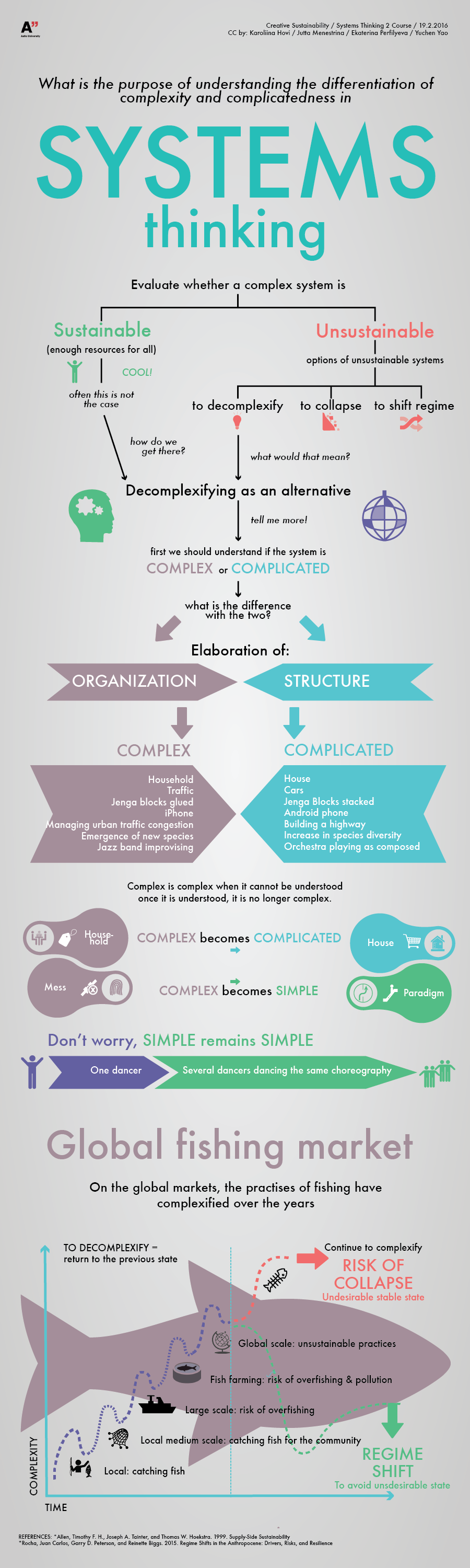 |
5. Ecosystems, collapse, resilience → What is the purpose of understanding the differentiation between complexity and complicatedness in systems thinkingGroup 5 reviewed a cluster of references on ecosystems, collapse and resilience and a map of the basic ideas to produce a presentation slide set.
The concluding infographic by Karolina Hovi, Jutta Menestrina, Ekaterina Perfilyeva and Yuchen Yao focused on the distinction between complexity and complicatedness, with an example of the global fishing market in risks of collapse and regime shifts. See the What is the purpose of understanding the differentiation between complexity and complicatedness in systems thinking infographic as 900px width or as 600px width. |
 |
6. Coevolution, turbulence, anticipatory systems → Anticipatory systems, turbulence and coevolutionGroup 6 worked through a cluster of references on coevolution, turbulence and anticipatory systems and a map of the basic ideas to produce a presentation slide set.
The concluding infographic by Kim Dau, Oona Anttila, Norbert Schmidt and Simone Menge extended the swing dancing example in their presentation to include turbulent fields, anticipatory systems, boundary, collapse and ignorance, complex systems, learning and coevolution. See the Anticipatory systems, turbulence and coevolution infographic as 900px width or as 600px width. |
 |
7. Living systems, viable systems, metabolism → How to make STEW (Systems Thinking Endless Wisdom)Group 7 studied a cluster of references on living systems, viable systems and metabolism and a map of the basic ideas to produce a presentation slide set.
The concluding infographic by Christine Everaars, Linda Lazarov, Maria Mercer and Noomi Schulman reflected on all of the content for the class, and presented it as a stew that cooked over multiple days. See the How to make STEW (Systems Thinking Endless Wisdom) infographic as 900px width or as 600px width. |
 |
8. Social-ecological systems, regime shifts → Systems? No problem!Group 8 reviewed a cluster of references on social-ecological systems and regime shifts and a map of the basic ideas to produce a presentation slide set.
The concluding infographic by Heini Huotari, Daniele Fasoli, Soroush Moradi, Kristaps Sveisbergs and Song Ping complemented their presentation with anticipatory systems, learning, and resilience. See the Systems? No problem! infographic as 900px width or as 600px width. |


This course on systems thinking recognized the variety of backgrounds across disciplines within student groups, and that their journeys through the content would be different. The infographics completed at the end of the class show that there isn’t a single way to approach systems thinking, and that diversity in thought is part of the learning.


