
Coevolving Innovations

… in Business Organizations and Information Technologies

Currently Viewing Posts Tagged values

Whom, when + where do Systems Changes situate?

Covering practical wisdom (phronesis), the third of four lectures again was compressed for the Systemic Design course in the Master’s program in Strategic Foresight and Innovation at OCAD University. The students in the part-time session on February 7 extended their discussion period longer than those in the full-time session on February 5. I again jumped slides in the sequence to stay within the timebox.

The agenda was in four sections:

  • [preamble] Episteme, Techne, Phronesis (reordered)
    • Intellectual Pursuits (Rethinking Systems Thinking)
    • Systems changes as situated c.f. ideal-seeking
  • A. Value(s), Judgment, Soft Systems Thinking
    • Appreciative Systems (Vickers, Checkland)
    • Policy, impacts and consequences of systems changes
  • B. Service Systems (c.f. Production Systems)
    • Science of Service Systems (Spohrer, Kijima)
    • Material-products c.f. information-services as systems changes
  • C. Socio-Technical Systems Perspective
    • Tavistock Institute + Legacy (Trist, Emery, Ramirez)
    • Coproduction and design principles guiding systems changes

The web video can be streamed on Youtube.

Copies of the video files are downloadable for disconnected viewing.

Video H.264 MP4 WebM
February 7
(1h21m)
[20200207_OCADU_Ing HD m4v]
(HD 2477kbps 1.6GB)
[20200207_OCADU_Ing nHD m4v]
(nHD 1344kps 866MB)
[20200207_OCADU_Ing HD webm]
(HD VP8 375kbps 349MB)
[20200207_OCADU_Ing nHD webm]
(nHD VP8 139kbps 206MB)

Readers who want to follow through on web link references may want to review the slides directly.
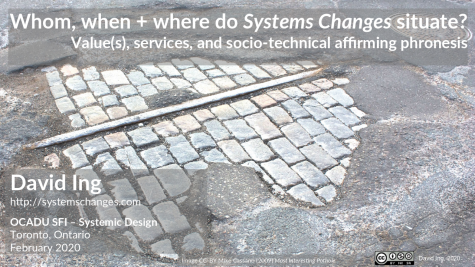
Whom, when + where do Systems Changes situated?

The same presentation slides were used for both lectures.  The questions from the students were considerably different across the class sections, so the diligent listener might want to compare them. … Read more (in a new tab)

Covering practical wisdom (phronesis), the third of four lectures again was compressed for the Systemic Design course in the Master’s program in Strategic Foresight and Innovation at OCAD University. The students in the part-time session on February 7 extended their discussion period longer than those in the full-time session on February 5. I again jumped slides in the sequence to stay within the timebox.

The agenda was in four sections:

  • [preamble] Episteme, Techne, Phronesis (reordered)
    • Intellectual Pursuits (Rethinking Systems Thinking)
    • Systems changes as situated c.f. ideal-seeking
  • A. Value(s), Judgment, Soft Systems Thinking
    • Appreciative Systems (Vickers, Checkland)
    • Policy, impacts and consequences of systems changes
  • B. Service Systems (c.f. Production Systems)
    • Science of Service Systems (Spohrer, Kijima)
    • Material-products c.f. information-services as systems changes
  • C. Socio-Technical Systems Perspective
    • Tavistock Institute + Legacy (Trist, Emery, Ramirez)
    • Coproduction and design principles guiding systems changes

The web video can be streamed on Youtube.

Copies of the video files are downloadable for disconnected viewing.

Video H.264 MP4 WebM
February 7
(1h21m)
[20200207_OCADU_Ing HD m4v]
(HD 2477kbps 1.6GB)
[20200207_OCADU_Ing nHD m4v]
(nHD 1344kps 866MB)
[20200207_OCADU_Ing HD webm]
(HD VP8 375kbps 349MB)
[20200207_OCADU_Ing nHD webm]
(nHD VP8 139kbps 206MB)

Readers who want to follow through on web link references may want to review the slides directly.

Whom, when + where do Systems Changes situated?

The same presentation slides were used for both lectures.  The questions from the students were considerably different across the class sections, so the diligent listener might want to compare them. … Read more (in a new tab)

Unfolding values in places, spaces and paces: Service systems thinking and architectural theory

Prior talks on Service Systems Thinking have focused on basics.  For this year’s Symposium on Service Systems Science at the Tokyo Institute of Technology, I decided to step up the emphasis in a short presentation on some selected ideas:

  • An unfolding is a process which gets you from one stage or moment of development to the next moment of development, in the evolution of a neighborhood or in the evolution of a building;  and
  • Value is dynamic, with access consciousness ex-ante and ex-post, and phenomenological consciousness in lived experience

From the 8 practices employed by Christopher Alexander on the 1985 Eishin project, I focused on one:

  • Find systems of centers in (i) the notions in people’s minds, and (ii) the places in the land. Combine them.

These ideas are at the core of how systems thinking is intertwined with service science, and pattern languages.  Jim Kijima and Hiroshi Deguchi arranged for a videographer this year, so there’s a record of the presentation.

Audio [20150228_1430_Titech_Ing_UnfoldingValuePlacesSpacesPaces_128kbps.mp3]
(45MB, 46m51s)
Video (47m01s) nHD
H.264 MP4 [640×360
454Kbps m4v] (160MB)
[640×360
1754Kbps m4v] (679MB)
[on archive.org]
WebM [640×360
247Kbps webm] (87MB)


The video is available on Youtube, or downloadable as audio or video.

A 90-year evolution: beliefs and values at IBM

In the IBM Archives, there’s a “IBM Management Principles & Practices” document that reflects the culture of an organization where I spent 28 years.  The 19 pages includes articles by seven IBM chairmen over a span of 90 years (published in 2002):

# Article Author Date
01. Basic Beliefs and Management Principles Thomas J. Watson, Jr. April 1969
02. Basic Management Responsibilities Thomas J. Watson, Jr July 1960
03. Be Yourself Frank Cary September 1975
04. Community Education Thomas J. Watson, Jr. August 1961
05. Community Service T. Vincent Larson December 1971
06. Conformity Frank Cary August 1973
07. Decision-Making Thomas J. Watson, Jr. October 1963
08. Equal Opportunity Frank Cary February 1974
09. Ethical Conduct Thomas J. Watson, Jr. June 1961
10. Gobbledygook Thomas J. Watson, Jr. February 1970
11. Human Relations Frank Cary December 1975
12. Managing People Thomas J. Watson, Jr. October 1964
13. Moves Thomas J. Watson, Jr. May 1968
14. Provincialism Thomas J. Watson, Jr. June 1962
15. Quality John R. Opel December 1981
16. Recognition Thomas J. Watson, Jr. March 1970
17. Thinking Thomas J. Watson, Sr. February 1930
18. Trust John F. Akers June 1986
19. Why Thomas J. Watson, Jr. May 1963
20. Women T. Vincent Learson August 1970
21. Win, Execute and Team Louis V. Gerstner, Jr. 1998

The article that led my interest was “Basic Beliefs and Management Principles”, which alphabetically happens to be first.  The “codification of the basic beliefs” is placed in the year 1962 by the IBM Archives, so the 1969 restatement by Thomas J.… Read more (in a new tab)

  • fediscience.org/@daviding (Mastodon)

    1. Loading Mastodon feed...
  • RSS feed: on IngBrief on IngBrief

    • 2026/01/07 | Rama Akkiraju | From LLMs to Living Systems: Applying Systems Science to Agentic AI in the Enterprise | HICSS-59 Keynote
      Abstract Enterprise AI is transitioning from simple single-LLM flows to complex agentic ecosystems—adaptive systems composed of multiple agents, tools, governed data, human workflows, and organizational policies. This keynote introduces a systems-science framework for designing and managing such ecosystems using principles of modularity, control, feedback, robustness, and socio-technical alignment. We illustrate these concepts through practical examples […]
    • Timothy F.H. Allen passed away on May 01, 2025
      Timothy F.H. Allen, president of International Society for the Systems Sciences 2008-2009, passed away peacefully in his home, surrounded by his family, on May 1, 2025. With his work on ecosystem ecology, I learned more about living systems than anyone else in the systems community. After his retirement, he was proud of putting together a […]
    • Installing WordPress Studio on Manjaro Linux
      In 2024, WordPress Studio was released, making installation on a local computer simpler. The instructions were modified from MacOS to Ubuntu Linux, by Daniel Kossmann, “How to install WordPress Studio in Ubuntu Linux” | Jun 15, 2024 at https://www.danielkossmann.com/how-to-install-wordpress-studio-ubuntu-linux/ I already had NVM installed, but in Terminal, with the result “command not found”. In the […]
    • Notion of Change in the Yijing | JeeLoo Lin 2017
      The appreciation of change is different in Western philosophy than in classical Chinese philosophy. JeeLoo Lin published a concise contrast on differences. Let me parse the Introduction to the journal article, that is so clearly written. A-theories divide time into past, present and future, and the point of reference is set at “the present.” B-theories, […]
    • World Hypotheses (Stephen C. Pepper) as a pluralist philosophy [Rescher, 1994]
      In trying to place the World Hypotheses work of Stephen C. Pepper (with multiple root metaphors), Nicholas Rescher provides a helpful positioning. — begin paste — Philosophical perspectivism maintains that substantive philosophical positions can be maintained only from a “perspective” of some sort. But what sort? Clearly different sorts of perspectives can be conceived of, […]
    • The Nature and Application of the Daodejing | Ames and Hall (2003)
      Ames and Hall (2003) provide some tips for those studyng the DaoDeJing.
  • Recent Posts

  • Archives

  • RSS feed: on daviding.com on daviding.com

    • 2026/10 Moments October 2026
      Dartmouth, Nova Scotia; Halifax, Nova Scotia; Lunenberg, Nova Scotia; Peggy’s Cove, Nova Scotia; Bible Hill, Nova Scotia; Louisbourg, Nova Scotia; Sydney, Nova Scotia; Baddeck, Nova Scotia; Toronto, Ontario Fraser’s Mills Fish Hatchery: Side trip to hatchery built in 1928 by provincial government, gravity-fed from South River. Water in pen dark, ripples at surface due to […]
    • 2026/09 Moments September 2026
      Vancouver BC; Toronto, Ontario, Burlington, Ontario; Shanghai PR China Serenade of the Seas: From the foredeck of level 12 of the Royal Caribbean Line ship, the panorama west to the Vancouver Convention Centres, turning to the north across Vancouver Harbour. Observed Princess Line ship leaving the dock, a departure we never experienced. Arrived for lunch, […]
    • 2026/08 Moments August 2026
      Toronto, Ontario; Vancouver BC Next Perfect Day Playlist: Korean Town Street Festival, 20260808 Night View O What A Shiny Night Honey Haneum Playlist: Korean Town Street Festival, 20260808 Happiness Prince of Jeju Ieodo Sana Seouje Sori Leida Lay Down Together Star North Sky Beautiful Country Encore Chris Fraser Trio | Meo | 2026-08-30: Nestled in […]
    • 2026/07 Moments July 2026
      Quiet summer mostly at home writing, taking breaks to meet with friends, and exercise on bike rides.
    • 2026/06 Moments June 2026
      Cool summer catching up with family and friends, music festivals
    • 2026/05 Moments May 2026
      Cool spring, busy with Jane's Walk, bathroom renovation, closing out father's apartment, OCADU GradEx, Problematique Dialogue applying the Banathy Conversation Methodology, Qingming.
  • RSS feed: on Media Queue on Media Queue

  • Meta

  • Creative Commons License
    This work is licensed under a Creative Commons Attribution-NonCommercial-ShareAlike 4.0 International License
    Theme modified from DevDmBootstrap4 by Danny Machal