
Coevolving Innovations

… in Business Organizations and Information Technologies

Currently Viewing Posts Tagged christopher alexander

Systems Changes: Learning from the Christopher Alexander Legacy (ST-ON, 2019/02/11)

One of the aims of the Systems Changes research program is to build on the pattern language approach.  This body of work stretches back into the 1960s, and has been cross-appropriated from built environments to software development (e.g. agile methods) and organizational change.  The February 2019 meeting of Systems Thinking Ontario was an opportunity to bring some people not familiar with the territory up to speed.

Here is the abstract for the talk:

The 1977 book, A Pattern Language: Towns, Buildings, Construction is prominent in public library collections around the world. It represents, however, only one stage of the many works by Christopher Alexander, from his first book published in 1964, to his final book released in 2012. In addition multiple international conferences continue his legacy, in architecture and urban design (PUARL, for 10 years), in software development (PLoP, for 25 years), and in social change (PURPLSOC, for 5 years). Alexander was a builder of environment structure — an architect — and other communities have aspired to adopt the approach that he championed.

This Systems Thinking Ontario session will review pattern languages in three parts:

  1. The Eishin School project (1985, published as a book in 2012);
  2. Multi-Service Centers (1968); and
  3. Beyond Built Environments, cross-appropriating the approach from architecture to other domains.

The pursuit of “systems generating systems” at the foundation of Christopher Alexander’s pattern language has generally not been appreciated, and deserves a deeper inquiry.
… Read more (in a new tab)

One of the aims of the Systems Changes research program is to build on the pattern language approach.  This body of work stretches back into the 1960s, and has been cross-appropriated from built environments to software development (e.g. agile methods) and organizational change.  The February 2019 meeting of Systems Thinking Ontario was an opportunity to bring some people not familiar with the territory up to speed.

Here is the abstract for the talk:

The 1977 book, A Pattern Language: Towns, Buildings, Construction is prominent in public library collections around the world. It represents, however, only one stage of the many works by Christopher Alexander, from his first book published in 1964, to his final book released in 2012. In addition multiple international conferences continue his legacy, in architecture and urban design (PUARL, for 10 years), in software development (PLoP, for 25 years), and in social change (PURPLSOC, for 5 years). Alexander was a builder of environment structure — an architect — and other communities have aspired to adopt the approach that he championed.

This Systems Thinking Ontario session will review pattern languages in three parts:

  1. The Eishin School project (1985, published as a book in 2012);
  2. Multi-Service Centers (1968); and
  3. Beyond Built Environments, cross-appropriating the approach from architecture to other domains.

The pursuit of “systems generating systems” at the foundation of Christopher Alexander’s pattern language has generally not been appreciated, and deserves a deeper inquiry.

… Read more (in a new tab)

Exploring the Context of Pattern Languages

Pattern language is not for wicked problems, said Max Jacobson, coauthor with Christopher Alexander of the 1977 A Pattern Language: Towns, Building, Construction.  In addition, the conventional definition of an Alexandrian pattern as “a solution to a problem in context” when applied to social change might better use the term “intervention”, rather than “solution”.

These are two of the major ideas that emerged at Purplsoc 2017 conference last October.  A 90-minute workshop was run in parallel with other breakouts.

For about the first hour, vocal participants included Max Jacobson (who had given a plenary talk on “A Building is not a Turkish Carpet“), Christian Kohls (who gave a plenary talk on “Patterns for Creative Space“) and Peter Baumgarnter (one of the Purlpsoc chairs).

As an impetus to discussion, we stepped through slides that had been posted on the Coevolving Commons.

For people who would like the next-best experience to being there, the slides have now been matched up with the digital audio recording, for viewing as a web video.

For devices decoupled from the Internet, downloadable video files are portable.

Video H.264 MP4 WebM
Digital video
(1h22m51s)
[20171021_Purplsoc_Ing_Exploring HD_578kpbs m4v]
(HD 578Kbps 342MB) [on the Internet Archive]
[20171021_Purplsoc_Ing_Exploring nHD_477kpbs m4v]
(nHD 495Kkps 283MB)
[20171021_Purplsoc_Ing_Exploring HD_416kpbs webm]
(HD 416Kbps 246MB)
[20171021_Purplsoc_Ing_Exploring nHD_191kpbs webm]
(nHD 191Kbps 114MB)

The length of the conversation may encourage listeners to download an audio recording.

Audio
Digital audio
(1h22m51s)
[20171021_0930_Purplsoc_Ing ExploringTheContext mp3] (76MB)

In producing the multimedia, a digest of timecodes highlights some interesting conversation points.… Read more (in a new tab)

Christopher Alexander, Horst Rittel, C. West Churchman

At U.C. Berkeley in the 1960s, Christopher Alexander, Horst Rittel and C. West Churchman could have had lunch together.  While disciplinary thinking might lead novices to focus only on each of pattern language, wicked problems and the systems approach, there are ties (as well as domain-specific distinctions) between the schools.

West Churchman joined Berkeley in 1957, and initiated master’s and doctoral programs in operations research at the School of Business Administration.   From 1964 to 1970, Churchman was associate director and research philosopher at UC Berkeley’s Space Sciences Laboratory, directing its social sciences program.  After his retirement in 1981, Churchman taught in the Peace and Conflict Studies program for 13 years.

Horst Rittel came to the Berkeley College of Environmental Design in 1963, the same year that dean William Wurster recruited Christopher Alexander.  In 1973, Rittel split his time between Berkeley and the architecture faculty at the University of Stuttgart, where he founded the Institut für Grundlagen der Planung.

Christopher Alexander became a cofounder of the Center for Environmental Structure at Berkeley in 1967, gradually moving outside of the university by 2000.

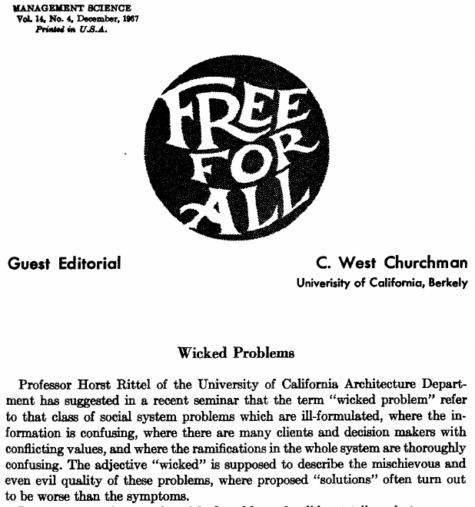
The tie between Churchman and Rittel are well-documented, in a 1967 article in Management Science.

Professor Horst Rittel of the University of California Architecture Department has suggested in a recent seminar that the term “wicked problem” refer to that class of social system problems which are ill-formulated, where the information is confusing, where there are many clients and decision makers with conflicting values, and where the ramifications in the whole system are thoroughly confusing.

… Read more (in a new tab)

Pattern Manual for Service Systems Thinking

At the PUARL Conference 2016, a proposal was made on adapting pattern language for service systems thinking.  In 1967, Christopher Alexander published Pattern Manual at the founding of the Center for Environmental Structure, describing a pattern format for physical built environments.  While we can learn a lot from the nearly 50 years work originating at the CES, service systems have features beyond physicality that suggest reconsidering some of the foundations of pattern language.

An article for discussion was accepted into the proceedings for the PUARL conference.  The 20-minute presentation quickly covered the following topics:

  • 1. Pattern Manual 1967 + Service Systems
  • 2. Alexandrian example → services
  • 3. Methods clarified since 1973
  • 4. A new format:  amplifying, rephilosophizing, reinterpreting prior doxa
  • 5. Generating and legitimizing in communities

Slides have been added over the audio recording to produce a video presentation.

Audio [20161029_PUARL_Ing_PatternManualS2T.mp3]
(20MB, 20m19s)
[20161029_PUARL_Ing_PatternManualS2T_3db.mp3]
(volume boosted 3db, 20MB, 20m19s)
[20161029_PUARL_Ing_PatternManualS2T_6db.mp3]
(volume boosted 6db, 20MB, 20m19s)
Video HD (20m19s)
H.264 MP4 [1280×720 384Kbps m4v]
(70MB)
[1280×720 5000Kbps m4v]
(76MB) [on archive.org]
WebM [1280×720 110Kbps webm]
(34MB)
[1280×720 826Kbps webm]
(153MB)

For people who prefer visuals at their own pace, the slides are posted on the Coevolving Commons.  The video is available on Youtube.

Purplsoc 2015 digests and presentation

The pattern language community — followers of Christopher Alexander’s approach — is distributed globally.  I participated in PLoP 2014 at Allerton Park, Illinois last September, and then attended AsianPLoP 2015 in Tokyo last March.  I had been eyeing the PUARL (Portland Urban Architecture Research Laboratory) conference for fall 2015, but then heard that the event was being incorporated into Purplsoc for 2015.  I originally couldn’t justify a trip to Europe for the Purplsoc (Pursuit of Pattern Language for Societal Change) 2015 conference, but then its timing turned out to be back-to-back with the ISIE conference.  So, just 3 weeks before the conference, I booked a triangular routing to arrive just in time for the start on July 3, in Krems, Austria.

On the Friday, the program started with some plenary session keynotes:

  • Hermann Czech, “Remarks about the Truth and the Whole” [digest]
  • “Opening”, with Peter Baumgartner; a delegate of the Mayor of the City of Krems; Monica Kil; Christian Hanus; Hajo Neis [digest]
  • Wolfgang Stark, “Performative Patterns for Innovation: The Power of Tacit Knowing in Social Systems” [digest]

Saturday morning started with a keynote.

The rest of Saturday morning had parallel streams.  I was in the Pattern applications and practices session.

  • Hajo Neis and Perrin Wright, “Up and Out: Oregon Tsunami Wayfinding Survival Language” [digest]
  • Taichi Isaku, “The Cooking Language: Applying the Theory of Properties and Patterns into Cooking” [digest] [slides on slideshare.com
… Read more (in a new tab)

Unfolding values in places, spaces and paces: Service systems thinking and architectural theory

Prior talks on Service Systems Thinking have focused on basics.  For this year’s Symposium on Service Systems Science at the Tokyo Institute of Technology, I decided to step up the emphasis in a short presentation on some selected ideas:

  • An unfolding is a process which gets you from one stage or moment of development to the next moment of development, in the evolution of a neighborhood or in the evolution of a building;  and
  • Value is dynamic, with access consciousness ex-ante and ex-post, and phenomenological consciousness in lived experience

From the 8 practices employed by Christopher Alexander on the 1985 Eishin project, I focused on one:

  • Find systems of centers in (i) the notions in people’s minds, and (ii) the places in the land. Combine them.

These ideas are at the core of how systems thinking is intertwined with service science, and pattern languages.  Jim Kijima and Hiroshi Deguchi arranged for a videographer this year, so there’s a record of the presentation.

Audio [20150228_1430_Titech_Ing_UnfoldingValuePlacesSpacesPaces_128kbps.mp3]
(45MB, 46m51s)
Video (47m01s) nHD
H.264 MP4 [640×360
454Kbps m4v] (160MB)
[640×360
1754Kbps m4v] (679MB)
[on archive.org]
WebM [640×360
247Kbps webm] (87MB)


The video is available on Youtube, or downloadable as audio or video.

  • fediscience.org/@daviding (Mastodon)

    1. Loading Mastodon feed...
  • RSS feed: on IngBrief on IngBrief

    • 2026/01/07 | Rama Akkiraju | From LLMs to Living Systems: Applying Systems Science to Agentic AI in the Enterprise | HICSS-59 Keynote
      Abstract Enterprise AI is transitioning from simple single-LLM flows to complex agentic ecosystems—adaptive systems composed of multiple agents, tools, governed data, human workflows, and organizational policies. This keynote introduces a systems-science framework for designing and managing such ecosystems using principles of modularity, control, feedback, robustness, and socio-technical alignment. We illustrate these concepts through practical examples […]
    • Timothy F.H. Allen passed away on May 01, 2025
      Timothy F.H. Allen, president of International Society for the Systems Sciences 2008-2009, passed away peacefully in his home, surrounded by his family, on May 1, 2025. With his work on ecosystem ecology, I learned more about living systems than anyone else in the systems community. After his retirement, he was proud of putting together a […]
    • Installing WordPress Studio on Manjaro Linux
      In 2024, WordPress Studio was released, making installation on a local computer simpler. The instructions were modified from MacOS to Ubuntu Linux, by Daniel Kossmann, “How to install WordPress Studio in Ubuntu Linux” | Jun 15, 2024 at https://www.danielkossmann.com/how-to-install-wordpress-studio-ubuntu-linux/ I already had NVM installed, but in Terminal, with the result “command not found”. In the […]
    • Notion of Change in the Yijing | JeeLoo Lin 2017
      The appreciation of change is different in Western philosophy than in classical Chinese philosophy. JeeLoo Lin published a concise contrast on differences. Let me parse the Introduction to the journal article, that is so clearly written. A-theories divide time into past, present and future, and the point of reference is set at “the present.” B-theories, […]
    • World Hypotheses (Stephen C. Pepper) as a pluralist philosophy [Rescher, 1994]
      In trying to place the World Hypotheses work of Stephen C. Pepper (with multiple root metaphors), Nicholas Rescher provides a helpful positioning. — begin paste — Philosophical perspectivism maintains that substantive philosophical positions can be maintained only from a “perspective” of some sort. But what sort? Clearly different sorts of perspectives can be conceived of, […]
    • The Nature and Application of the Daodejing | Ames and Hall (2003)
      Ames and Hall (2003) provide some tips for those studyng the DaoDeJing.
  • Recent Posts

  • Archives

  • RSS feed: on daviding.com on daviding.com

    • 2026/10 Moments October 2026
      Dartmouth, Nova Scotia; Halifax, Nova Scotia; Lunenberg, Nova Scotia; Peggy’s Cove, Nova Scotia; Bible Hill, Nova Scotia; Louisbourg, Nova Scotia; Sydney, Nova Scotia; Baddeck, Nova Scotia; Toronto, Ontario Fraser’s Mills Fish Hatchery: Side trip to hatchery built in 1928 by provincial government, gravity-fed from South River. Water in pen dark, ripples at surface due to […]
    • 2026/09 Moments September 2026
      Vancouver BC; Toronto, Ontario, Burlington, Ontario; Shanghai PR China Serenade of the Seas: From the foredeck of level 12 of the Royal Caribbean Line ship, the panorama west to the Vancouver Convention Centres, turning to the north across Vancouver Harbour. Observed Princess Line ship leaving the dock, a departure we never experienced. Arrived for lunch, […]
    • 2026/08 Moments August 2026
      Toronto, Ontario; Vancouver BC Next Perfect Day Playlist: Korean Town Street Festival, 20260808 Night View O What A Shiny Night Honey Haneum Playlist: Korean Town Street Festival, 20260808 Happiness Prince of Jeju Ieodo Sana Seouje Sori Leida Lay Down Together Star North Sky Beautiful Country Encore Chris Fraser Trio | Meo | 2026-08-30: Nestled in […]
    • 2026/07 Moments July 2026
      Quiet summer mostly at home writing, taking breaks to meet with friends, and exercise on bike rides.
    • 2026/06 Moments June 2026
      Cool summer catching up with family and friends, music festivals
    • 2026/05 Moments May 2026
      Cool spring, busy with Jane's Walk, bathroom renovation, closing out father's apartment, OCADU GradEx, Problematique Dialogue applying the Banathy Conversation Methodology, Qingming.
  • RSS feed: on Media Queue on Media Queue

  • Meta

  • Creative Commons License
    This work is licensed under a Creative Commons Attribution-NonCommercial-ShareAlike 4.0 International License
    Theme modified from DevDmBootstrap4 by Danny Machal