Coevolving Innovations

… in Business Organizations and Information Technologies

Systems Thinking and the Learning Aesthetic (Systems Thinking Ontario, 2013-03-21)

When can learning about system thinking be fun (and when can’t it be)?  This was the focus question for the third Systems Thinking Ontario meeting. We had a slight change in format from the reading-oriented prior agendas, as Steve Easterbrook led us through a more experiential approach to systems thinking.  As usual, participants were provided with pre-readings, this time from Linda Booth Sweeney.  As a change for the in-person meeting, Steve went directly to exercises from the Systems Thinking Playbook, which he has been using in classes such as Systems Thinking for Global Problems.  While the exercises are appropriate for students down into the primary school level, Steve has found that graduate students also enjoy and learn from them.  In the short time available, we played through two exercises and then broke out into discussion subgroups.

The first exercise was called “Frames”.  Steve provided each of us with a piece of paper with a small aperture cut out of the centre.

di_20130321_174830_st-on_sme_frame.jpg

The playbook gives the following directions.

Geographic Framing

Step 1:  Ask all participants to hold their viewing holes out at arm’s length.

Ask them to look through the holes and focus on a specific object; for example, a cluster of tennis balls on a table, a poster, you, or whatever object you choose.  [….]

Step 2:  Ask the following questions, pausing for 10-20 seconds after each, so participants have time to ponder their answer.
… Read more (in a new tab)

Full version: “Rethinking Systems Thinking: Learning and coevolving with the world”, Aalto University, 2012/11/26

A guest lecture on systems thinking for the Creativity Sustainability program at Aalto University provided an opportunity to stretch out on the plenary presentation that I had given at ISSS 2012.  In San Jose last July, plenary speakers (including myself) were constrained to 45 minute slots preceding dialectic panelists.  In Helsinki in November, the luxury of time allowed me to explain the ideas more fully.  The lecture took 85 minutes, and was then followed by a question and answer session.

Rehinking Systems Thinking

Versions of the web video can be viewed on Youtube, or viewed or downloaded at http://media.isss.org , at 480x272p, 720x400p, and 1280x720p.  The video shoot and post-production editing of the lecture was done by Seungho Lee, on behalf of the Creative Sustainability program.

The presentation on “Rethinking Systems Thinking” is probably the most comprehensive talk that I’ve given (and may ever give).  It is a personal perspective on systems, gained since the attending my first ISSS meeting in 1998 — that’s 14 years with the society.  My focus has recently shifted from the international audience to the local audience around Toronto, with Systems Thinking Ontario.  Systems thinking can be doled out in smaller chunks.  Over the Internet, viewers may choose to use the pause button.

Systems Thinking and Futures Studies (Systems Thinking Ontario, 2013-02-21)

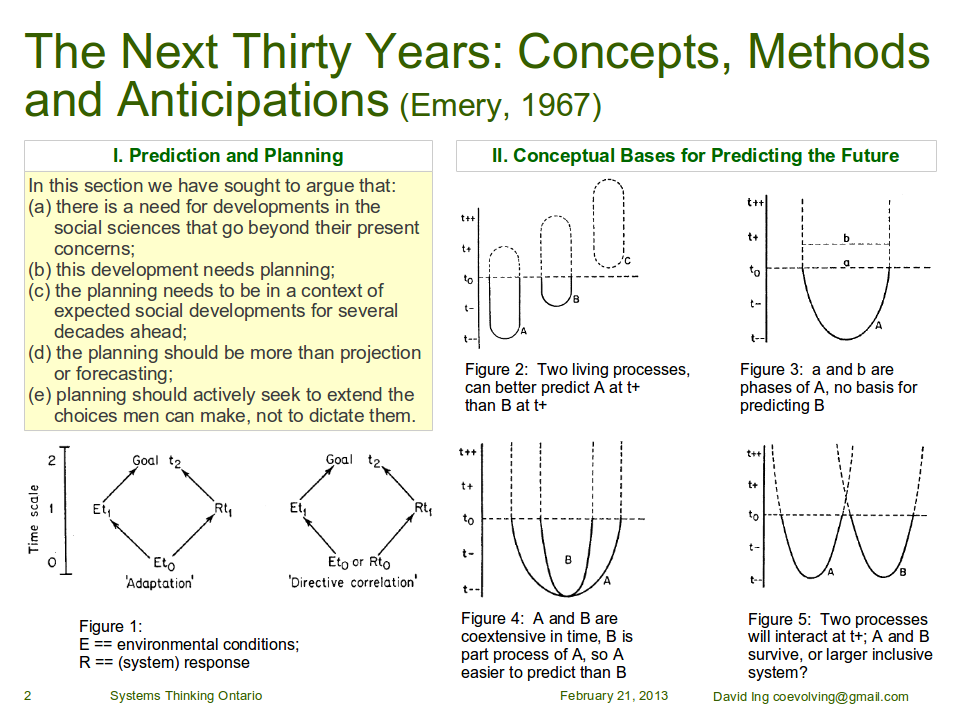
The pre-reading of Emery (1967), “The Next Thirty Years: Concepts, Methods and Anticipations” was introduced as a challenging article for the second meeting of Systems Thinking Ontario on Feb. 21, 2013.  The theme for the evening was “Systems Thinking and Future Studies”, so there was some irony in looking backwards to 1967 to have a discussion on looking forward.

In my role as reviewer in Systems Thinking Ontario sessions, I would prefer to try to stick to the text rather than adding editorializing.  However, since this Emery (1967) article is particular rich, I tried to provide some additional context to make the reading easier.

Fred Emery is especially known for his work with the Tavistock Institute for Human Relations, as one of the pioneers of the field we know today as organization science, including organization development and organization design.  In 1967, systems thinking was new:  The Systems Approach would be published by West Churchman in 1968, and On Purposeful Systems by Ackoff and Emery would follow years later in 1972.  The Club of Rome was founded in 1968.  In this article, Emery was thinking about how systems thinking frames viewing the future.

I. Prediction and Planning; II. Conceptual Bases for Predicting the Future

In I. Prediction and Planning, the systems of interest are in the social sciences.  The longer history of systems thinking prior to 1967 would have been a stronger cybernetics orientation.  The research from the Tavistock Institute on the socio-psychological, socio-technical and socio-ecological systems perspectives would have been fresh.  … Read more (in a new tab)

Systems Thinking and Science, (Systems Thinking Ontario, 2013-01-17)

The inaugural meeting of Systems Thinking Ontario convened in the Lambert Lounge at OCAD U. on the evening of January 17.  The theme for the meeting was “Systems Thinking and Science”, with the focus question for the evening as: “Is the function of systems thinking to be (i) a science or (ii) a complement to science?”

The suggested pre-reading for the session was a rather old (1956) foundational article:

After a preamble on the role of Kenneth Boulding in the founding of the Society for General Systems Research (now known as the International Society for the Systems Sciences), some slides with the major points of the article were provided by attendees.

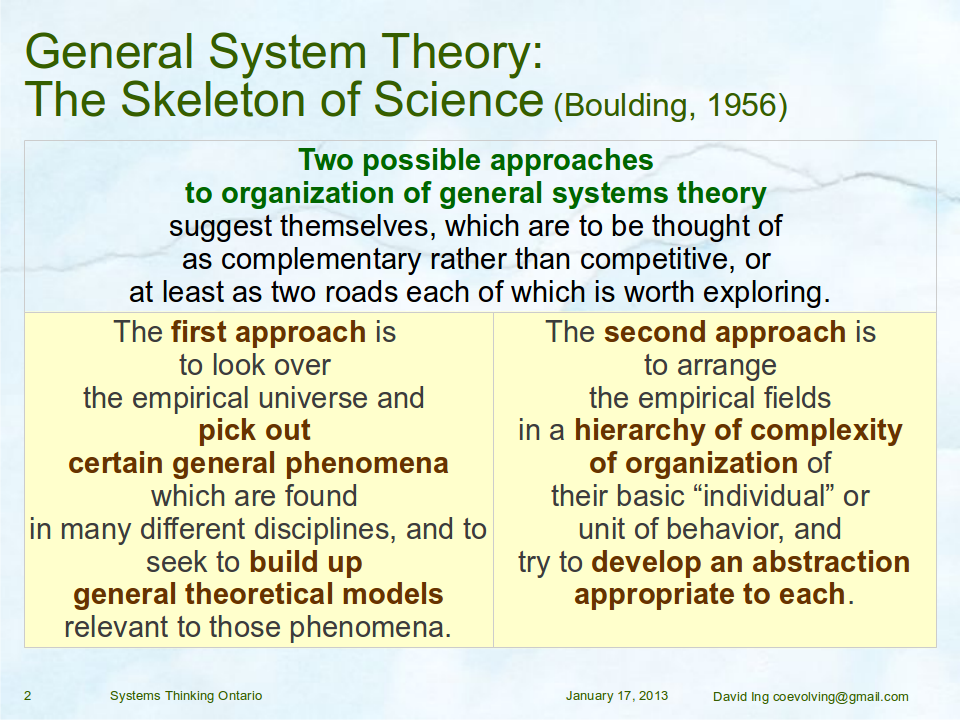
Towards a goal of organizing general systems theory, Boulding suggested two approaches:  (i) looking empirically for general phenomena across disciplines, and building up general theoretical models, or (ii) arranging the empirical fields into a hierarchy of complexity of organization, while trying to develop an abstraction appropriate to each.

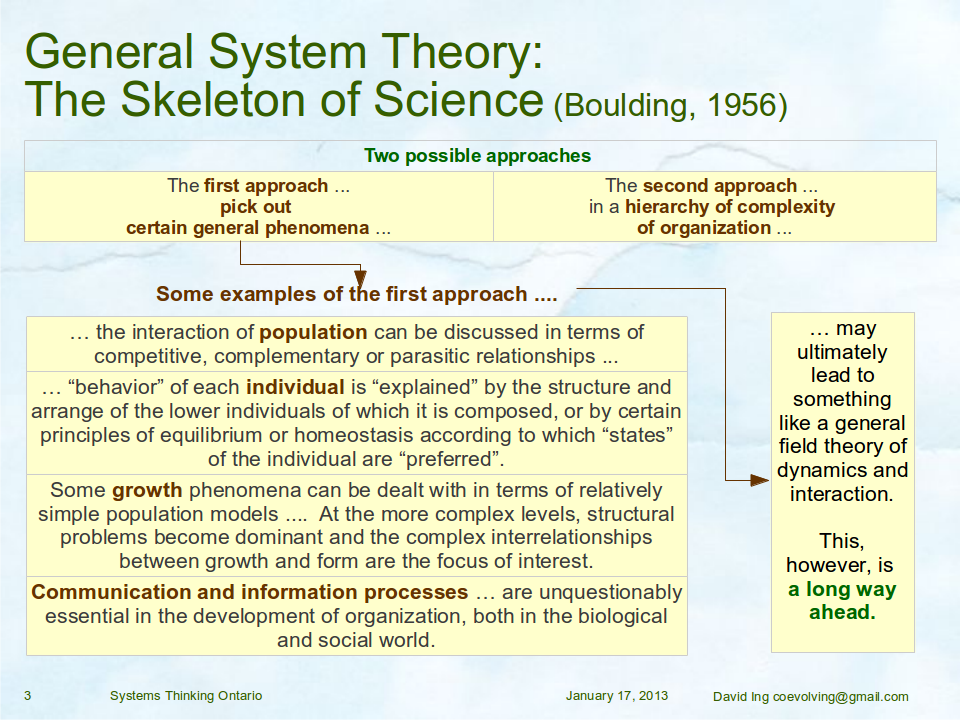
Examples of the first approach included the interactions of populations, behaviours of individuals, growth, and communication and information processes.  Boulding saw that such an approach could lead to a general theory (of dynamics and interaction), but thought that this would be “a long way ahead”.

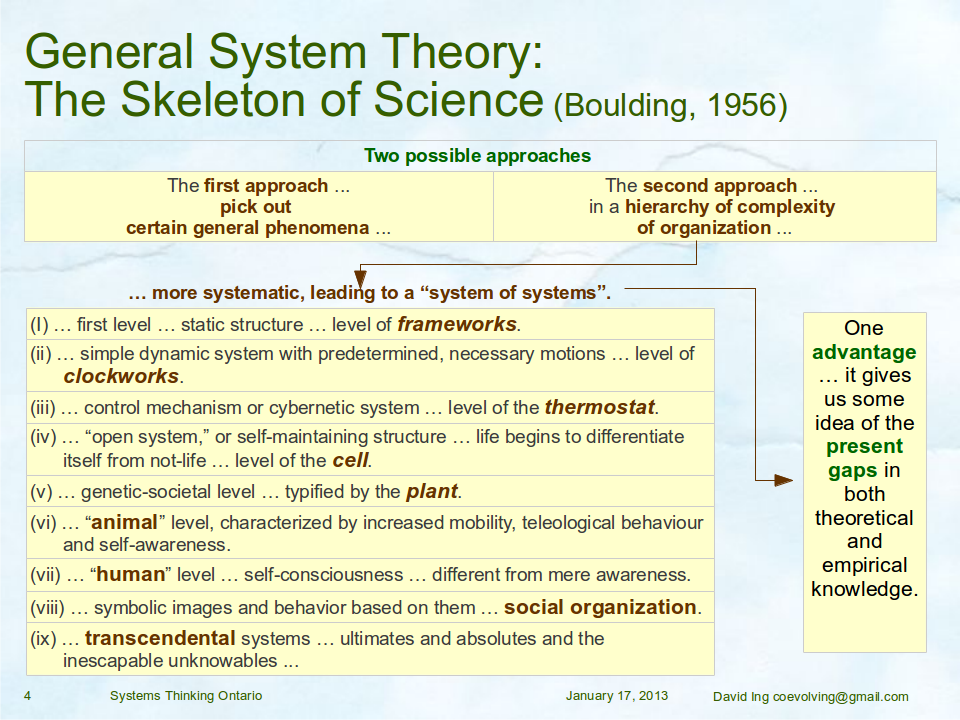
In the second approach, Boulding proposed a hierarchy of complexity — of (i) frameworks, (ii) clockworks, (iii) thermostat, (iv) cell, (v) plant, (vi) animal, (vii) human, (viii) social organization, and (ix) transcendental systems — that was more systematic.  … Read more (in a new tab)

Reconciling Perspectives in Futures Research and Systems Thinking

The postgraduate course on Philosophical, Methodological and Pragmatic Approaches to Scientific Futures Research was offered by the Finnish Futures Academy at the University of Turku at the end of November 2012.  I had never taken a course on scientific futures research before.  I had never been to Turku before.  Since I was scheduled to be Finland in mid-November, this presented an opportunity to get expert knowledge from leaders in future studies.  I registered for the course.

In the typical style of Finnish intensive courses, a long list of articles was prescribed in advance.  On the course schedule, a lecture for systemic approaches — naming Soft Systems Methodology — was slated on the last of three days.  Working through the articles, the ties between futures studies and systems thinking led me to read about their parallel development, particularly through the 1970s.  While most graduate students would try to relate the course content to their thesis, I’m so far along on my dissertation that that wouldn’t be productive.  Thus, for my presentation, I decided to talk about the prescribed readings in futures research from my perspective founded in systems thinking.

The philosophy of Finnish school of scientific futures is based much in critical realism (via Alan Musgrave) through Wendell Bell (honoured in an August 2011 issue of Futures, edited by Paul Dragos Aligica).  I came to realize that my view of the world is based much more on foundations on the design of inquiring systems, originating from C.… Read more (in a new tab)

Open source, private source: foundations

In my dissertation for Aalto University, I’ve chosen the label of “private source” in opposition for the label “open source”.  This dissertation has been under development for some years.  In November 2012, the annual Arctic Workshop — a meeting of graduate students and supervisors of the Finnish Doctoral Program in Industrial Engineering and Management — was scheduled to bring together participants from across Finland.  With a theme for 2012 of “Innovation and Sourcing”, and an opportune opening on my calendar, I went to Finland to participate.

As a graduate student, I prepared an article and presentation slides for the event.  The abstract sent in advance said:

This research paper is an excerpt from a forthcoming dissertation titled “Open source with private source: coevolving architectures, styles and subworlds in business”. The content has been extracted from the first and second chapters, particularly on foundational definitions. It has being contributed to the Arctic Workshop 2012 as a research paper as part of a thesis under development.

This thesis, as a complete work, inquires into the question: How do open source and private source coexist and coevolve as patterns of behaviour in business? The research approach chosen is inductive, from nine cases in which both open source and private source have been in play. Theories built in the fully-developed thesis are placed into pluralistic contexts, as an inductive approach to multiparadigm inquiry.

Coincident with the theme of “Innovation and Sourcing” for the Arctic Workshop 2012, this research paper aims to explain the terms “open source” and “private source”, mostly as distinct patterns as phenomena in contemporary business.

… Read more (in a new tab)
  • fediscience.org/@daviding (Mastodon)

    1. Loading Mastodon feed...
  • RSS feed: on IngBrief on IngBrief

    • 2026/01/07 | Rama Akkiraju | From LLMs to Living Systems: Applying Systems Science to Agentic AI in the Enterprise | HICSS-59 Keynote
      Abstract Enterprise AI is transitioning from simple single-LLM flows to complex agentic ecosystems—adaptive systems composed of multiple agents, tools, governed data, human workflows, and organizational policies. This keynote introduces a systems-science framework for designing and managing such ecosystems using principles of modularity, control, feedback, robustness, and socio-technical alignment. We illustrate these concepts through practical examples […]
    • Timothy F.H. Allen passed away on May 01, 2025
      Timothy F.H. Allen, president of International Society for the Systems Sciences 2008-2009, passed away peacefully in his home, surrounded by his family, on May 1, 2025. With his work on ecosystem ecology, I learned more about living systems than anyone else in the systems community. After his retirement, he was proud of putting together a […]
    • Installing WordPress Studio on Manjaro Linux
      In 2024, WordPress Studio was released, making installation on a local computer simpler. The instructions were modified from MacOS to Ubuntu Linux, by Daniel Kossmann, “How to install WordPress Studio in Ubuntu Linux” | Jun 15, 2024 at https://www.danielkossmann.com/how-to-install-wordpress-studio-ubuntu-linux/ I already had NVM installed, but in Terminal, with the result “command not found”. In the […]
    • Notion of Change in the Yijing | JeeLoo Lin 2017
      The appreciation of change is different in Western philosophy than in classical Chinese philosophy. JeeLoo Lin published a concise contrast on differences. Let me parse the Introduction to the journal article, that is so clearly written. A-theories divide time into past, present and future, and the point of reference is set at “the present.” B-theories, […]
    • World Hypotheses (Stephen C. Pepper) as a pluralist philosophy [Rescher, 1994]
      In trying to place the World Hypotheses work of Stephen C. Pepper (with multiple root metaphors), Nicholas Rescher provides a helpful positioning. — begin paste — Philosophical perspectivism maintains that substantive philosophical positions can be maintained only from a “perspective” of some sort. But what sort? Clearly different sorts of perspectives can be conceived of, […]
    • The Nature and Application of the Daodejing | Ames and Hall (2003)
      Ames and Hall (2003) provide some tips for those studyng the DaoDeJing.
  • Recent Posts

  • Archives

  • RSS feed: on daviding.com on daviding.com

    • 2026/10 Moments October 2026
      Dartmouth, Nova Scotia; Halifax, Nova Scotia; Lunenberg, Nova Scotia; Peggy’s Cove, Nova Scotia; Bible Hill, Nova Scotia; Louisbourg, Nova Scotia; Sydney, Nova Scotia; Baddeck, Nova Scotia; Toronto, Ontario Fraser’s Mills Fish Hatchery: Side trip to hatchery built in 1928 by provincial government, gravity-fed from South River. Water in pen dark, ripples at surface due to […]
    • 2026/09 Moments September 2026
      Vancouver BC; Toronto, Ontario, Burlington, Ontario; Shanghai PR China Serenade of the Seas: From the foredeck of level 12 of the Royal Caribbean Line ship, the panorama west to the Vancouver Convention Centres, turning to the north across Vancouver Harbour. Observed Princess Line ship leaving the dock, a departure we never experienced. Arrived for lunch, […]
    • 2026/08 Moments August 2026
      Toronto, Ontario; Vancouver BC Next Perfect Day Playlist: Korean Town Street Festival, 20260808 Night View O What A Shiny Night Honey Haneum Playlist: Korean Town Street Festival, 20260808 Happiness Prince of Jeju Ieodo Sana Seouje Sori Leida Lay Down Together Star North Sky Beautiful Country Encore Chris Fraser Trio | Meo | 2026-08-30: Nestled in […]
    • 2026/07 Moments July 2026
      Quiet summer mostly at home writing, taking breaks to meet with friends, and exercise on bike rides.
    • 2026/06 Moments June 2026
      Cool summer catching up with family and friends, music festivals
    • 2026/05 Moments May 2026
      Cool spring, busy with Jane's Walk, bathroom renovation, closing out father's apartment, OCADU GradEx, Problematique Dialogue applying the Banathy Conversation Methodology, Qingming.
  • RSS feed: on Media Queue on Media Queue

  • Meta

  • Creative Commons License
    This work is licensed under a Creative Commons Attribution-NonCommercial-ShareAlike 4.0 International License
    Theme modified from DevDmBootstrap4 by Danny Machal