
Coevolving Innovations

… in Business Organizations and Information Technologies

Designing for thrownness, design attitude, decision attitude

“Designing for Thrownness” showed up for me via “Design, Wicked Problems and Throwness” by Harold G. Nelson.  The citation of Karl Weick as a source, with references to Flores & Winograd (1986), led me to find the Managing by Designing research led by Boland and Collopy, with the 2004 conference as Case Western Reserve abstracted in a series of videos (of which Thrownness is #4 of 7).

Boland and Collopy differentiate between a design attitude and a decision attitude.

A decision attitude toward problem solving is used extensively in management education. It portrays the manager as facing a set of alternative courses of action from which a choice must be made.

  • The decision attitude assumes it is easy to come up with alternatives to consider, but difficult to choose among them.
  • The design attitude toward problem solving, in contrast, assumes that it is difficult to design a good alternative, but once you have developed a truly great one, the decision about which alternative to select becomes trivial.

The design attitude appreciates that the cost of not conceiving of a better course of action than those that are already being considered is often much higher than making the “wrong” choice among them.

The decision attitude toward problem solving and the many decision-making tools we have developed for supporting it have strengths that make them suitable for certain situations. In a clearly defined and stable situation, when the feasible alternatives are well known, a decision attitude may be the most efficient and effective way to approach problem solving.
… Read more (in a new tab)

Revisiting the Socio-Ecological, Social-Technical and Socio-Psychological Systems Perspectives

A report, plus a contributed article, on the socio-ecological, socio-technical and socio-psychological systems perspectives is now available.

The Tavistock Institute for Human Relations, from the 1950s through the 1980s, developed a legacy of research based in systems thinking that has had lasting impact on theories of organization design and change.  The International Federation for Systems Research biannually hosts a conversation event in Austria where systems researchers have the luxury of time to share in mutual learning.  A trigger question for a team was proposed:

  • In which ways is the Tavistock legacy still relevant, and which ways might these ideas be advanced and/or refreshed (for the globalized/service economy)?

Pointers to some of the relevant literature were provided.  Joining the team, at Linz, were:

Minna Takala led the development of the team report for the proceedings, as well as contributing an independent article extending learnings from the group.  An excerpt of these two publications is a repackaging from the full proceedings that comprise the work of four teams meeting in parallel.

Robust Yet Fragile Complexity, or Scale Free Network?

A mention of “Robust-Yet-Fragile” label by resilience author @andrew_zolli led me to John Doyle‘s research at Caltech.  Andrew Zolli writes:

We rightfully add safety systems to things like planes and oil rigs, and hedge the bets of major banks, in an effort to encourage them to run safely yet ever-more efficiently. Each of these safety features, however, also increases the complexity of the whole.  Add enough of them, and soon these otherwise beneficial features become potential sources of risk themselves, as the number of possible interactions — both anticipated and unanticipated — between various components becomes incomprehensibly large.

This, in turn, amplifies uncertainty when things go wrong, making crises harder to correct: Is that flashing alert signaling a genuine emergency? Is it a false alarm? Or is it the result of some complex interaction nobody has ever seen before? [….]

CalTech system scientist John Doyle has coined a term for such systems: he calls them Robust-Yet-Fragile — and one of their hallmark features is that they are good at dealing with anticipated threats, but terrible at dealing with unanticipated ones. As the complexity of these systems grow, both the sources and severity of possible disruptions increases, even as the size required for potential ‘triggering events’ decreases — it can take only a tiny event, at the wrong place or at the wrong time, to spark a calamity.

In an 2007 Discover Magazine article, Carl Zimmer provides a simplified description of research conducted from a theoretical foundation (in Scale Free Networks) in contrast to that from empirical practicalities in control engineering.… Read more (in a new tab)

City Sciences workshop, U. of Toronto

The Cities Centre at the University of Toronto recently hosted a two day workshop on “Finding Connections Towards a Holistic View of City Systems“, as an NSERC Partnership Workshop to bring together academics, industry and government participants.  I was privileged to be invited as one of the 30 attendees to discuss potential future collaborations through a systems approach to urban issues.  The meeting was hosted by professors Steve Easterbrook and Eric J. Miller, and coordinated by Kathryn Grond.

On the first day, we had three speakers set stage for discussion:

Groups broke out for an exercise developing stories using Drivers of Change cards as triggers, and then writing some future headlines of outcomes that might be a result of future research.… Read more (in a new tab)

Human capital spin-offs, free agent (learners), encore careers

Tuesday, September 25, 2012 was my last day as an employee of IBM Canada.  I have been with company for almost 28 years, and was offered an option for an “early retirement” as an exit from the organization.  However, I expect that I will continue to work (and study) elsewhere for at least 10 to 15 years.  Since I’m not expecting to draw from the Canada Pension Plan any time soon, the label of “retirement” as applied by the company isn’t the same as that as applied by the government.  Statistics Canada has three categories in the Survey of Labour and Income Dynamics.

  • Career employment means having employment income or Employment Insurance (EI) benefits, no pension income and not reporting retirement as the major activity.
  • Bridge employment means having employment income or EI benefits, pension income or reporting retirement as the major activity, and not out of the labour force for more than six consecutive months at the end of the year.
  • Retirement means having pension income or self-identifying as retired with no employment income or EI benefits, or having pension income or self-identifying as retired with employment income or EI benefits, but out of the labour force for more than six consecutive months at the end of the year [Hébert and Luong 2008].

I don’t intend to take myself out of the work force in the near future.  It seems as though it’s not uncommon for retirement-eligible individuals to work.… Read more (in a new tab)

Learning styles and online instruments

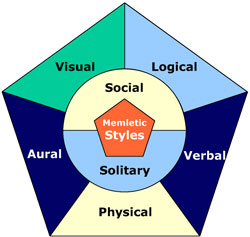
Sean Whiteley synthesized the Memletics (Learning) Styles from two brain models: Multiple Intelligences (from Howard Gardner) and the Visual-Auditory-Kinesthetic model (derived from sensory-based modes from NLP).

The Memletics Learning Styles Questionnaire on http://learning-styles-online.com is cited as created in 2004, based on the Memletics Accelerated Learning Manual, by Sean Whiteley (Advanogy, 2003).  With neither memletics.com nor advanogy.com domains currently online, the ebook has been reproduced on scribd.com by Maria McConkey.  Whiteley bases his model on “brain regions”.

… we first look at the basis of learning styles and their influence on learning.  [….] We then look at each of the Memletic Styles in turn.  In summary, these are:

  • Visual. You prefer using pictures, images, and spatial understanding.
  • Aural. You prefer using sound and music.
  • Verbal. You prefer using words, both in speech and writing.
  • Physical. You prefer using your body, hands and sense of touch.
  • Logical. You prefer using logic, reasoning and systems.
  • Social. You prefer to learn in groups or with other people.
  • Solitary. You prefer to work alone and use self-study.

Lastly, we look at how you can improve your learning by using learning styles. One obvious way is to use more of your dominant learning styles. An interesting feature of learning styles is that you can also improve your learning performance by using styles you do not often use. If you are a mainly visual person, then you can make a lesson more memorable by using some aural content in your visualizations.

… Read more (in a new tab)
  • fediscience.org/@daviding (Mastodon)

    1. Loading Mastodon feed...
  • RSS feed: on IngBrief on IngBrief

    • 2026/01/07 | Rama Akkiraju | From LLMs to Living Systems: Applying Systems Science to Agentic AI in the Enterprise | HICSS-59 Keynote
      Abstract Enterprise AI is transitioning from simple single-LLM flows to complex agentic ecosystems—adaptive systems composed of multiple agents, tools, governed data, human workflows, and organizational policies. This keynote introduces a systems-science framework for designing and managing such ecosystems using principles of modularity, control, feedback, robustness, and socio-technical alignment. We illustrate these concepts through practical examples […]
    • Timothy F.H. Allen passed away on May 01, 2025
      Timothy F.H. Allen, president of International Society for the Systems Sciences 2008-2009, passed away peacefully in his home, surrounded by his family, on May 1, 2025. With his work on ecosystem ecology, I learned more about living systems than anyone else in the systems community. After his retirement, he was proud of putting together a […]
    • Installing WordPress Studio on Manjaro Linux
      In 2024, WordPress Studio was released, making installation on a local computer simpler. The instructions were modified from MacOS to Ubuntu Linux, by Daniel Kossmann, “How to install WordPress Studio in Ubuntu Linux” | Jun 15, 2024 at https://www.danielkossmann.com/how-to-install-wordpress-studio-ubuntu-linux/ I already had NVM installed, but in Terminal, with the result “command not found”. In the […]
    • Notion of Change in the Yijing | JeeLoo Lin 2017
      The appreciation of change is different in Western philosophy than in classical Chinese philosophy. JeeLoo Lin published a concise contrast on differences. Let me parse the Introduction to the journal article, that is so clearly written. A-theories divide time into past, present and future, and the point of reference is set at “the present.” B-theories, […]
    • World Hypotheses (Stephen C. Pepper) as a pluralist philosophy [Rescher, 1994]
      In trying to place the World Hypotheses work of Stephen C. Pepper (with multiple root metaphors), Nicholas Rescher provides a helpful positioning. — begin paste — Philosophical perspectivism maintains that substantive philosophical positions can be maintained only from a “perspective” of some sort. But what sort? Clearly different sorts of perspectives can be conceived of, […]
    • The Nature and Application of the Daodejing | Ames and Hall (2003)
      Ames and Hall (2003) provide some tips for those studyng the DaoDeJing.
  • Recent Posts

  • Archives

  • RSS feed: on daviding.com on daviding.com

    • 2026/10 Moments October 2026
      Dartmouth, Nova Scotia; Halifax, Nova Scotia; Lunenberg, Nova Scotia; Peggy’s Cove, Nova Scotia; Bible Hill, Nova Scotia; Louisbourg, Nova Scotia; Sydney, Nova Scotia; Baddeck, Nova Scotia; Toronto, Ontario Fraser’s Mills Fish Hatchery: Side trip to hatchery built in 1928 by provincial government, gravity-fed from South River. Water in pen dark, ripples at surface due to […]
    • 2026/09 Moments September 2026
      Vancouver BC; Toronto, Ontario, Burlington, Ontario; Shanghai PR China Serenade of the Seas: From the foredeck of level 12 of the Royal Caribbean Line ship, the panorama west to the Vancouver Convention Centres, turning to the north across Vancouver Harbour. Observed Princess Line ship leaving the dock, a departure we never experienced. Arrived for lunch, […]
    • 2026/08 Moments August 2026
      Toronto, Ontario; Vancouver BC Next Perfect Day Playlist: Korean Town Street Festival, 20260808 Night View O What A Shiny Night Honey Haneum Playlist: Korean Town Street Festival, 20260808 Happiness Prince of Jeju Ieodo Sana Seouje Sori Leida Lay Down Together Star North Sky Beautiful Country Encore Chris Fraser Trio | Meo | 2026-08-30: Nestled in […]
    • 2026/07 Moments July 2026
      Quiet summer mostly at home writing, taking breaks to meet with friends, and exercise on bike rides.
    • 2026/06 Moments June 2026
      Cool summer catching up with family and friends, music festivals
    • 2026/05 Moments May 2026
      Cool spring, busy with Jane's Walk, bathroom renovation, closing out father's apartment, OCADU GradEx, Problematique Dialogue applying the Banathy Conversation Methodology, Qingming.
  • RSS feed: on Media Queue on Media Queue

  • Meta

  • Creative Commons License
    This work is licensed under a Creative Commons Attribution-NonCommercial-ShareAlike 4.0 International License
    Theme modified from DevDmBootstrap4 by Danny Machal