
Coevolving Innovations

… in Business Organizations and Information Technologies

Eight infographics on Systems Methods (UToronto iSchool 2018)

Learning only a single systems method is reductive.  A course that exposes breadth in a variety of systems methods encourages students to reflect on their circumstances-at-hand, and their explicit and implicit influences on guiding others in projects espousing systems thinking.  This was a premise behind the structuring of “Systems Thinking, Systems Design“, an Information Workshop (i.e. 6-week elective quarter course) offered to master’s students at the University of Toronto Faculty of Information (iSchool).

The first class day had a short course introduction focused on the history of the systems sciences, and a minimal orientation to the most basic concept in systems theory.  Then, for the four class days that followed, student groups led 8 presentation-facilitations on a research reference cluster (with the instructor on standby as a subject matter expert on the content).  The topics included:

  1. Object Process Methodology
  2. Dialogue Mapping
  3. Idealized Design
  4. Soft Systems Methodology
  5. Viable System Model
  6. Resilience in Socio-Ecological Systems
  7. Service Systems
  8. Generative Pattern Language

After each of the four days, students wrote Personal Appreciation Diary Logs (blog posts), mostly on the open web.  These provided feedback to the instructor for commentary (and some remediation) at the beginning of the subsequent class meeting.  We could review common understandings, difficulties and misconceptions about systems methods.

For the last (sixth) class meeting, each student group was asked to “prepare and present an infographic poster on their impressions about the system approaches most relevant to their research”.  The conclusions reflected different interests, experiences and orientations amongst the iSchool students.… Read more (in a new tab)
Negotiating Order with Generative Pattern Language

Positioning “A Pattern Language” more like “Creating Order of”, then “The Timeless Way of Building” more like “Negotiating Order with”, was a productive framing to discuss the systems theory inside Christopher Alexander’s thinking (as well as positioning “The Nature of Order“).

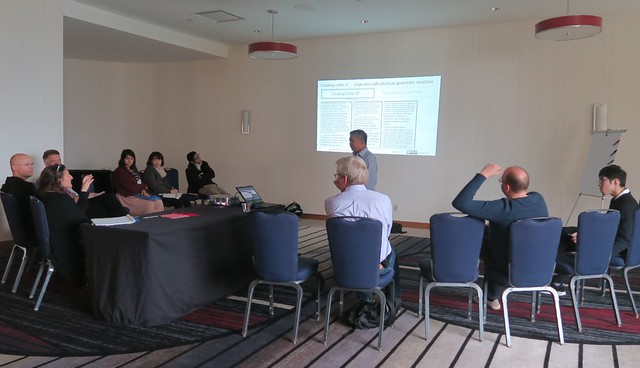
The purpose of a workshop on “Negotiating Order with Generative Pattern Language” at PLoP 2017 was to open up discussions that could deepen the foundational understanding in linkages between pattern language and systems thinking. At least three of us routed to Vancouver BC for a Monday morning start, in a quick trip from the Purplsoc meeting in Austria that finished on Saturday.  The PLoP program emphasizing writers’ workshops meant that our 90-minute dialogue didn’t conflict with any presentations.

On the audio recording, active participants in the sensemaking included Helene Finidori and Christian Kohls.  With a more relaxed pace, the open time after the slides were completed allowed some pattern language novices to also have questions answered.

PLoP 2017

The frame for discussion was slides that had previously been posted on the Coevolving Commons.

The digital audio recording has been matched up with slides, for a less ambiguous viewing as a web video.

For observers who prefer to be mobile, video files can be downloaded directly on a device.

Video H.264 MP4 WebM
Digital video
(1h38m45s)
[20171023_PLoP_Ing NegotiatingOrder HD 537kpbs m4v]
(HD 537Kbps 379MB) [on the Internet Archive]
[20171023_PLoP_Ing NegotiatingOrder nHD 214kpbs m4v]
(nHD 214Kkps 151MB)
[20171023_PLoP_Ing NegotiatingOrder HD 348kpbs webm]
(HD 348Kbps 245MB)
[20171023_PLoP_Ing NegotiatingOrder nHD 168kpbs webm]
(nHD 168Kbps 119MB)

The downloadable audio recording includes the conversation of all participants.… Read more (in a new tab)

Exploring the Context of Pattern Languages

Pattern language is not for wicked problems, said Max Jacobson, coauthor with Christopher Alexander of the 1977 A Pattern Language: Towns, Building, Construction.  In addition, the conventional definition of an Alexandrian pattern as “a solution to a problem in context” when applied to social change might better use the term “intervention”, rather than “solution”.

These are two of the major ideas that emerged at Purplsoc 2017 conference last October.  A 90-minute workshop was run in parallel with other breakouts.

For about the first hour, vocal participants included Max Jacobson (who had given a plenary talk on “A Building is not a Turkish Carpet“), Christian Kohls (who gave a plenary talk on “Patterns for Creative Space“) and Peter Baumgarnter (one of the Purlpsoc chairs).

As an impetus to discussion, we stepped through slides that had been posted on the Coevolving Commons.

For people who would like the next-best experience to being there, the slides have now been matched up with the digital audio recording, for viewing as a web video.

For devices decoupled from the Internet, downloadable video files are portable.

Video H.264 MP4 WebM
Digital video
(1h22m51s)
[20171021_Purplsoc_Ing_Exploring HD_578kpbs m4v]
(HD 578Kbps 342MB) [on the Internet Archive]
[20171021_Purplsoc_Ing_Exploring nHD_477kpbs m4v]
(nHD 495Kkps 283MB)
[20171021_Purplsoc_Ing_Exploring HD_416kpbs webm]
(HD 416Kbps 246MB)
[20171021_Purplsoc_Ing_Exploring nHD_191kpbs webm]
(nHD 191Kbps 114MB)

The length of the conversation may encourage listeners to download an audio recording.

Audio
Digital audio
(1h22m51s)
[20171021_0930_Purplsoc_Ing ExploringTheContext mp3] (76MB)

In producing the multimedia, a digest of timecodes highlights some interesting conversation points.… Read more (in a new tab)

Multiparadigm Inquiry Generating Service Systems Thinking

What if a pattern language was opened up to contemporaneous research into wicked problems, the systems approach, ecological epistemology, hierarchy theory, and interactive value?  This 30-minute presentation at Purplsoc 2017 last October aimed to provide a broader context to a social change community focused on works of Christopher Alexander.

This talk was a complement to “Pattern Manual for Service Systems Thinking” presented a year earlier, at PUARL 2016.  Last year, the agenda was centered on the approach from Christopher Alexander, and divergences due to the changing in domain from the built environment to service systems.

The slides on the Coevolving Commons are dense.  I had showed them at the poster session in the day preceding, and promised to spend more time speaking to them in the workshop scheduled for the next day.

For 2017, the view looked beyond Alexander, to related research both at Berkeley, and elsewhere in the systems community.  The agenda was in 3 major sections (here expanded with more detailed overview of the middle section):

  • 1. What is multiparadigm inquiry?
  • 2. Where have (and might have) (1960s-2010s) paradigms influenced generative pattern language?
    • a. Over 50 years, Christopher Alexander and coauthors evolved concepts and language in built environments
    • b. At Berkeley: Churchman, Rittel and Alexander taught in 1960-1970s
      • i. “Systems Generating Systems”, Alexander (1968)
      • ii. “The Systems Approach and Its Enemies”, (Churchman, 1979)
      • iii. “Dilemmas in a General Theory of Planning”, (Rittel + Weber, 1973)
    • c.
… Read more (in a new tab)

Christopher Alexander, Horst Rittel, C. West Churchman

At U.C. Berkeley in the 1960s, Christopher Alexander, Horst Rittel and C. West Churchman could have had lunch together.  While disciplinary thinking might lead novices to focus only on each of pattern language, wicked problems and the systems approach, there are ties (as well as domain-specific distinctions) between the schools.

West Churchman joined Berkeley in 1957, and initiated master’s and doctoral programs in operations research at the School of Business Administration.   From 1964 to 1970, Churchman was associate director and research philosopher at UC Berkeley’s Space Sciences Laboratory, directing its social sciences program.  After his retirement in 1981, Churchman taught in the Peace and Conflict Studies program for 13 years.

Horst Rittel came to the Berkeley College of Environmental Design in 1963, the same year that dean William Wurster recruited Christopher Alexander.  In 1973, Rittel split his time between Berkeley and the architecture faculty at the University of Stuttgart, where he founded the Institut für Grundlagen der Planung.

Christopher Alexander became a cofounder of the Center for Environmental Structure at Berkeley in 1967, gradually moving outside of the university by 2000.

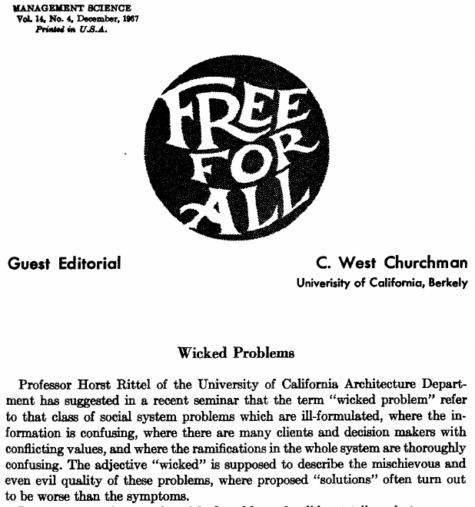
The tie between Churchman and Rittel are well-documented, in a 1967 article in Management Science.

Professor Horst Rittel of the University of California Architecture Department has suggested in a recent seminar that the term “wicked problem” refer to that class of social system problems which are ill-formulated, where the information is confusing, where there are many clients and decision makers with conflicting values, and where the ramifications in the whole system are thoroughly confusing.

… Read more (in a new tab)

Open Innovation Learning and Open Data

Making my dissertation relevant to non-academics calls for a change in style.  An invitation to speak at the Open Data Häme workshop, following announcement of funding by the European Regional Development Fund, gave a venue to unveil some normative theory-building from my research potentially useful in the real world.

This talk was fewer slides, and more talk.  With 9 content slides to cover in about an hour, the agenda was:

  • 1. Why does open data mean open sourcing (with commercial potential)?
  • 2. When did open data begin? What’s the history?
  • 3. How do behaviours change with open innovation learning?

The slides had been posted on the Coevolving Commons in advance of the event.

The slides has now been matched up with the digital audio recording, for viewing as a web video.  Another voice in the mix is Minna Takala, as a Senior Advisor at Häme Regional Council.

The audio recording was exceptionally clear, and is downloadable (so boosted volume is probably unnecessary).

Audio
Digital audio
(1h03m08s)
[20170810_Hame_Ing mp3] (58MB)
[20170810_Hame_Ing 3db mp3] (volume boosted 3db, 58MB)
[20170810_Hame_Ing 6db mp3] (volume boosted 6db, 58MB)

Alternatively, downloadable video files may be better for people on the move.

Video H.264 MP4 WebM
Digital video
(1h03m08s)
[Hame_Ing_HD  m4v]
(HD 325Kbps 238MB) [on the Internet Archive]
[20170810_Hame_Ing_nHD m4v]
(nHD 109Kkps 97MB)
[20170810_Hame_Ing webm]
(HD 470Kbps 212MB)
[20170810_Hame_Ing nHD webm]
(nHD 177Kbps 80MB)

The first part of the talk places open data in the larger context and trend towards the behaviour of open sourcing, and open innovation.… Read more (in a new tab)

  • fediscience.org/@daviding (Mastodon)

    1. Loading Mastodon feed...
  • RSS feed: on IngBrief on IngBrief

    • 2026/01/07 | Rama Akkiraju | From LLMs to Living Systems: Applying Systems Science to Agentic AI in the Enterprise | HICSS-59 Keynote
      Abstract Enterprise AI is transitioning from simple single-LLM flows to complex agentic ecosystems—adaptive systems composed of multiple agents, tools, governed data, human workflows, and organizational policies. This keynote introduces a systems-science framework for designing and managing such ecosystems using principles of modularity, control, feedback, robustness, and socio-technical alignment. We illustrate these concepts through practical examples […]
    • Timothy F.H. Allen passed away on May 01, 2025
      Timothy F.H. Allen, president of International Society for the Systems Sciences 2008-2009, passed away peacefully in his home, surrounded by his family, on May 1, 2025. With his work on ecosystem ecology, I learned more about living systems than anyone else in the systems community. After his retirement, he was proud of putting together a […]
    • Installing WordPress Studio on Manjaro Linux
      In 2024, WordPress Studio was released, making installation on a local computer simpler. The instructions were modified from MacOS to Ubuntu Linux, by Daniel Kossmann, “How to install WordPress Studio in Ubuntu Linux” | Jun 15, 2024 at https://www.danielkossmann.com/how-to-install-wordpress-studio-ubuntu-linux/ I already had NVM installed, but in Terminal, with the result “command not found”. In the […]
    • Notion of Change in the Yijing | JeeLoo Lin 2017
      The appreciation of change is different in Western philosophy than in classical Chinese philosophy. JeeLoo Lin published a concise contrast on differences. Let me parse the Introduction to the journal article, that is so clearly written. A-theories divide time into past, present and future, and the point of reference is set at “the present.” B-theories, […]
    • World Hypotheses (Stephen C. Pepper) as a pluralist philosophy [Rescher, 1994]
      In trying to place the World Hypotheses work of Stephen C. Pepper (with multiple root metaphors), Nicholas Rescher provides a helpful positioning. — begin paste — Philosophical perspectivism maintains that substantive philosophical positions can be maintained only from a “perspective” of some sort. But what sort? Clearly different sorts of perspectives can be conceived of, […]
    • The Nature and Application of the Daodejing | Ames and Hall (2003)
      Ames and Hall (2003) provide some tips for those studyng the DaoDeJing.
  • Recent Posts

  • Archives

  • RSS feed: on daviding.com on daviding.com

    • 2026/10 Moments October 2026
      Dartmouth, Nova Scotia; Halifax, Nova Scotia; Lunenberg, Nova Scotia; Peggy’s Cove, Nova Scotia; Bible Hill, Nova Scotia; Louisbourg, Nova Scotia; Sydney, Nova Scotia; Baddeck, Nova Scotia; Toronto, Ontario Fraser’s Mills Fish Hatchery: Side trip to hatchery built in 1928 by provincial government, gravity-fed from South River. Water in pen dark, ripples at surface due to […]
    • 2026/09 Moments September 2026
      Vancouver BC; Toronto, Ontario, Burlington, Ontario; Shanghai PR China Serenade of the Seas: From the foredeck of level 12 of the Royal Caribbean Line ship, the panorama west to the Vancouver Convention Centres, turning to the north across Vancouver Harbour. Observed Princess Line ship leaving the dock, a departure we never experienced. Arrived for lunch, […]
    • 2026/08 Moments August 2026
      Toronto, Ontario; Vancouver BC Next Perfect Day Playlist: Korean Town Street Festival, 20260808 Night View O What A Shiny Night Honey Haneum Playlist: Korean Town Street Festival, 20260808 Happiness Prince of Jeju Ieodo Sana Seouje Sori Leida Lay Down Together Star North Sky Beautiful Country Encore Chris Fraser Trio | Meo | 2026-08-30: Nestled in […]
    • 2026/07 Moments July 2026
      Quiet summer mostly at home writing, taking breaks to meet with friends, and exercise on bike rides.
    • 2026/06 Moments June 2026
      Cool summer catching up with family and friends, music festivals
    • 2026/05 Moments May 2026
      Cool spring, busy with Jane's Walk, bathroom renovation, closing out father's apartment, OCADU GradEx, Problematique Dialogue applying the Banathy Conversation Methodology, Qingming.
  • RSS feed: on Media Queue on Media Queue

  • Meta

  • Creative Commons License
    This work is licensed under a Creative Commons Attribution-NonCommercial-ShareAlike 4.0 International License
    Theme modified from DevDmBootstrap4 by Danny Machal