
I had previously written that “the (new) service economy is not the same as the service sector“. There’s an deep problem in trying to define and measure something new, when we have to rely on government statistics that have an anchor point of 1980, 1971, or even 1945. Using old definitions doesn’t necessary invalidate the measurements, but is problem if we’re dealing with a paradigm shift in a scientific revolution.

In quantifying economic systems, many of the approaches take an output-oriented (i.e. GDP or value-added) approach. Another alternative is to take an input-oriented approach (i.e. labour). Looking into labour has brought me back to Richard Florida’s research. In The Rise of the Creative Class (2002) appears a breakdown of U.S. statistics that contrast to the three-sector view.

Appendix Table 1 Counting the Classes, 1999 [p. 330]1

Share Employees (OES data) Percent Share Employees (Emp. & Earnings data) Percent Share
Creative Class 38,278,110 30.0% 38,453,000 28.8%
  Super-Creative Core 14.932,420 11.7% 14,133,000 10.6%
  Other Creative Class 23.345,690 18.3% 24,320,000 18.2%
Working Class 33,238,810 26.1% 32.760,000 24.5%
Service Class 55,293,720 43.4% 58,837,000 44.1%
Agriculture 463,360 0.4% 3,426,000 2.6%
  Total 127,274,000   133,488,000  

Why does the view of occupations as super-creative core and other creative class matter? From The Flight of the Creative Class in 2004, creative class occupations are shown to drive disproportionate amounts of wealth generation in the U.S. (Their creative sector I’ll frame as “new” service economy occupations, to contrast from their service sector as traditional service economy occupations).

As Service Science, Management and Engineering (SSME) has been developing, I’ve noticed a refinement of language. Rather than just abbreviating the long clause to service science, I’m now careful to use the phrase of a science of service systems, following Spohrer, Maglio et. al (2007). There’s a clear definition of service system in the final April 2008 revision of the report by the University of Cambridge Institute for Manufacturing.

What is a service system?
A service system can be defined as a dynamic configuration of resources (people, technology, organisations and shared information) that creates and delivers value between the provider and the customer through service. In many cases, a service system is a complex system in that configurations of resources interact in a non-linear way. Primary interactions take place at the interface between the provider and the customer. However, with the advent of ICT, customer-to-customer and supplier-to-supplier interactions have also become prevalent. These complex interactions create a system whose behaviour is difficult to explain and predict. [p. 6]

I’ve been sorting through the significance of this service system orientation, and have reached the following personal points-of-view.

  • 1. The definition of a service system as a system is earnest
  • 2. A service system creating and delivering value emphasizes a value constellation perspective over a value chain perspective
  • 3. Research into service systems is muddled in the ideas of coproduction and (value) cocreation
  • 4. A service system creates value with an offering as a platform for co-production
  • 5. The constraints on service systems are changed with advances in technology
  • 6. The (new) service economy is not the same as the service sector

Each of these points-of-view require some elaboration. (If the content that follow isn’t detailed enough, there are footnotes, too!)

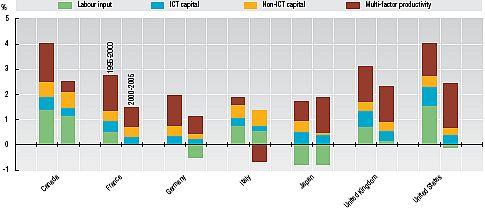
I happened to be looking at the 2007 OECD Science, Technology and Industry Scorecard, and noticed a chart on “Growth Accounts for OECD Countries”. I’ve never thought of a breakdown this way, so I was intrigued by the legend.

2007_OECD_ScienceTechnologyIndustryScoreboard_legend.jpg

We naturally think of labour inputs, and capital inputs, but I didn’t realize that there were statistics that break out ICT capital (in blue) from non-ICT capital (in orange). Information and Communications Technologies (ICT) isn’t something that Karl Marx specifically thought about. The OECD reports acknowledges that breaking economic growth down into factors of production is tricky thing.

Economic growth can be increased by increasing the amount and types of labour and capital used in production, and by attaining greater overall efficiency in how these factors of production are used together, i.e. higher multifactor productivity. Growth accounting involves breaking down growth of GDP into the contribution of labour input, capital input and MFP. The growth accounting model is based on the microeconomic theory of production and rests on a number of assumptions ….1

Assuming that we really can break down factors contributing to growth by labour, ICT capital, and non-ICT capital — as well as some multi-factor productivity that can’t be broken down — what does it look like? Look at the blue bar in the view of the G7 countries …

Contributions to GDP growth, G7 countries, 1995-2000 and 2000-05
(percentage points)

2007_OECD_ScienceTechnologyIndustryScoreboard_G7.jpg


Recent Posts

Recent Comments:

Recent Trackbacks:

Archives

December 2008 (1)
November 2008 (1)
September 2008 (4)
June 2008 (1)
May 2008 (6)
April 2008 (1)
March 2008 (1)
February 2008 (1)
January 2008 (1)
December 2007 (3)
November 2007 (5)
October 2007 (2)
September 2007 (5)
August 2007 (2)
July 2007 (4)
June 2007 (3)
May 2007 (4)
April 2007 (3)
February 2007 (2)
January 2007 (5)
December 2006 (8)
November 2006 (1)
May 2006 (1)
April 2006 (2)
March 2006 (4)
February 2006 (8)
January 2006 (3)

January 2009
S M T W T F S
« Dec    
 123
45678910
11121314151617
18192021222324
25262728293031
Point on this calendar to see all posts from a day. Word search is faster using the search bar up top.

Categories

Recently on daviding.com

Listening queue

Web Personas

Coevolving Innovations Publications
Articles, reports, presentations

Media Input Queue –> Coevolving Innovations
What thoughts are going into David Ing’s ears

Coevolving Innovation Digests
A participant’s notes from conferences, seminars and meetings

Rendez project
Research into business innovation

Systemic Business Community
Researchers in business and systems science

International Society for the Systems Science
Researchers in the systems sciences

Distractions, reflections — David Ing, at large
Sometimes, my mind wanders

Sites I Follow

Minna Takala
Quest & Reflections

Jim Spohrer
Spohrer on Service

Gary Metcalf
Systems and the way the world works

Luis Suarez - elsua.net
Knowledge management

Doug McDavid
Business architecture (Douglas W. McDavid)

Irving Wladawsky-Berger
Vice President, Technical Strategy and Innovation, IBM

Notifications by e-mail

Enter your e-mail address to receive notifications when new postings are published

Syndicate


Creative Commons License
This work is licensed under a Creative Commons Attribution-NonCommercial-NoDerivs 2.5 Canada License.